
Eastern Barn Owl
Tyto javanica
Order: Strigiformes / Family: Tytonidae
Wikimedia Commons
About the Eastern Barn Owl
The Eastern Barn Owl (Tyto javanica) is a raptor renowned for its ghostly appearance and haunting screech. Found across a wide expanse of regions, this owl plays a pivotal role in controlling rodent populations. Its adaptability allows it to thrive in diverse environments, from the rural farmland of Australia to the open grasslands of Southeast Asia. The Eastern Barn Owl's presence is significant in both cultural folklore and natural ecosystems.
These owls are known for their ethereal beauty, with pale, golden-buff feathers that shimmer in the moonlight. Their heart-shaped facial disc is not merely an aesthetic feature but serves as an acoustic tool, funneling sound to their ears and enhancing their ability to detect even the slightest rustle of prey in the dark. This auditory prowess, coupled with their silent flight, makes them exceptionally effective nocturnal hunters.
Ecologically, the Eastern Barn Owl is a keystone species in the habitats it occupies. By preying on rodents and other small mammals, it helps maintain a balance that prevents these populations from overwhelming the agricultural landscapes. Throughout the year, these owls exhibit varied behaviors; they are most active during the breeding season, which aligns with periods of rodent abundance. In certain regions, these breeding cycles are closely tied to seasonal rainfall patterns that influence prey availability.
In many parts of their range, Eastern Barn Owls have adapted to human-altered landscapes. They often nest in old barns, buildings, and other structures, demonstrating their ability to coexist with human populations. This adaptability is crucial for their survival in rapidly changing environments. Despite their widespread presence, the Eastern Barn Owl faces threats from habitat destruction and pesticide use, which can impact their prey base.
The Eastern Barn Owl belongs to the family Tytonidae, within the order Strigiformes. These birds typically live typically 4-6 years, though some have been known to live up to 12 years..
How to Identify a Eastern Barn Owl
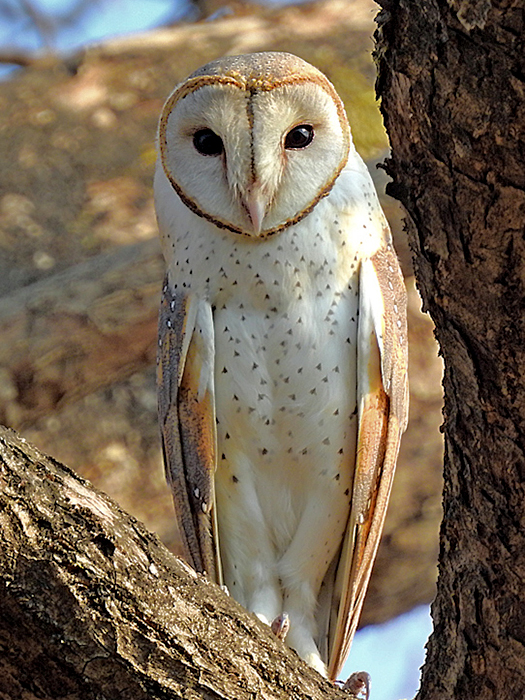
Eastern Barn Owls are medium-sized raptors, easily identified by their striking heart-shaped facial disc, which is white bordered with a tawny color. Their eyes are dark and set within this disc, adding to their spectral appearance. The upperparts are a combination of golden buff and gray, speckled with black and white spots, providing excellent camouflage against the tree bark and barn walls where they often roost. The underparts are predominantly white or light buff, sometimes with scattered darker spots.
Juvenile Eastern Barn Owls resemble adults but may have more buff and less defined facial discs. Both sexes appear similar, though females are often slightly heavier and may exhibit a more pronounced spotting pattern on the chest. In flight, the Eastern Barn Owl presents a distinct silhouette, with broad, rounded wings and a short tail, facilitating their agile and silent flight.
When perching, these owls often sit upright, with their long legs visible and their heads often cocked inquisitively. Confusion with other owl species is minimized by their unique facial shape and coloration. However, care should be taken not to mistakenly identify them as the Western Barn Owl (Tyto alba), which can appear similar but generally occupies different geographical ranges.
Having trouble telling birds apart? Upload a photo to our bird identification tool for an instant species match.
Eastern Barn Owl Habitat and Range
Preferred Habitat
The Eastern Barn Owl inhabits a wide range of environments, showcasing a remarkable adaptability. Commonly found in open habitats such as grasslands, farmlands, and savannas, it also frequents the edges of forests and wetlands. In regions like Australia and Southeast Asia, these owls are often seen in agricultural areas, where they make use of old barns and silos for nesting.
Elevation-wise, Eastern Barn Owls can be found from sea level up to mountainous regions at about 2,000 meters. This owl species does not exhibit significant seasonal habitat shifts, maintaining a year-round presence in suitable locales. In urban areas, they have adapted to nest in buildings and other structures, taking advantage of the readily available prey populations that thrive in such environments.
Geographic Range
The Eastern Barn Owl has a broad geographic range, stretching from the Indian subcontinent through Southeast Asia and across the islands of Indonesia to Australia. In Australia, they are widespread, inhabiting both the eastern and western regions. Their presence extends into the islands of the Pacific, where they have been recorded in places like New Guinea and the Solomon Islands.
Unlike some other owl species, the Eastern Barn Owl is non-migratory, maintaining a stable presence in most of its range. However, in areas where prey abundance fluctuates significantly, they may exhibit local movements in search of food. Certain regions, such as the grasslands of Indonesia and the farmlands of Malaysia, serve as population density hotspots, where these owls take advantage of the abundant rodent prey.
Their absence from some parts of the world, such as the Americas and Europe, distinguishes them from other members of the Tyto genus, which have a more global distribution. This restricted range highlights the importance of regional conservation efforts to ensure their continued survival in these areas.
Want to know which birds visit your area? Browse our backyard birds by location guides for region-specific species lists.
What Does the Eastern Barn Owl Eat?
The Eastern Barn Owl is primarily a nocturnal hunter, with a diet heavily dominated by small mammals, particularly rodents. This includes rats, mice, and voles, which constitute the bulk of their diet. During times when rodent populations are low, these owls may also prey on small birds, insects, and occasionally reptiles.
Seasonal changes can affect prey availability, prompting slight dietary shifts. In the wet season, when rodents are more abundant, these owls focus almost exclusively on these mammals. Their hunting technique is a testament to their proficiency, involving a combination of silent flight and acute hearing to locate and capture prey, even in complete darkness.
Prey size typically ranges from 20 to 200 grams, with the owls capable of subduing animals as large as half their body weight. They usually hunt from dusk till dawn, with peak activity during the early night hours. By controlling rodent populations, Eastern Barn Owls play a vital role in the ecosystems they inhabit, indirectly benefiting agricultural productivity.
Eastern Barn Owl Behavior and Social Structure
Eastern Barn Owls exhibit solitary and territorial behavior outside the breeding season. They are primarily nocturnal, resting during the day and becoming active after sunset. Their hunting method involves flying low over open fields, listening intently for the movements of prey.
During the breeding season, males perform aerial displays to attract mates, showcasing their agility and strength. This courtship involves flight displays accompanied by a series of screeches and calls. Once paired, Eastern Barn Owls are generally monogamous and maintain their territory to raise young.
In response to predators, such as larger raptors, they may exhibit defensive behaviors, including hissing and clicking, while puffing up their plumage to appear larger. Occasionally, when food is abundant, Eastern Barn Owls may form loose roosting flocks in suitable habitat, although these gatherings tend to be temporary.
Their adaptability to human environments also means that they can often be seen in more urban areas, where they utilize artificial structures for roosting and nesting. Despite their quiet nature, their presence is often detected by their distinctive screeches at night.
Eastern Barn Owl Nesting and Reproduction
Eastern Barn Owls prefer to nest in cavities, whether natural or man-made. They often select tree hollows, cliff crevices, or abandoned buildings, where they are sheltered from predators and the elements. Nesting materials are minimal, usually consisting of the pellets regurgitated by the owls themselves.
A typical clutch consists of 3 to 6 eggs, although larger clutches are not uncommon in years of high prey availability. The female incubates the eggs for approximately 30 to 34 days, during which time the male supplies food. Once hatched, the chicks grow rapidly and fledge after about 50 to 55 days.
Eastern Barn Owls may raise up to two broods per year, depending on food availability. Both parents partake in feeding the young, with the male providing most of the food while the female initially focuses on brooding. After fledging, the young remain dependent on their parents for several more weeks as they hone their hunting skills.
Eastern Barn Owl Sounds and Vocalizations
The Eastern Barn Owl's primary call is a long, harsh screech, lasting about 2 seconds and often repeated. This call, unlike the hoots of many other owls, is more akin to a loud hissing sound and serves as both a territorial claim and a communication tool between mates.
In addition to their screeches, these owls emit various clicks and hisses, especially when threatened. Their vocal repertoire also includes softer, repetitive calls used during courtship. Unlike songbirds, the Eastern Barn Owl does not participate in a dawn chorus, instead remaining most vocal during the night.
These vocalizations are distinct and can be unsettling to those unaccustomed to them, often compared to the sound of tearing fabric or distant screams.
Interesting Facts About the Eastern Barn Owl
- 1Eastern Barn Owls have the most sensitive hearing of any tested bird species, allowing them to hunt in complete darkness.
- 2A single Eastern Barn Owl can consume up to 1,000 rodents in a year, making them invaluable for natural pest control.
- 3Unlike many owl species, Eastern Barn Owls do not have ear tufts, giving them a more streamlined and distinct facial profile.
- 4The heart-shaped face of the Eastern Barn Owl serves not only an aesthetic purpose but also aids in directing sound to their ears.
- 5In Australian Aboriginal mythology, the Eastern Barn Owl is often associated with spirits or omens, highlighting its cultural significance.
- 6Barn owls are one of the most widespread species of owls, occurring on every continent except Antarctica, although the Eastern Barn Owl is specific to the Indo-Pacific region.
- 7Eastern Barn Owls are known for their silent flight, achieved through a combination of specialized feather structure and wing morphology.
Eastern Barn Owl Conservation Status
The Eastern Barn Owl is currently listed as a species of Least Concern by the IUCN, reflecting a stable population trend across much of its range. However, regional populations face different challenges, including habitat loss, particularly in agricultural zones where modern practices reduce nesting and foraging opportunities. Pesticides pose a significant threat, as they can reduce prey availability and lead to secondary poisoning. Conservation efforts focus on providing artificial nesting sites and promoting pesticide-free farming practices. Historically, Eastern Barn Owls have adapted well to changes in their environment, but ongoing habitat destruction and climate change could pose future challenges. Local conservation programs that monitor population dynamics and promote awareness are crucial in ensuring the species' continued success.


