
Ecuadorian Tyrannulet
Phylloscartes gualaquizae
Order: Passeriformes / Family: Tyrannidae
Wikimedia Commons
About the Ecuadorian Tyrannulet
The Ecuadorian Tyrannulet, scientifically known as Phylloscartes gualaquizae, is a diminutive member of the Tyrannidae family. This species inhabits the subtropical and tropical montane forests of Ecuador and northern Peru, primarily at elevations ranging from 1,200 to 2,400 meters. Its preferred habitats include the dense, humid understories of these forests, where it actively participates in the ecological balance by controlling insect populations.
The Ecuadorian Tyrannulet plays a significant role in its ecosystem, acting as both a predator and a prey species. By consuming a variety of insects, it helps regulate pest populations, contributing to forest health and biodiversity. This species also serves as a food source for larger avian predators, thus integrating seamlessly into the complex food web of the Andean montane forests.
Behaviorally, the Ecuadorian Tyrannulet is known for its high energy and agility, flitting from branch to branch in search of food. It engages in mixed-species foraging flocks, often associating with other small insectivorous birds. This social behavior enhances its foraging efficiency and provides an added layer of protection against predators. Seasonal variations in food availability might influence its foraging strategies, though it remains primarily insectivorous throughout the year.
In terms of conservation, maintaining the integrity and extent of its montane forest habitat is crucial. These forests are increasingly threatened by deforestation and land conversion for agriculture, making conservation efforts vital for the survival of the Ecuadorian Tyrannulet. Protecting its habitat not only supports this species but also preserves the rich biodiversity of the Andean region.
The Ecuadorian Tyrannulet belongs to the family Tyrannidae, within the order Passeriformes. These birds typically live average 5 years with a maximum recorded of 8 years.
How to Identify a Ecuadorian Tyrannulet
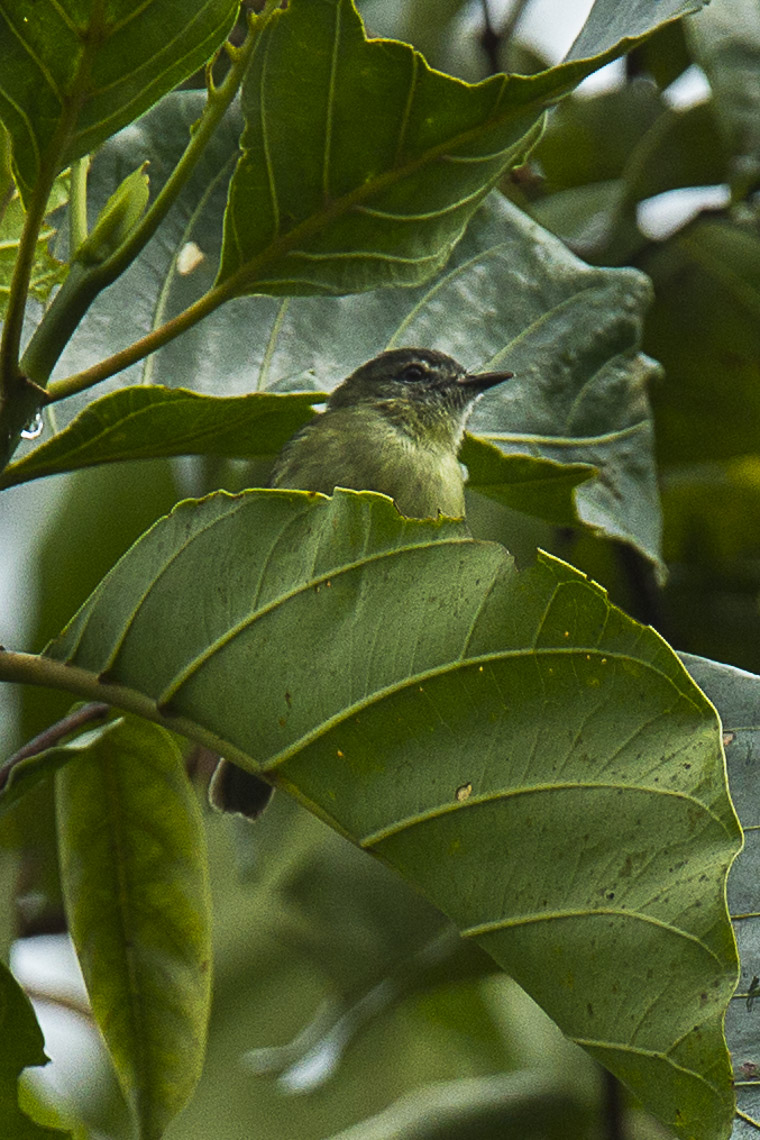
The Ecuadorian Tyrannulet is a small bird, approximately 11 cm in length, with dull olive-green upperparts that provide excellent camouflage among the forest foliage. Its underparts are a paler yellowish-green, offering a subtle contrast that can aid in identification. The bird features a faint white eye-ring and a slightly forked tail, which is often flicked while foraging.
Juvenile Ecuadorian Tyrannulets may exhibit slightly duller plumage compared to adults, but overall, there is minimal variation between the life stages. Males and females are similar in appearance, making sex differentiation in the field challenging without close examination or behavioral cues during the breeding season.
In flight, the Ecuadorian Tyrannulet displays a rapid, fluttering pattern, often moving in short bursts as it navigates the dense canopy. When perched, it typically maintains a horizontal posture, using its tail for balance. This species might be confused with other small flycatchers in its range, such as the Marble-faced Bristle Tyrant, but the Ecuadorian Tyrannulet's more muted coloration and distinct vocalizations can help observers distinguish it.
Having trouble telling birds apart? Upload a photo to our bird identification tool for an instant species match.
Ecuadorian Tyrannulet Habitat and Range
Preferred Habitat
The Ecuadorian Tyrannulet thrives in subtropical and tropical montane forests, particularly favoring areas with dense understory vegetation. It typically occupies elevations from 1,200 to 2,400 meters, where the humid conditions and abundant foliage provide ample foraging opportunities. These forests are characterized by a rich diversity of plant species, including large trees, shrubs, and epiphytes, which support a variety of insect prey.
This species is predominantly found in rural and remote forest regions, with minimal presence in urbanized areas. The Ecuadorian Tyrannulet demonstrates some adaptability to habitat changes, but significant forest loss due to agricultural expansion poses a threat to its preferred environments. Seasonal habitat shifts are not well-documented, suggesting a stable use of montane forests year-round.
Geographic Range
The Ecuadorian Tyrannulet's range is restricted to the Andean regions of South America, specifically within Ecuador and the northern parts of Peru. It is primarily found on the eastern slopes of the Andes, where the montane forests provide a suitable habitat. Its range does not extend far beyond these regions, making it a relatively localized species.
Despite its limited geographic range, the Ecuadorian Tyrannulet is considered stable in population within its preferred habitats. Key population density hotspots include areas near the Podocarpus National Park and other protected montane forest reserves. There is no significant migratory behavior observed in this species, as it remains within its montane habitat throughout the year.
Want to know which birds visit your area? Browse our backyard birds by location guides for region-specific species lists.
What Does the Ecuadorian Tyrannulet Eat?
The diet of the Ecuadorian Tyrannulet predominantly consists of insects, reflecting its role as an insectivore in the Andean montane forests. It targets a variety of small arthropods, including beetles, caterpillars, and spiders, which it captures through active foraging techniques.
This species employs a methodical approach to foraging, gleaning insects from leaves and branches with precision. It often joins mixed-species flocks, increasing its foraging efficiency by exploiting different microhabitats within the forest. Seasonal changes in insect availability may influence its diet composition, but the Ecuadorian Tyrannulet remains primarily insectivorous throughout the year.
The bird typically feeds during daylight hours, taking advantage of the abundant insect activity in the warm, humid conditions of its habitat. Its small size and agility allow it to maneuver easily through dense foliage, optimizing its feeding strategy.
Ecuadorian Tyrannulet Behavior and Social Structure
The Ecuadorian Tyrannulet displays a range of behaviors that highlight its adaptability and social nature. As a small, active bird, it often participates in mixed-species foraging flocks, which enhance its foraging success and offer protection from predators. This cooperative behavior is particularly beneficial in the dense forest environments it inhabits.
Territoriality in the Ecuadorian Tyrannulet is not well-documented, but its participation in social flocks suggests a level of tolerance towards conspecifics and other small bird species. During the breeding season, however, it may exhibit more territorial behavior, particularly in defense of nesting sites.
Courtship displays have not been extensively studied in this species, but vocalizations likely play a role in mate attraction and territory establishment. The Ecuadorian Tyrannulet is generally more active during the day, with peak activity occurring during the early morning and late afternoon when insect prey is most abundant.
Ecuadorian Tyrannulet Nesting and Reproduction
The nesting habits of the Ecuadorian Tyrannulet reflect its adaptation to dense forest environments. It typically constructs a cup-shaped nest using fine plant fibers, mosses, and lichens, camouflaging it effectively against the forest backdrop. These nests are often situated on horizontal branches or within dense shrubs, providing some protection from predators.
A typical clutch consists of 2 to 3 eggs, which are incubated by the female. The incubation period lasts approximately 14 to 16 days, during which the male may assist by providing food. Once hatched, the chicks remain in the nest for about 15 to 18 days before fledging.
Both parents share responsibilities in feeding and caring for the young, ensuring a high survival rate for fledglings. The Ecuadorian Tyrannulet usually produces one brood per year, though a second brood may occur if conditions are favorable.
Ecuadorian Tyrannulet Sounds and Vocalizations
The vocalizations of the Ecuadorian Tyrannulet are characterized by a series of quick, high-pitched notes, often delivered in a rapid sequence. Its primary song consists of a rhythmic 'chip-chip-chip' pattern, which serves both in communication with conspecifics and as a territorial signal.
Call notes are typically short and sharp, used to maintain contact with flock members and alert others to potential threats. During the dawn chorus, its vocalizations become more frequent, contributing to the rich soundscape of the montane forests.
Alarm calls are more intense and rapid, designed to alert nearby birds to the presence of predators. These vocalizations play a crucial role in the bird's social interactions and survival in its habitat.
Interesting Facts About the Ecuadorian Tyrannulet
- 1The Ecuadorian Tyrannulet measures only about 11 cm in length, making it one of the smallest members of the flycatcher family.
- 2Despite its small size, the Ecuadorian Tyrannulet plays a vital role in controlling insect populations in its montane forest habitat.
- 3This bird's rapid, fluttering flight pattern helps it maneuver through dense forest canopies while foraging.
- 4The Ecuadorian Tyrannulet often joins mixed-species foraging flocks, enhancing its efficiency in locating prey.
- 5Its vocalizations are a distinctive part of the dawn chorus in the Andean montane forests.
- 6The species is primarily found in Ecuador and northern Peru, with no significant migratory behavior.
- 7The Ecuadorian Tyrannulet's subtle plumage provides effective camouflage among the forest foliage.
Ecuadorian Tyrannulet Conservation Status
The Ecuadorian Tyrannulet is currently classified as Least Concern by the International Union for Conservation of Nature (IUCN). Its population is considered stable, with no immediate threats pushing it towards endangerment. However, habitat loss due to deforestation and agricultural expansion remains a concern. Conservation efforts focus on preserving the montane forest ecosystems that this species relies on. Protected areas such as national parks and reserves play a crucial role in safeguarding its habitat. Historical population trends have shown stability, but continued monitoring is necessary to ensure that environmental changes do not negatively impact this species.


