
Edwards's Fig-Parrot
Psittaculirostris edwardsii
Order: Psittaciformes / Family: Psittacidae
Wikimedia Commons
About the Edwards's Fig-Parrot
The Edwards's Fig-Parrot, scientifically known as Psittaculirostris edwardsii, is a captivating bird species endemic to the lush, tropical forests of New Guinea. It belongs to the family Psittacidae and is a small yet vibrant member known for its striking coloration and ecological significance. This parrot plays a crucial role in the forests it inhabits by aiding in seed dispersal and maintaining the health of its ecosystem. The Edwards's Fig-Parrot is primarily found in the lowland rainforests of New Guinea, where it thrives in the humid, dense canopy.
New Guinea's unique biodiversity provides a perfect backdrop for the Edwards's Fig-Parrot. It is often sighted in regions such as the Vogelkop Peninsula and the Huon Peninsula, where the rich availability of fig trees offers ample foraging opportunities. The bird’s habitat is characterized by its humid, tropical climate, which remains consistent throughout the year, allowing the parrot to remain a year-round resident.
The Edwards's Fig-Parrot plays a significant role in its ecosystem by contributing to seed dispersal. Its diet primarily consists of figs and other fruits, and as it consumes these, it unintentionally aids in spreading the seeds throughout the forest. This process ensures the regeneration of plant species and contributes to the overall health and diversity of the forest. The bird’s presence is an indicator of the rich biodiversity found in New Guinea’s rainforests.
Seasonally, the Edwards's Fig-Parrot exhibits slight behavioral changes, most notably during the breeding season, when its activities become more focused on nest building and rearing young. Its ecological role remains consistent throughout the year as the bird continues to engage in its seed dispersal activities, helping to sustain the forest's intricate web of life.
The Edwards's Fig-Parrot belongs to the family Psittacidae, within the order Psittaciformes. These birds typically live average 10 years, with a maximum recorded of 15 years..
How to Identify a Edwards's Fig-Parrot
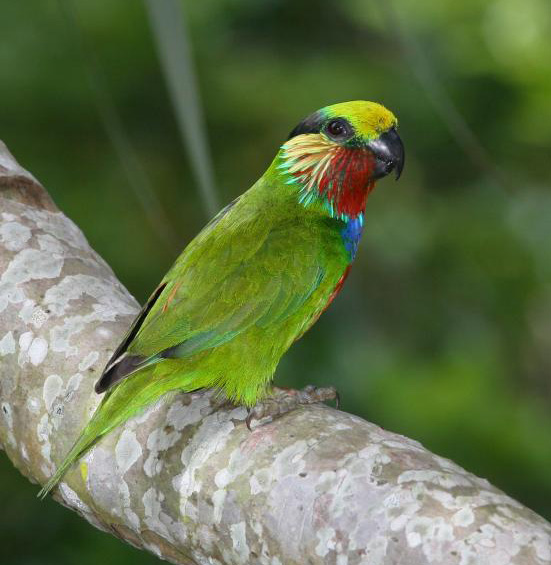
The Edwards's Fig-Parrot stands out with its vivid green plumage, making it a striking presence in the New Guinea forests. Adult birds exhibit a bright green body, complemented by a red and blue facial patch that distinguishes it from other parrots. The crown is a rich blue, providing a beautiful contrast to the red face and green body. Juveniles, while similar in coloration, tend to have a slightly duller plumage, with the facial colors not as pronounced as in adult birds.
Male and female Edwards's Fig-Parrots look remarkably similar, making it challenging to differentiate them by appearance alone. However, males often have more pronounced facial patches, particularly during the breeding season when they engage in courtship displays.
This parrot can sometimes be confused with other fig-parrot species found in New Guinea, such as the Double-eyed Fig-Parrot, but the Edwards's Fig-Parrot is distinguished by its unique facial coloration. In flight, the Edwards's Fig-Parrot displays a distinctive silhouette with rapid wingbeats and a swift, direct flight path. When perched, they exhibit a stocky build with a short tail, often seen clinging to branches in the dense canopy.
Having trouble telling birds apart? Upload a photo to our bird identification tool for an instant species match.
Edwards's Fig-Parrot Habitat and Range
Preferred Habitat
The Edwards's Fig-Parrot inhabits the lowland rainforests of New Guinea, thriving in regions with abundant fig trees. These tropical forests provide a humid, dense canopy that offers ample foraging opportunities and nesting sites. The parrot is found at elevations ranging from sea level to 1,200 meters, although it predominantly occupies the lower strata of the forest.
This bird prefers primary forests, where the diversity of fruiting trees supports its dietary needs. Secondary forests and degraded habitats are less frequently used, as they offer fewer resources. The Edwards's Fig-Parrot is a resident of rural areas rather than urban environments, as the latter lacks the dense foliage and fruit availability necessary for its survival.
Seasonal habitat shifts are minimal for this parrot due to the stable climate of New Guinea, which does not necessitate long-distance migrations or significant changes in habitat use. The Edwards's Fig-Parrot remains a consistent presence in its preferred habitat throughout the year.
Geographic Range
The Edwards's Fig-Parrot is endemic to New Guinea, where it occupies a range that spans the island's lowland forests. It is most commonly found in the northern and western regions, including the Vogelkop Peninsula and the Huon Peninsula. These areas are known for their dense rainforest habitats, which provide the ideal environment for the parrot's foraging and nesting activities.
Unlike many bird species, the Edwards's Fig-Parrot does not undertake long-distance migrations. It is a year-round resident of its forested home, taking advantage of the consistent climate and abundant food resources available throughout the year. Its range is relatively restricted to these forested areas, and it is not typically found in open or urban environments.
Population density is highest in regions where fig trees are abundant, as these are the primary food source for the parrot. These hotspots of activity are crucial for observing the bird and understanding its ecological role within the forest. Conservation efforts are focused on preserving these key habitats to ensure the parrot's continued survival.
Want to know which birds visit your area? Browse our backyard birds by location guides for region-specific species lists.
What Does the Edwards's Fig-Parrot Eat?
The diet of the Edwards's Fig-Parrot is predominantly frugivorous, with figs being the primary component. This reliance on figs is typical of fig-parrot species and plays a crucial role in their survival. The parrot feeds on various fig species, taking advantage of the different fruiting seasons to maintain a consistent food supply throughout the year.
In addition to figs, the Edwards's Fig-Parrot consumes other fruits, seeds, and occasionally flowers and nectar. This dietary flexibility allows it to exploit a range of food sources within its habitat, although figs remain the most important. The size of the figs and fruits consumed varies, but the parrot typically targets small to medium-sized items that can be easily handled and ingested.
The parrot employs a methodical foraging technique, using its strong bill to manipulate and consume fruit with precision. Feeding occurs primarily during the early morning and late afternoon, when temperatures are cooler and the forest is more active. This schedule helps the parrot avoid the midday heat, which can be intense in its tropical environment.
Edwards's Fig-Parrot Behavior and Social Structure
The Edwards's Fig-Parrot is a social bird, often observed in small groups or pairs. This social structure is particularly evident during the breeding season when pairs engage in courtship displays that include synchronized flying and mutual preening. These displays strengthen pair bonds and facilitate successful breeding outcomes.
Territorial behavior is minimal, as the parrot's reliance on widely distributed fig trees reduces competition for resources. However, they may defend specific feeding areas, especially when food is scarce. During non-breeding seasons, the Edwards's Fig-Parrot forms small flocks that roam the forest in search of food, demonstrating a degree of nomadism within their range.
The parrot's response to predators is characterized by loud alarm calls and evasive flight maneuvers. These calls serve to alert other members of the flock to potential dangers, enhancing their collective vigilance. Daily activity patterns include periods of foraging interspersed with rest and preening, maintaining their vibrant plumage and overall health.
Edwards's Fig-Parrot Nesting and Reproduction
The Edwards's Fig-Parrot nests in tree cavities, often selecting sites in tall, mature trees where the entrance is well-concealed within dense foliage. These cavities provide protection from predators and a stable environment for raising young. The parrot does not construct complex nests; instead, it relies on existing natural cavities, occasionally modifying them by removing debris.
Clutch size is typically two to three eggs, with both parents sharing incubation duties over a period of approximately 20 to 25 days. After hatching, the chicks remain in the nest for several weeks, during which time they are fed by both parents. Fledging occurs around six to eight weeks post-hatching, depending on food availability and environmental conditions.
The Edwards's Fig-Parrot generally raises one brood per year, although favorable conditions may allow for a second. Parental roles are shared, with both males and females actively involved in feeding and protecting the young, ensuring high survival rates in a stable environment.
Edwards's Fig-Parrot Sounds and Vocalizations
The Edwards's Fig-Parrot has a distinctive primary call, characterized by a series of sharp, high-pitched notes delivered in quick succession. These calls serve multiple purposes, including communication between flock members and signaling the presence of food sources.
Alarm calls differ slightly, featuring a more urgent and staccato rhythm, designed to alert other parrots to potential threats. These calls can be heard resonating through the forest when predators are near.
During the early morning hours, the Edwards's Fig-Parrot participates in a dawn chorus, contributing to the vibrant soundscape of the rainforest. The sound is reminiscent of a quick, repetitive whistle, each note clear and precise, aiding in maintaining social bonds and territorial announcements.
Interesting Facts About the Edwards's Fig-Parrot
- 1The Edwards's Fig-Parrot can be found at elevations up to 1,200 meters but prefers lowland forests.
- 2Despite its name, the Edwards's Fig-Parrot's diet includes a variety of fruits, seeds, and occasionally flowers.
- 3This parrot's vibrant green and red coloration provides excellent camouflage among the forest foliage.
- 4The Edwards's Fig-Parrot is a non-migratory species, remaining a year-round resident in its tropical habitat.
- 5Its strong bill is perfectly adapted for handling and consuming figs, its primary food source.
- 6The parrot's sharp, quick calls are a common sound in the forests of New Guinea, especially during the dawn chorus.
- 7Conservation efforts focus on protecting the rich biodiversity of New Guinea's rainforest, benefiting species like the Edwards's Fig-Parrot.
Edwards's Fig-Parrot Conservation Status
The Edwards's Fig-Parrot is currently listed as Least Concern by the IUCN, with a stable population trend. However, habitat loss due to deforestation poses a significant threat to its long-term survival. The expansion of agriculture and logging activities in New Guinea's forests has led to reduced habitat availability, prompting conservationists to prioritize habitat preservation. Efforts to protect the Edwards's Fig-Parrot include the establishment of protected areas and conservation initiatives aimed at sustainable forest management. Historical populations have remained relatively stable, but continued vigilance is necessary to mitigate the impacts of human activities. Community engagement and education programs are crucial in promoting conservation awareness, ensuring that local populations can coexist with this vibrant parrot. By safeguarding its habitat, the future of the Edwards's Fig-Parrot can be secured.
Other Psittacidae Species


Birds Similar to the Edwards's Fig-Parrot
These species are often confused with the Edwards's Fig-Parrot due to similar appearance or overlapping range.

