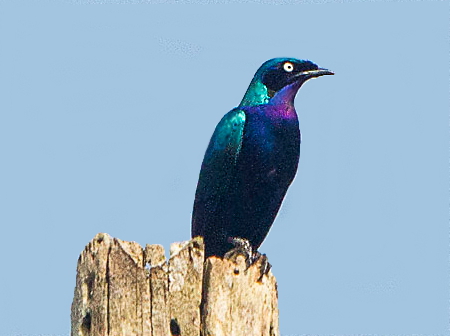
Emerald Starling
Lamprotornis iris
Order: Passeriformes / Family: Sturnidae

Wikimedia Commons
About the Emerald Starling
The Emerald Starling, scientifically known as Lamprotornis iris, is a visually striking bird belonging to the Sturnidae family. This medium-sized passerine captivates birdwatchers with its iridescent green plumage, which shimmers in sunlight. Native to the dense tropical forests and savannas of West Africa, the Emerald Starling plays a vital ecological role as both a seed disperser and an insect predator. Its range primarily includes countries such as Sierra Leone, Guinea, and Liberia, where it thrives in the humid and lush environment. The bird is typically found at elevations up to 1,500 meters, adapting well to the dense canopy and understory.
The Emerald Starling's significance extends beyond its visual appeal. It contributes to the ecosystem by controlling insect populations and aiding in the dispersal of seeds through its diet. Its presence indicates a healthy, biodiverse environment, as it relies on a variety of food sources and habitats. In the breeding season, which coincides with the rainy season, the bird's behavior shifts as it becomes more territorial and active in courtship displays. These displays are characterized by aerial acrobatics and vocalizations that resonate through the forest.
Throughout the year, the Emerald Starling exhibits a semi-nomadic behavior, moving in response to food availability and environmental conditions. Although not considered a migratory species, it may travel short distances within its range to exploit new feeding opportunities. This adaptability allows it to maintain stable populations despite seasonal fluctuations in food supply. The Emerald Starling's resilience in the face of environmental challenges underscores its importance as a component of its native ecosystems.
The Emerald Starling belongs to the family Sturnidae, within the order Passeriformes. These birds typically live average 5-7 years, with a maximum recorded of 10 years..
How to Identify a Emerald Starling
The Emerald Starling is easily identifiable by its brilliant, iridescent green plumage that covers most of its body. Adults have an almost metallic sheen, with a subtle bluish tint that can be seen when the light hits at certain angles. Their head, back, and wings exhibit this green hue, while the underparts may appear slightly darker. In contrast, the eyes are a striking yellow, providing a vivid contrast to the bird's overall coloration.
Juvenile Emerald Starlings differ from adults in that they show a duller plumage lacking the full iridescence of mature birds. They also have darker eyes, which gradually lighten as they age. There is little sexual dimorphism in this species, meaning males and females look similar, though males might appear slightly larger and more vibrant during the breeding season.
This species might be confused with other starlings, particularly those in the Lamprotornis genus, such as the Splendid Starling. However, the Emerald Starling is distinguished by its more uniform green coloration and smaller size. In flight, the bird presents a compact silhouette with pointed wings and a relatively short tail, typical of the starling family. When perched, it often adopts an upright posture, showcasing its iridescent plumage to full effect.
Having trouble telling birds apart? Upload a photo to our bird identification tool for an instant species match.
Emerald Starling Habitat and Range
Preferred Habitat
The Emerald Starling primarily inhabits tropical forests and woodlands within West Africa. It favors areas with dense vegetation, where it can find ample food and nesting sites. This bird is commonly spotted in the humid lowland forests of Sierra Leone, Guinea, and Liberia, thriving in both primary and secondary growth forests.
The Emerald Starling also shows adaptability to human-altered landscapes, sometimes venturing into plantations and farmlands where trees and shrubs provide suitable cover. While it predominantly remains in forested areas, it occasionally forages in open savannas or near forest edges, especially when food is scarce.
Seasonal habitat shifts are minimal for the Emerald Starling, as it does not migrate over long distances. However, it might move locally within its range to exploit seasonal food sources. In urban settings, its presence is less common, as it generally prefers the seclusion and resources of more natural environments.
Geographic Range
The breeding range of the Emerald Starling is confined to West Africa. It is found primarily in Sierra Leone, Guinea, and Liberia, where it occupies forested regions. This bird is non-migratory, but it may exhibit local movements to exploit changing food resources within its range.
Population densities are highest in areas with dense forest cover, where the bird finds abundant opportunities for feeding and nesting. These regions support stable populations, though the bird's presence in less forested areas is more sporadic. There are no significant migration corridors for the Emerald Starling, as it tends to remain within its established geographic range.
Although the Emerald Starling is not widely distributed outside its core range, it plays a crucial role in the ecosystems of the West African forests. Its localized distribution makes it a unique component of the region's avian diversity, contributing to the intricate web of life in these biodiverse habitats.
Want to know which birds visit your area? Browse our backyard birds by location guides for region-specific species lists.
What Does the Emerald Starling Eat?
The diet of the Emerald Starling is predominantly insectivorous, with a strong emphasis on feeding on a variety of insects and other invertebrates. It actively forages for beetles, grasshoppers, and caterpillars, which it finds among the foliage and branches of the forest. This bird employs a variety of foraging techniques, including gleaning from leaves and branches as well as catching insects in flight.
In addition to insects, the Emerald Starling consumes a range of fruits and berries, which provide essential nutrients and energy, especially during the breeding season. The availability of fruit often influences its movements within its habitat, prompting short-distance nomadic behavior in search of food sources.
Seasonal changes can affect its diet composition, with a greater reliance on fruits and seeds when insect populations decline during the dry season. The Emerald Starling's diet reflects its adaptability and resourcefulness, allowing it to maintain its ecological role as both a seed disperser and insect predator, contributing to the health of its forest environment.
Emerald Starling Behavior and Social Structure
Emerald Starlings are social birds, often seen moving in small flocks that can number from a few individuals to larger gatherings of up to 20 birds. They exhibit complex social structures, maintaining a hierarchy within the flock. These birds are known for their vocalizations, communicating with a variety of calls that serve different purposes, from maintaining flock cohesion to alerting others to the presence of predators.
During the breeding season, which aligns with the rainy months, the Emerald Starling becomes more territorial. Males perform elaborate courtship displays involving aerial acrobatics and singing to attract mates. Once paired, both male and female participate in defending their nesting territory from intruders.
In terms of daily activity, the Emerald Starling is diurnal, with peak activities occurring in the early morning and late afternoon when it forages for food. The bird is vigilant in the presence of potential predators, such as hawks and snakes, and will often give alarm calls to warn other members of the flock. Despite this, it remains an active and energetic bird, displaying an impressive range of behaviors that reflect its adaptability and intelligence.
Emerald Starling Nesting and Reproduction
The nesting habits of the Emerald Starling involve selecting tree cavities or dense vegetation as sites for their nests. These birds prefer to nest in locations that provide cover and protection from predators, often choosing high branches of large trees. The nest is constructed from natural materials such as twigs, leaves, and grass, with the interior lined with softer materials like feathers and moss for cushioning.
A typical clutch consists of two to four eggs, which are pale blue or greenish with speckles. Both parents share the responsibility of incubating the eggs, which takes approximately 12 to 14 days. After hatching, the chicks remain in the nest for about 18 to 21 days before fledging.
Parental care continues even after the young fledge, as the parents teach them foraging skills and provide food until they are fully independent. The Emerald Starling typically raises one to two broods per year, with the potential for more if environmental conditions are favorable.
Emerald Starling Sounds and Vocalizations
The Emerald Starling's vocalizations are a distinctive feature of its behavior. Its primary song consists of a series of melodic whistles and trills, often delivered in a complex and rapid sequence. The song is typically high-pitched and clear, carrying through the forest canopy.
In addition to its song, the Emerald Starling uses a variety of call notes for communication. These include short, sharp calls used for flock cohesion and longer alarm calls to warn of predators. During the dawn chorus, its vocalizations contribute to the vibrant symphony of forest sounds, often being one of the more prominent within its habitat.
The quality of its calls can be compared to the melodic tinkling of bells, making it a captivating element of the forest soundscape. Its vocal repertoire is an essential part of its social structure, facilitating interactions both within its flock and with other bird species.
Interesting Facts About the Emerald Starling
- 1Emerald Starlings can live up to 10 years in the wild, showcasing remarkable resilience.
- 2Their iridescent green plumage results from microscopic structures that refract light.
- 3Emerald Starlings often join mixed-species flocks, enhancing foraging efficiency and predator vigilance.
- 4The species was first described in 1851, highlighting its longstanding recognition in ornithology.
- 5Emerald Starlings are known to mimic sounds from their environment, adding to their vocal complexity.
- 6Their diet shifts seasonally, showcasing adaptability to different food availabilities.
- 7Despite their size, Emerald Starlings can travel up to 5 km in a single day while foraging.
Emerald Starling Conservation Status
The Emerald Starling currently holds a status of Least Concern on the IUCN Red List. Its population trend is considered stable, without significant declines observed in recent years. However, habitat loss due to deforestation and human encroachment poses a potential threat to its long-term survival. Conservation efforts focus on protecting its natural habitats, particularly the preservation of tropical forests in West Africa. Initiatives aimed at sustainable land use practices and the establishment of protected areas are crucial in mitigating habitat destruction. Historically, the Emerald Starling populations have remained relatively stable, benefiting from the bird's adaptability to various forest environments. Continued monitoring and conservation efforts are vital to ensure that this species continues to thrive in its native habitat.
Other Sturnidae Species


Birds Similar to the Emerald Starling
These species are often confused with the Emerald Starling due to similar appearance or overlapping range.