
Finsch's Conure
Aratinga finschi
Order: Psittaciformes / Family: Psittacidae
Wikimedia Commons
About the Finsch's Conure
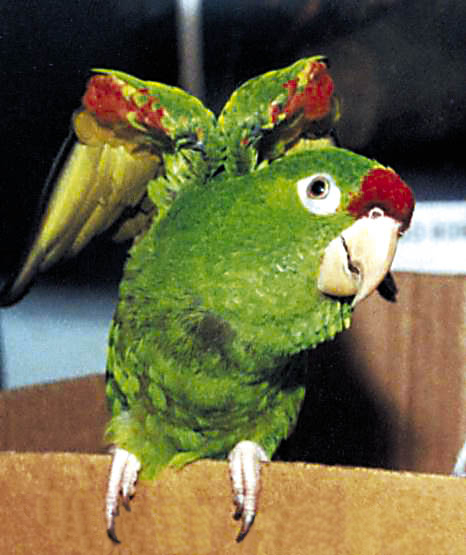
Finsch's Conure (Aratinga finschi) is a striking parrot species belonging to the family Psittacidae. This bird is predominantly green, with flashes of red and blue adorning its wings and tail. It occupies the tropical forests of Central America, with a distribution mainly spanning from the Pacific slopes of southern Mexico through Costa Rica and occasionally into western Panama. These parrots are typically found in humid lowland forests, though they are also known to inhabit secondary growth and cultivated areas where forest patches remain intact. The ecological role of Finsch's Conure is significant as they contribute to seed dispersal, aiding in forest regeneration. Seasonal behaviors include slight altitudinal movements in response to food availability, though the species generally exhibits non-migratory tendencies. During the breeding season, these birds can be observed engaging in animated courtship displays, which are vital for pair bonding. Their social structure is complex, as they form flocks that provide protection and increase foraging efficiency. Finsch's Conure is also noted for its role in cultural settings across its range, where it often features in indigenous folklore due to its vocal nature and vivid appearance.
The Finsch's Conure belongs to the family Psittacidae, within the order Psittaciformes. These birds typically live average 15 years with a max recorded of 30 years.
How to Identify a Finsch's Conure
Adult Finsch's Conures are medium-sized parrots, typically measuring around 28-30 cm in length. Their plumage is primarily bright green, with vibrant red patches on the bend of the wings and blue-tipped feathers on the wings and tail. The beak is strong and pale, contrasting with the dark ring around the eyes. Juveniles resemble adults but display paler coloration and lack the fully developed wing markings. Males and females are similar in appearance, making sexing in the field challenging. This species can be confused with the similar Green Parakeet (Psittacara holochlorus), but Finsch's Conure is distinguishable by its more extensive red wing patches and shorter tail. In flight, they exhibit a rapid, undulating flight pattern, often flying in small groups. When perched, their posture is upright, and they often engage in mutual preening, a behavior that strengthens social bonds.
Having trouble telling birds apart? Upload a photo to our bird identification tool for an instant species match.
Finsch's Conure Habitat and Range
Preferred Habitat
Finsch's Conure thrives in humid lowland tropical forests and is also found in secondary forests and areas with scattered trees. They prefer elevations ranging from sea level to about 1,500 meters. These birds are adaptable, often seen in agricultural landscapes where forest fragments persist. While they do not typically inhabit urban areas, they occasionally venture into gardens or farms adjacent to their natural habitats. Seasonal habitat shifts are minimal, largely driven by local food availability rather than temperature fluctuations.
Geographic Range
The range of Finsch's Conure extends from southern Mexico through Costa Rica, occasionally reaching western Panama. They are primarily found on the Pacific slopes, with significant populations in Oaxaca and Chiapas in Mexico, and throughout the volcanic terrains of Costa Rica. The species does not undertake long migratory journeys but may move in response to food sources or breeding requirements. Key areas of population density include the lush forests of the Osa Peninsula and the Talamanca Mountains in Costa Rica.
Want to know which birds visit your area? Browse our backyard birds by location guides for region-specific species lists.
What Does the Finsch's Conure Eat?
Finsch's Conure primarily feeds on a variety of seeds, fruits, and nuts. Their diet changes seasonally based on availability, with a preference for figs and other fleshy fruits in the wet season. These birds exhibit adept foraging techniques, often seen using their strong beaks to crack open hard seeds or peel fruits to access the nutritious insides. They forage in flocks, which allows them to efficiently locate food resources and reduce individual predation risk. Feeding typically occurs in the early morning and late afternoon, with birds resting during the hottest part of the day.
Want to attract Finsch's Conures to your yard? See our recommended feeders and seed types for the best results.
Finsch's Conure Behavior and Social Structure
Finsch's Conure exhibits a highly social behavior, often forming flocks ranging from a few individuals to several dozen. These flocks engage in coordinated flight patterns, which serve both social and protective functions. Territorial behavior is limited, as these parrots are generally nomadic within their home range, moving in search of food. Courtship displays are elaborate, involving vocalizations and synchronized movements. When faced with predators, the flock will often take to the air, emitting loud calls to warn others. Daily activities include foraging, preening, and resting, with peak activity occurring during the cooler morning and late afternoon hours.
Finsch's Conure Nesting and Reproduction
The nesting habits of Finsch's Conure are intricate, as they typically nest in tree cavities. Preferred nesting sites include old woodpecker holes or natural cavities in large trees. These nests are often located high above the ground, providing safety from ground predators. The typical clutch size ranges from 3 to 5 eggs, with an incubation period of approximately 23 to 25 days. Both parents share responsibilities during incubation and chick-rearing. Young conures fledge about 7 to 8 weeks after hatching, and the species generally produces one brood per year, although favorable conditions may lead to a second.
Finsch's Conure Sounds and Vocalizations
Finsch's Conure is known for its loud, raucous calls, which are characterized by high-pitched, screechy notes. These calls are often repeated in rapid succession, serving as both communication within the flock and a warning to other birds. Their vocalizations can be heard most frequently at dawn and dusk, when they are most active. At times, their calls may resemble the sound of a distant metallic object being scraped, adding a mechanical quality to their natural repertoire.
Interesting Facts About the Finsch's Conure
- 1Finsch's Conure can live up to 25 years in the wild, a lifespan that reflects their adaptability.
- 2These parrots are named after the German naturalist Otto Finsch, who greatly contributed to avian studies.
- 3Finsch's Conures are known to participate in mutualistic relationships with certain tree species, aiding seed dispersal.
- 4Despite their vibrant colors, Finsch's Conures blend well into their leafy environments, providing effective camouflage.
- 5The social structure of Finsch's Conure flocks allows them to effectively communicate and coordinate during foraging.
- 6These birds are often seen bathing in rainwater collected in tree hollows, an important behavior for feather maintenance.
- 7Finsch's Conure has a call that can be heard from up to a kilometer away, facilitating long-distance communication.
Finsch's Conure Conservation Status
Finsch's Conure is currently listed as Near Threatened on the IUCN Red List due to habitat loss and fragmentation. The population trend shows a decline, attributed mainly to deforestation and agricultural expansion in their native range. Conservation efforts include habitat preservation and legal protection against capture for the pet trade. Historical population assessments indicate a reduction in numbers, necessitating continued monitoring and habitat restoration initiatives to secure their future.
Attracting Finsch's Conures to Your Feeder
The Finsch's Conure is a regular visitor to backyard bird feeders across its range. At the Eye On The Fly feeding station, we observe Finsch's Conures regularly and capture footage with our feeder cameras.
Other Psittacidae Species


Birds Similar to the Finsch's Conure
These species are often confused with the Finsch's Conure due to similar appearance or overlapping range.
