
Firewood-gatherer
Anumbius annumbi
Order: Passeriformes / Family: Furnariidae
Wikimedia Commons
About the Firewood-gatherer
The Firewood-gatherer, Anumbius annumbi, is a fascinating member of the Furnariidae family, often observed in the open landscapes of South America. This bird is particularly notable for its intricate and conspicuous nests, which serve as a hallmark of its presence. Found primarily in countries such as Argentina, Uruguay, and southern Brazil, the Firewood-gatherer thrives in open scrublands, grasslands, and agricultural areas where it can find ample materials for its nest-building activities. Unlike many other bird species, the Firewood-gatherer is a non-migratory resident, maintaining its territory year-round.
The Firewood-gatherer plays a crucial ecological role in its habitat by contributing to the structural complexity of the environment. Its nests, constructed from sticks and other available materials, provide shelter and breeding sites for various invertebrates and even small mammals. This bird's presence can indicate a healthy ecosystem, as it requires specific structural elements in its environment to thrive.
In terms of behavior, the Firewood-gatherer is known for its cooperative breeding strategies, often involving extended family groups in the construction and maintenance of nests. This social structure enhances survival rates and fosters strong familial bonds. The bird's diet primarily consists of insects and small invertebrates, but it occasionally supplements its diet with seeds and plant material, particularly during the dry season when other food sources are scarce. Observers can often spot the Firewood-gatherer foraging on the ground, using its strong beak to probe soil and leaf litter for hidden prey.
The Firewood-gatherer is not only significant for its ecological contributions but also as a subject of interest for ornithologists and bird enthusiasts. Its unique nesting behavior, combined with its adaptability to various open habitats, makes it an intriguing species for study and observation. Seasonal behaviors include increased vocalizations during the breeding season, as well as heightened territorial displays to ward off potential intruders.
The Firewood-gatherer belongs to the family Furnariidae, within the order Passeriformes. These birds typically live average 5 years with a maximum recorded of 10 years..
How to Identify a Firewood-gatherer
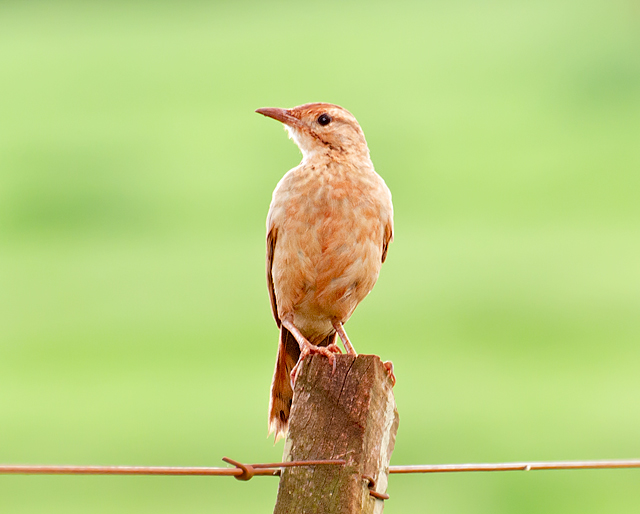
The Firewood-gatherer is a medium-sized bird, measuring about 20-22 cm in length. Its plumage is predominantly brown, which provides excellent camouflage against the earthy tones of its habitat. The underparts are lighter, often displaying a buff or whitish hue. One of the key identifying features is its slightly curved, robust bill, well-suited for gathering nesting materials and foraging.
Juveniles resemble adults but have a slightly duller plumage, lacking the more defined patterning found in mature birds. There is no significant sexual dimorphism in this species, meaning males and females look alike. The Firewood-gatherer may be confused with other members of the Furnariidae family, such as the Rufous Hornero, but its distinctive nesting habits and vocalizations can help differentiate it.
In flight, the Firewood-gatherer shows a straightforward silhouette with broad, rounded wings, and a steady, direct flight pattern. When perched, it often holds its tail slightly cocked upward, a posture that, along with its iconic nest-building behavior, can aid in quick identification.
Having trouble telling birds apart? Upload a photo to our bird identification tool for an instant species match.
Firewood-gatherer Habitat and Range
Preferred Habitat
The Firewood-gatherer inhabits open areas such as grasslands, savannas, and farmlands, where it can access abundant nesting materials. It is also found in secondary growth and scrubby pastures, thriving at elevations up to 1,000 meters. Unlike some species, the Firewood-gatherer demonstrates little seasonal movement, remaining in its chosen territory throughout the year.
In rural areas, the Firewood-gatherer is a common sight, often seen perching on fence posts or low shrubs. Urban encroachment poses a challenge, yet it adapts by utilizing available green spaces. In agricultural landscapes, it benefits from the presence of hedges and isolated trees, which provide both foraging grounds and nesting sites.
Geographic Range
The Firewood-gatherer resides mainly in the southern regions of South America. Its range extends across Argentina, Uruguay, Paraguay, and southern Brazil, with some scattered populations in Bolivia. It is a non-migratory species, maintaining a stable presence in these areas year-round.
In Argentina, it is particularly abundant in the Pampas region, where its preferred habitat of open grasslands and agricultural fields is prevalent. Uruguay and southern Brazil also support dense populations, as the landscapes in these areas provide suitable nesting and foraging opportunities. Unlike many other birds, the Firewood-gatherer does not engage in long-distance migrations, focusing instead on local movements within its territory.
Want to know which birds visit your area? Browse our backyard birds by location guides for region-specific species lists.
What Does the Firewood-gatherer Eat?
The diet of the Firewood-gatherer is primarily insectivorous, consisting of ants, beetles, and caterpillars, which it skillfully extracts from the ground and vegetation. During the dry season, when insect abundance decreases, it shifts to consuming more seeds and plant matter to supplement its diet.
Foraging mainly occurs on the ground, where the bird can be seen using its strong bill to flip over leaves and debris. It employs a methodical approach, often returning to successful foraging spots. The Firewood-gatherer's feeding schedule peaks during the cooler hours of the morning and late afternoon, allowing it to avoid the midday heat.
The bird's ability to adapt its diet according to seasonal changes ensures its survival even when preferred food sources are scarce. This dietary flexibility is a testament to its successful adaptation to varied environments.
Firewood-gatherer Behavior and Social Structure
Firewood-gatherers are social birds, often found in small family groups, particularly during the nesting season. These groups cooperate in building and maintaining the large, stick-based nests that are a signature of the species. Territorial behavior is pronounced, especially during breeding when pairs vigorously defend their nesting sites from intruders.
Courtship displays involve both visual and vocal elements, with males often seen presenting nesting materials to females as part of the pair-bonding process. The species is generally monogamous, with pairs remaining together across multiple breeding seasons.
Firewood-gatherers exhibit a clear daily rhythm of activity. They are most active during the early morning and late afternoon, engaging in foraging and social interactions. During the heat of midday, they often retreat to shaded areas or the interior of their nests. When faced with predators, such as birds of prey or snakes, Firewood-gatherers rely on alarm calls and group mobbing behavior to deter threats.
Firewood-gatherer Nesting and Reproduction
The nests of the Firewood-gatherer are remarkable constructions, often resembling small towers made of sticks and twigs. These nests can reach up to 1 meter in height and are typically built in isolated trees or tall shrubs. The location is chosen for its clear vantage points, allowing the birds to spot predators from a distance.
A typical clutch consists of 2-4 eggs, with incubation lasting around 14 days. Both parents share incubation duties and are involved in feeding and caring for the young. The chicks fledge approximately 18-20 days after hatching, but they continue to rely on parental support for several weeks post-fledging.
Firewood-gatherers typically produce one to two broods per year, depending on environmental conditions and food availability. The extended family structure of this species means that older siblings often help care for subsequent broods, enhancing the survival prospects of the young.
Firewood-gatherer Sounds and Vocalizations
The primary song of the Firewood-gatherer is a series of rapid, sharp notes that can be described as a "chattering" sound. This vocalization is used predominantly during the breeding season to establish territory and attract mates. The rhythm is fast and somewhat mechanical, reminiscent of a sewing machine.
In addition to their song, Firewood-gatherers produce a variety of calls, including a distinct "chip" sound used for communication within family groups and an alarm call that alerts others to potential danger. During the dawn chorus, their chattering is particularly prominent, often leading the acoustic environment of their habitat.
Compared to other birds in the Furnariidae family, the Firewood-gatherer's vocal repertoire is quite varied, reflecting its complex social interactions and territorial behaviors.
Interesting Facts About the Firewood-gatherer
- 1The Firewood-gatherer's nests can weigh over 10 kilograms, an impressive feat for a bird its size.
- 2Firewood-gatherers often reuse their nests for multiple years, adding to them each season.
- 3Their nests provide shelter for other species, including small mammals and reptiles.
- 4Despite their name, Firewood-gatherers do not use firewood but prefer small sticks and twigs.
- 5During the breeding season, both male and female Firewood-gatherers actively participate in nest construction.
- 6The Firewood-gatherer's nests are sometimes used by other bird species, such as the Rufous Hornero.
- 7This bird is a common sight in the Pampas region, where its distinctive nests dot the landscape.
Firewood-gatherer Conservation Status
Currently, the Firewood-gatherer is classified as Least Concern by the IUCN, with a stable population trend. However, habitat loss due to agricultural expansion and urban development poses potential threats to its preferred environments. Conservation efforts focus on preserving open grassland and scrub habitats, which are crucial for the species' nesting and foraging activities. Historically, the population has remained relatively stable, thanks in part to its adaptability and the wide availability of suitable habitat. Ongoing monitoring of population trends is essential to ensure that changes in land use do not negatively impact this species. Local conservation groups are actively working to raise awareness of the ecological role of the Firewood-gatherer and the importance of maintaining biodiversity in South America's open landscapes.
Other Furnariidae Species


Birds Similar to the Firewood-gatherer
These species are often confused with the Firewood-gatherer due to similar appearance or overlapping range.

