
Gabon Boubou
Laniarius bicolor
Order: Passeriformes / Family: Malaconotidae
Wikimedia Commons
About the Gabon Boubou
The Gabon Boubou, scientifically known as Laniarius bicolor, is a striking avian species belonging to the Malaconotidae family. It is native to Central Africa, where it thrives in the dense humid forests of Gabon, Equatorial Guinea, and surrounding regions. This bird is an integral part of the ecosystem, playing a critical role in insect population control, which benefits the overall health of its habitat. The Gabon Boubou is best known for its distinctive black and white plumage, which provides excellent camouflage in the dappled light of the forest understory. Its strong, melodious calls, often performed in duets, echo through the forest, marking its presence and establishing territory. The Gabon Boubou's ecological role extends beyond its predatory habits. As an insectivore, it helps maintain a balance in the ecosystem, and its feeding activities contribute to the propagation of various plant species. By controlling insect populations, the Gabon Boubou indirectly supports the survival of other species that share its habitat. The bird is most active during the wet season, from October to May, when insect abundance peaks. During this period, their breeding activity also intensifies, taking advantage of the increased food availability. Beyond its ecological impact, the Gabon Boubou holds cultural significance in the regions it inhabits. Local communities often recognize its call as a harbinger of rain, and its presence is considered an indicator of a healthy forest. Conservationists emphasize the importance of preserving the Gabon Boubou's habitat, as deforestation poses a significant threat to its population. Efforts to protect these birds often focus on maintaining the integrity of their forest environment, ensuring that the Gabon Boubou can continue its vital ecological role.
The Gabon Boubou belongs to the family Malaconotidae, within the order Passeriformes. These birds typically live average 5 years, with a maximum recorded of 8 years..
How to Identify a Gabon Boubou
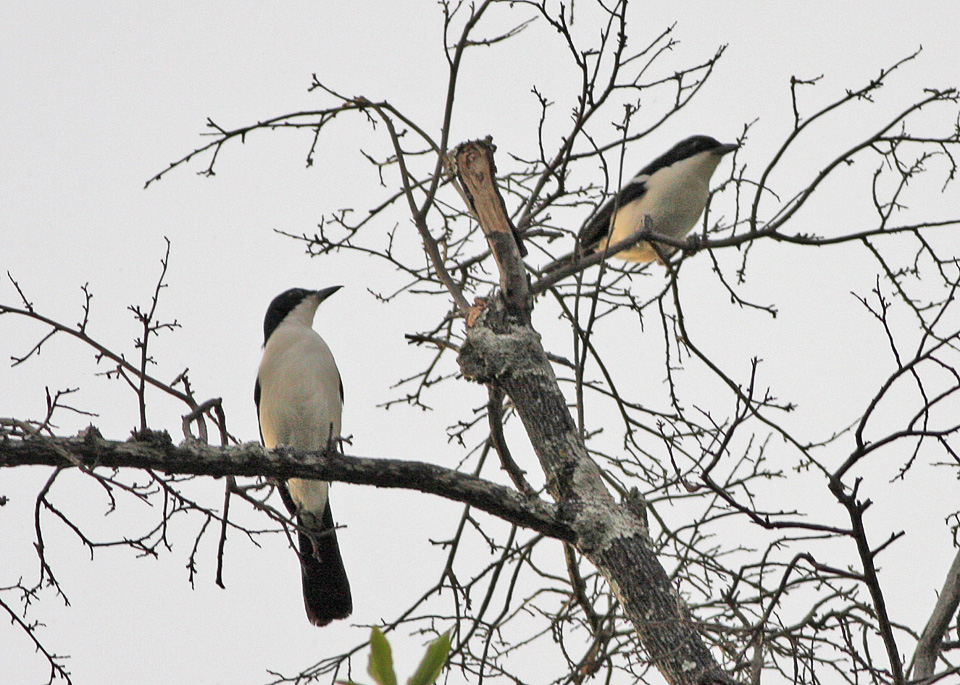
The Gabon Boubou is easily identifiable by its distinctive black and white plumage. The adult bird displays a glossy black upper body with striking white underparts, creating a sharp contrast that aids in identification. The wings also feature black with white markings, especially visible in flight. Juvenile Gabon Boubous have a more muted coloration, with brownish tones blending into the black, providing them with additional camouflage. Unlike many bird species, there is little sexual dimorphism; males and females appear similar in plumage coloration. However, females may be slightly smaller, though this is not always easily noticeable in the field. In silhouette, the Gabon Boubou appears robust with a strong, slightly curved bill and a relatively long tail. When perched, it often sits in an upright posture, occasionally flicking its tail. This posture, combined with its vocal activity, makes it a conspicuous presence in its forest habitat. Confusion with similar species, such as the Tropical Boubou, can occur, but the Gabon Boubou's specific geographical range and more intense black and white contrast often aid in proper identification.
Having trouble telling birds apart? Upload a photo to our bird identification tool for an instant species match.
Gabon Boubou Habitat and Range
Preferred Habitat
The Gabon Boubou inhabits dense, humid lowland forests, primarily within Gabon and neighboring countries such as Equatorial Guinea and Cameroon. It thrives in tropical rainforests, preferring areas with thick undergrowth that provide ample cover and foraging opportunities. The species can also be found in secondary forests and forest edges, where human activity has created a mosaic of natural and altered landscapes. Unlike some other forest birds, the Gabon Boubou does not typically venture into urban areas, remaining closely tied to its natural forest environment. It is most frequently observed at elevations ranging from sea level to about 800 meters. During the rainy season, the Gabon Boubou remains in the same habitat but may move slightly to areas with denser insect populations to maximize food intake. While primarily a forest dweller, occasional sightings in more open habitats nearby suggest some adaptability in changing environmental conditions.
Geographic Range
The Gabon Boubou's range is relatively restricted to the tropical regions of Central Africa. It is found predominantly in Gabon, with its range extending into Equatorial Guinea, Cameroon, and parts of the Republic of the Congo. The species is largely resident, showing little to no migratory behavior, which means it can be found in these regions throughout the year. The population density is highest in the untouched rainforests of Gabon, where human impact is minimal. While the Gabon Boubou does not undertake long migrations, some local movement within its range occurs, particularly in response to changes in food availability. During the breeding season, these birds may become more concentrated in areas with high insect activity. Despite its limited range, the Gabon Boubou continues to maintain stable populations in its core habitats, although habitat destruction poses a significant long-term risk.
Want to know which birds visit your area? Browse our backyard birds by location guides for region-specific species lists.
What Does the Gabon Boubou Eat?
The Gabon Boubou primarily feeds on insects and other small invertebrates, which constitute the bulk of its diet. Common prey items include beetles, caterpillars, and spiders. During the rainy season, the abundance of insects increases, allowing the Gabon Boubou to feed more efficiently and support its breeding activities. In addition to insects, the species occasionally consumes small reptiles and amphibians, such as lizards and frogs, when the opportunity arises. Foraging typically occurs in the understory and lower canopy, where the bird actively searches for prey by gleaning and probing among leaves and branches. The Gabon Boubou employs a sit-and-wait technique, often remaining motionless for extended periods before pouncing on unsuspecting prey. Feeding activity peaks in the early morning and late afternoon, coinciding with periods of increased insect activity. The bird's keen eyesight and quick reflexes make it an adept hunter, contributing to its success in the complex forest environment.
Gabon Boubou Behavior and Social Structure
The Gabon Boubou exhibits a range of interesting behaviors, particularly in its social and territorial dynamics. It is typically seen alone or in pairs, with pairs often engaging in vocal duets that serve both to strengthen pair bonds and to establish territory. These duets involve a series of calls, with one bird starting and the other responding in a harmonious sequence. The Gabon Boubou is highly territorial, with pairs defending their area aggressively against intruders, including other birds of the same species. During the breeding season, which coincides with the rainy months, territorial displays become more pronounced as pairs prepare for nesting. Despite its aggressive territorial behavior, the Gabon Boubou does not form large flocks and tends to avoid areas with high human activity. The bird is diurnal, with most of its activities concentrated during daylight hours. It starts its day with a series of calls at dawn, often remaining active until dusk, except during the hottest midday hours, when it retreats to shaded areas. The Gabon Boubou's response to predators involves loud alarm calls and flight to denser cover, where it remains hidden until the threat passes.
Gabon Boubou Nesting and Reproduction
The Gabon Boubou constructs a cup-shaped nest, typically placed in dense shrubbery or small trees, well-concealed from predators. These nests are built from a variety of materials, including twigs, leaves, and grasses, often lined with softer materials for added comfort. The female usually lays a clutch of 2 to 3 eggs, which she incubates for about 14 days. Both parents share in feeding the young, which fledge approximately 15 to 17 days after hatching. The timing of breeding coincides with the rainy season, ensuring a plentiful supply of food for the growing chicks. The Gabon Boubou typically raises one brood per year, although in favorable conditions, especially with abundant food sources, a second brood might be attempted. Parental care is attentive, with both adults participating actively in protecting and feeding their offspring, ensuring the young birds have the best possible start in life.
Gabon Boubou Sounds and Vocalizations
The Gabon Boubou is known for its rich, melodious song, which consists of a series of whistles and clicks. These sounds are delivered in a harmonized duet by mated pairs, creating a distinctive and complex melody that resonates through the forest. The primary song is often described as a series of fluty whistles, each note clear and sweet, with a rhythmic pattern that varies slightly between individuals. In addition to their songs, Gabon Boubous produce a range of calls, including sharp alarm notes when threatened and softer contact calls to maintain pair cohesion. The dawn chorus is a particularly active time for vocalizations, with the Gabon Boubou contributing to the overall symphony of forest sounds. Their calls and songs serve not only as a means of communication but also as an effective tool in maintaining territory and deterring rival pairs.
Interesting Facts About the Gabon Boubou
- 1The Gabon Boubou's duets are so synchronized that they can fool listeners into thinking a single bird is singing.
- 2This bird's striking black and white plumage provides excellent camouflage in the dappled light of the forest understory.
- 3Gabon Boubous are known to mimic the calls of other bird species, an unusual trait among bushshrikes.
- 4Despite their bold appearance, Gabon Boubous are shy and often remain hidden in dense foliage.
- 5The Gabon Boubou's strong, melodious calls can travel over long distances, helping them maintain territory.
- 6Females participate equally in territorial defense, showcasing the species' strong pair bonds.
- 7Research has shown that Gabon Boubous rarely venture more than a kilometer from their established territory.
Gabon Boubou Conservation Status
The Gabon Boubou is currently listed as a species of Least Concern on the IUCN Red List, with stable population trends. However, habitat destruction due to logging and agricultural expansion poses a significant threat to its future stability. Conservation efforts focus on preserving the bird's natural forest habitat, which is crucial for its survival. Protected areas within Gabon and neighboring countries offer some refuge, but ongoing deforestation outside these zones remains a concern. Historical data suggests that while the Gabon Boubou population has remained relatively stable, continued habitat loss could lead to declines. Conservationists advocate for sustainable land-use practices and increased awareness to mitigate these risks.


