
Gambel's Quail
Callipepla gambelii
Order: Galliformes / Family: Odontophoridae

Wikimedia Commons
About the Gambel's Quail
Gambel's Quail, scientifically known as Callipepla gambelii, is a quintessential bird of the arid regions of the southwestern United States. This species plays a vital role in the ecology of desert and scrub habitats. It is often seen scurrying along the ground in family groups, known as coveys, searching for food and shelter. A key component of these birds' ecological role is seed dispersal, which helps in the propagation of various desert plant species. They are adapted to survive in harsh environments with limited water availability and high temperatures. The quail's ability to endure such conditions is partly due to their efficient water conservation mechanisms and their diet, which includes moisture-rich foods such as insects and succulent plant material. The habitats of Gambel's Quail extend across a range of desert landscapes, including the Sonoran Desert, the Mojave Desert, and the Chihuahuan Desert. They are particularly abundant in areas with a mix of open ground and dense vegetation, such as sagebrush and mesquite. In addition to their ecological significance, Gambel's Quail hold cultural importance for many indigenous peoples and local communities. They are a popular game bird, contributing to local economies and wildlife management practices. Seasonal behaviors of Gambel's Quail include their breeding activities in spring, when males become more vocal and territorial. During this time, they engage in elaborate courtship displays to attract mates. As the seasons change, these quail adjust their behavior and movements to cope with environmental challenges. In winter, Gambel's Quail may form larger coveys, which provide increased protection from predators and help in thermoregulation during colder months. This social behavior is crucial for their survival in an environment where food resources can be scarce.
The Gambel's Quail belongs to the family Odontophoridae, within the order Galliformes. These birds typically live average lifespan is 1.5 years, with a maximum recorded of 6 years in the wild..
How to Identify a Gambel's Quail
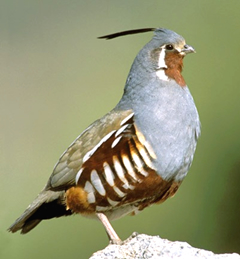
Adult Gambel's Quail are medium-sized birds with a distinctive forward-curling topknot of black feathers. The plumage is predominantly gray with a brown back and chestnut sides, which are barred with white. Males have a striking black face and throat bordered by white, adding to their distinctive appearance. Females are similar but lack the bold facial markings, appearing more uniformly gray. Juveniles resemble females but have a more muted coloration overall. The species can be confused with the California Quail, but Gambel's Quail have a more pronounced topknot and a less intricate pattern on the body. In flight, they exhibit a short, rounded silhouette with rapid, whirring wing beats. Their perching posture is typically upright, often seen atop low shrubs or rocks, scanning for danger or calling to other quail.
Having trouble telling birds apart? Upload a photo to our bird identification tool for an instant species match.
Gambel's Quail Habitat and Range
Preferred Habitat
Gambel's Quail inhabit a variety of desert environments, including creosote bush flats, cactus-studded landscapes, and riparian thickets. They are commonly found at elevations ranging from sea level to 5000 feet. These quail are well-suited to the desert, utilizing areas with mixed open ground for foraging and dense cover for protection. While primarily associated with rural settings, they can also be spotted in urban areas where suitable vegetation is present, such as parks and gardens. Seasonal habitat shifts occur, with quail moving to areas with more cover during the hottest parts of the year.
Geographic Range
Gambel's Quail occupy a range that includes much of the southwestern United States and northwestern Mexico. Their breeding range spans across Arizona, New Mexico, Texas, southern Utah, Nevada, and parts of California. During winter, they remain in these areas, as they are non-migratory birds, relying on the mild desert climate for year-round residency. Population density is highest in the Sonoran Desert, where suitable habitat is abundant. They are less common in higher elevation areas where the climate is cooler and vegetation differs significantly from their preferred desert scrub.
Want to know which birds visit your area? Browse our backyard birds by location guides for region-specific species lists.
What Does the Gambel's Quail Eat?
The diet of Gambel's Quail primarily consists of seeds, which make up about 70% of their intake. They favor seeds from desert plants such as mesquite, acacia, and cactus. During spring and summer, they supplement their diet with insects, which provide essential protein for breeding and rearing young. Quail forage in the early morning and late afternoon, using their strong legs to scratch the ground in search of food. Their foraging technique involves pecking and scratching, allowing them to uncover hidden seeds and insects. During dry periods, they will consume more succulent plant material to meet their hydration needs.
Gambel's Quail Behavior and Social Structure
Gambel's Quail are social birds, often forming coveys of up to 20 individuals outside the breeding season. These coveys provide mutual protection and increase foraging efficiency. During the breeding season, males become territorial, engaging in displays and vocalizations to attract mates and deter rivals. Courtship involves the male fluffing his plumage and bobbing his head to showcase his topknot. When threatened by predators, Gambel's Quail rely on their cryptic coloration and swift running ability to escape. They are diurnal, with peak activity occurring at dawn and dusk. Their daily routine revolves around foraging, preening, and avoiding predators.
Gambel's Quail Nesting and Reproduction
Gambel's Quail nest on the ground, often under a shrub or in dense grass for concealment. The nest is a simple scrape lined with grass and feathers. Clutch sizes range from 10 to 12 eggs, with incubation lasting about 21 to 23 days. Both parents share the responsibility of incubating the eggs and caring for the young. Chicks are precocial, leaving the nest shortly after hatching. They are capable of feeding themselves but remain under the watchful eyes of their parents. Gambel's Quail typically raise one brood per year, though in favorable conditions, they may attempt a second.
Gambel's Quail Sounds and Vocalizations
The primary call of Gambel's Quail is a distinctive, nasal 'Chi-ca-go', repeated several times, often heard at dawn and dusk. This call serves to maintain contact within coveys and establish territory. Alarm calls are sharp and quick, alerting others to potential threats. The vocal repertoire also includes soft clucks and purrs used for communication within the family group. Compared to other quail, their calls are more resonant, aiding in long-distance communication across open desert landscapes.
Interesting Facts About the Gambel's Quail
- 1Gambel's Quail can run up to 12 miles per hour, using their speed to escape predators quickly.
- 2The quail's topknot, made of six feathers, is unique to each individual, much like a human fingerprint.
- 3These quail are proficient jumpers, capable of leaping up to 6 feet to reach low-hanging food or escape threats.
- 4Gambel's Quail chicks are precocial, meaning they can walk and feed themselves just hours after hatching.
- 5A group of quail is called a covey, and these social groups can contain up to 20 individuals.
- 6During extreme heat, Gambel's Quail enter a state of torpor, reducing their activity to conserve energy and water.
- 7Despite being non-migratory, they may travel several miles in search of food during particularly dry seasons.
Gambel's Quail Conservation Status
Currently, Gambel's Quail are listed as a species of Least Concern by the IUCN. Their populations are generally stable, although localized declines have been noted due to habitat loss and fragmentation. Conservation efforts focus on habitat preservation and management of hunting practices. Historical data indicate fluctuations in population size, largely influenced by variations in rainfall and food availability. Continued monitoring and conservation initiatives are essential to maintain stable populations in the face of changing environmental conditions.
Other Odontophoridae Species


Birds Similar to the Gambel's Quail
These species are often confused with the Gambel's Quail due to similar appearance or overlapping range.