
Gartered Trogon
Trogon caligatus
Order: Trogoniformes / Family: Trogonidae
Wikimedia Commons
About the Gartered Trogon
The Gartered Trogon, known scientifically as Trogon caligatus, is a striking bird found primarily in the tropical forests of Central America. This species is significant for its role in maintaining the ecological balance within its habitat. It primarily inhabits countries like Mexico, Belize, Costa Rica, and Panama, thriving in humid forests and tropical woodlands. The Gartered Trogon plays an essential role as both predator and seed disperser, contributing to the health of the forest ecosystem. Its presence is an indicator of forest health, as it relies on a well-preserved environment to thrive. During the breeding season, which peaks from March to June, the Gartered Trogon becomes more vocal and active, engaging in elaborate courtship displays. As the seasons change, the bird remains largely resident, showing little migratory behavior. In its native range, the Gartered Trogon is a year-round inhabitant of lowland and montane forests, often observed perching quietly under the canopy. Its ecological role extends beyond seed dispersal as it also helps control insect populations. The bird's diet consists primarily of insects and small fruits, thereby contributing to both the arthropod and plant communities. By consuming various fruit species, the Gartered Trogon aids in seed dispersal, facilitating forest regeneration and plant diversity. Its presence supports a complex web of interactions within its ecosystem, underscoring its ecological importance.
The Gartered Trogon belongs to the family Trogonidae, within the order Trogoniformes. These birds typically live average lifespan is around 5-7 years with a maximum recorded of 10 years.
How to Identify a Gartered Trogon
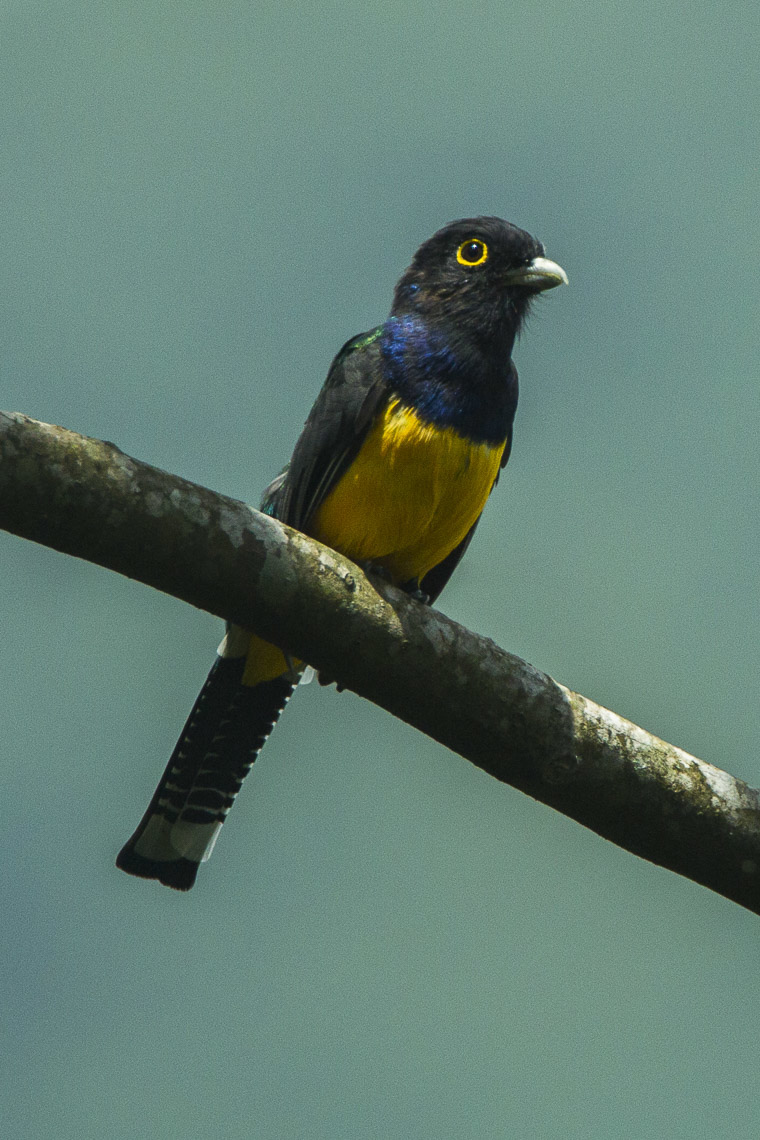
The Gartered Trogon is a medium-sized bird with a length of about 23 to 25 centimeters. Adult males possess a metallic green head and upperparts, a bright yellow belly, and a distinctive blue eye-ring. Their wings are black with fine white barring, while the tail is long and graduated, with black and white patterning on the underside. In contrast, females feature a more subdued coloration with a brownish-gray head and upperparts, yet they still exhibit the characteristic yellow belly and blue eye-ring. Juvenile Gartered Trogons resemble females but may display even duller plumage. This species can be confused with the similar Black-headed Trogon, which shares the same range. However, the Black-headed Trogon lacks the blue eye-ring, which is a key distinguishing feature of the Gartered Trogon. In flight, the Gartered Trogon exhibits a slow, direct movement with bursts of rapid wing beats. When perching, it maintains an upright posture, often staying motionless for extended periods, a behavior that aids in its identification.
Having trouble telling birds apart? Upload a photo to our bird identification tool for an instant species match.
Gartered Trogon Habitat and Range
Preferred Habitat
The Gartered Trogon predominantly inhabits tropical and subtropical forests, thriving in both lowland and montane regions. It prefers dense, humid environments such as primary and secondary forests, as well as forest edges. Typically found at elevations ranging from sea level to about 1,200 meters, the Gartered Trogon can occasionally be observed in slightly higher elevations in montane forests. This species is less common in urban areas, tending to avoid human-altered landscapes. During the dry season, the bird may venture into more open areas or forest edges in search of food but generally remains in forested habitats. Its reliance on intact forest ecosystems highlights the importance of preserving these habitats for the continued survival of the species.
Geographic Range
The Gartered Trogon is distributed across a range that includes parts of southern Mexico, Central America, and into northwestern South America. Its presence is notable in countries such as Belize, Honduras, Nicaragua, Costa Rica, Panama, and Colombia. This bird is a year-round resident, with no significant seasonal migration patterns. However, it may undertake local movements within its range in response to food availability and breeding conditions. Population density tends to be higher in well-preserved forest areas, where suitable nesting and foraging conditions are abundant. The Gartered Trogon is not considered migratory, although some altitudinal movement may occur as it shifts to different forest strata in response to seasonal changes.
Want to know which birds visit your area? Browse our backyard birds by location guides for region-specific species lists.
What Does the Gartered Trogon Eat?
The diet of the Gartered Trogon consists primarily of insects and fruits, making it an omnivorous bird with a diverse feeding palette. It forages by sallying from a perch to capture insects in mid-air or by gleaning them from foliage. Common prey items include caterpillars, beetles, and other small arthropods. Fruit forms a significant part of its diet, especially during the non-breeding season when insect availability may decrease. The Gartered Trogon displays a particular preference for small fruits and berries, which it swallows whole. Foraging occurs throughout the day, with peaks in activity during the early morning and late afternoon. This bird's feeding behavior contributes to its role as a seed disperser, aiding in forest regeneration.
Gartered Trogon Behavior and Social Structure
The Gartered Trogon exhibits a solitary or paired existence, rarely forming large groups. Territorial behavior is most pronounced during the breeding season, when males engage in vocal displays to ward off rivals and attract mates. Courtship involves a series of vocalizations, visual displays, and aerial chases. Males often present food to females as part of the courtship ritual. The Gartered Trogon is generally non-aggressive, preferring to rely on its camouflaged plumage to avoid predators. Its daily activity pattern includes a mix of foraging and resting, with increased activity during cooler parts of the day. In response to predators, the bird remains still or retreats quietly into denser foliage. Despite its relatively calm demeanor, the Gartered Trogon is an agile flyer, capable of rapid movements when necessary.
Gartered Trogon Nesting and Reproduction
Nesting for the Gartered Trogon occurs primarily in tree cavities, often those excavated by woodpeckers or naturally occurring in decayed wood. The preferred nest height varies but is typically between 1 and 15 meters above ground. The female lays a clutch of 2 to 3 eggs, which both parents incubate over a period of approximately 16 to 19 days. After hatching, the chicks remain in the nest for about 25 to 30 days before fledging. Both parents share the responsibilities of feeding and caring for the young, ensuring a higher survival rate. The Gartered Trogon typically raises one brood per year, although in optimal conditions, a second brood may be attempted. Parental roles are well-defined, with both male and female contributing significantly to the rearing of the offspring.
Gartered Trogon Sounds and Vocalizations
The primary song of the Gartered Trogon is a series of soft, melodious whistles that descend in pitch. These calls are often repeated in sequences, creating a rhythmic pattern that can be heard throughout its forest habitat. Call notes are typically short and sharp, serving as contact calls between mates or to signal alarm. The dawn chorus of the Gartered Trogon is especially notable, as males sing persistently to establish territory and attract females. The sound is reminiscent of a flute, offering a clear, musical quality that stands out against the background sounds of the forest. Alarm calls are less musical, consisting of more abrupt, harsh notes to alert others of potential danger.
Interesting Facts About the Gartered Trogon
- 1The Gartered Trogon can sit motionless for hours, making it difficult to spot despite its bright colors.
- 2Unlike many birds, the Gartered Trogon's eyes face forward, providing better depth perception for catching prey.
- 3The Gartered Trogon is known to follow troops of monkeys, catching insects disturbed by their movement.
- 4This species can consume fruits with seeds that are up to 5% of its body weight, aiding in seed dispersal.
- 5Despite its bright appearance, the Gartered Trogon can blend surprisingly well into the forest canopy.
- 6Its scientific name, Trogon caligatus, references its distinctive 'booted' or 'gartered' appearance due to its leg feathers.
- 7The Gartered Trogon has a symbiotic relationship with certain tree species, helping disperse their seeds over large areas.
Gartered Trogon Conservation Status
The Gartered Trogon is currently listed as Least Concern by the IUCN, with stable population trends across its range. However, habitat destruction poses a significant threat, as deforestation and land conversion reduce the availability of suitable habitats. Conservation efforts focus on preserving and restoring forested areas, particularly in regions experiencing high rates of deforestation. Protected areas and national parks play a crucial role in safeguarding the habitats of the Gartered Trogon. Monitoring programs aim to track population changes and habitat conditions to ensure continued stability. Despite current stability, ongoing conservation measures remain essential to prevent future declines.


