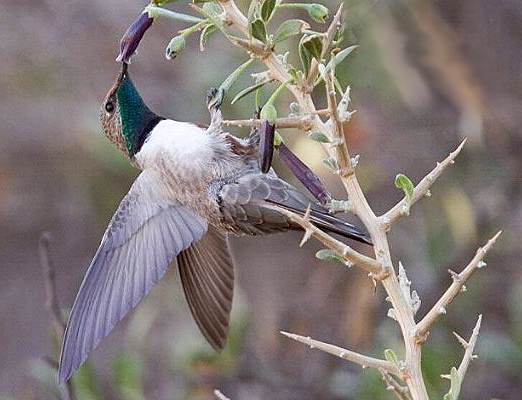
Giant Hummingbird
Patagona gigas
Order: Apodiformes / Family: Trochilidae

Wikimedia Commons
About the Giant Hummingbird
The Giant Hummingbird, scientifically known as Patagona gigas, stands out as the largest member of the hummingbird family, Trochilidae. This impressive bird, measuring up to 23 centimeters in length, inhabits the high-altitude regions of the Andes in South America. Found from northern Ecuador to central Chile and Argentina, it thrives in open habitats such as montane scrublands, dry valleys, and forest edges, often at elevations between 2,000 and 4,000 meters. The Giant Hummingbird plays a crucial ecological role as a pollinator, particularly for tubular flowers adapted to its long, specialized bill. Its range includes the arid and semi-arid zones, where its presence indicates healthy ecosystems capable of supporting diverse plant life. During the breeding season, which varies slightly depending on the locality, these birds engage in territorial displays and vigorous courtship flights over their chosen territories. The Giant Hummingbird is especially significant for its ability to survive in environments with extreme temperature fluctuations between day and night, a testament to its adaptability. As the seasons change, Patagona gigas may move locally in response to flowering patterns, though it is generally considered non-migratory. Its preference for open landscapes allows it to avoid dense forests, which are less ideal for its low-speed, energy-efficient flight. Despite its size, this hummingbird exhibits the characteristic agility and precision of its family, making it a fascinating subject for both birdwatchers and researchers. Observations of the Giant Hummingbird reveal a creature perfectly adapted to its niche, balancing energy expenditure with the demands of high-altitude living. Its interactions with the environment, from feeding strategies to nesting habits, highlight the intricate dynamics of Andean ecosystems. By pollinating a range of flowering plants, it supports biodiversity and the health of its habitat, underscoring the interconnectedness of Andean flora and fauna. The Giant Hummingbird's survival and reproductive success are closely tied to the availability of nectar resources, which in turn are influenced by climate and human activity. As such, this bird serves as an indicator species for the state of its environment, with its presence reflecting the ecological balance of its mountainous home.
The Giant Hummingbird belongs to the family Trochilidae, within the order Apodiformes. These birds typically live average 5-7 years with a max recorded of 12 years.
How to Identify a Giant Hummingbird
The Giant Hummingbird is unmistakable due to its large size, which can reach up to 23 centimeters in length, dwarfing other hummingbirds. Its plumage is primarily a muted olive-green with a lighter buff underbelly, offering excellent camouflage in its natural habitat. The wings are long and narrow, adapted for sustained flight at high altitudes, and the tail is relatively short and squared. Distinguishing between males and females can be challenging, as both sexes share similar coloration, though males may exhibit slightly more iridescence. Juveniles resemble adults but can appear slightly duller. In flight, the Giant Hummingbird's silhouette is unique, characterized by slow wing beats that contrast sharply with the rapid fluttering typical of smaller hummingbirds. When perched, it maintains an upright posture, often on exposed branches or utility lines, providing a clear view of its robust form. Observers might confuse it with other large birds, but its hovering capability and elongated bill are definitive identifiers. The flight pattern of Patagona gigas is deliberate and powerful, unlike the frenetic movement of smaller hummingbirds, making it easier to spot and track in open areas.
Having trouble telling birds apart? Upload a photo to our bird identification tool for an instant species match.
Giant Hummingbird Habitat and Range
Preferred Habitat
The Giant Hummingbird inhabits the montane regions of the Andes, preferring open landscapes such as arid scrublands, high-altitude valleys, and forest peripheries. It thrives at elevations ranging from 2,000 to 4,000 meters where temperatures can vary dramatically. This bird adapts to environments with sparse vegetation, often seen in areas with flowering plants suited to its feeding habits. Seasonal shifts may lead it to slightly different altitudes or areas within its range, depending on the availability of nectar. While it primarily occupies rural, undisturbed habitats, it occasionally ventures into urban areas, especially in gardens that feature suitable flowering plants. Its presence in urban settings, however, is less frequent compared to more remote and natural environments, where it can find ample food sources.
Geographic Range
The Giant Hummingbird's range extends along the Andes from northern Ecuador through Peru, and Bolivia, reaching as far south as central Chile and Argentina. In these regions, it is a year-round resident, with no significant long-distance migration patterns. However, local altitudinal movements may occur in response to the seasonal availability of flowers. In Ecuador and Peru, it is found in the highland areas, while in Bolivia, it occupies both the altiplano and the eastern slopes of the Andes. In Chile and Argentina, its presence is more common in the central regions, where it frequents the Andean foothills. Population density hotspots are typically associated with areas rich in flowering plants, which provide the necessary nectar resources for sustenance. The bird's distribution is patchy, reflecting the fragmented nature of suitable habitats along the Andes.
Want to know which birds visit your area? Browse our backyard birds by location guides for region-specific species lists.
What Does the Giant Hummingbird Eat?
The primary diet of the Giant Hummingbird consists of nectar from a variety of flowering plants, particularly those with tubular blooms that match its bill shape. Common food sources include species of the genera Puya and Salvia, among others. During different seasons, the bird's diet may shift slightly as it exploits the flowering peaks of various plants. In addition to nectar, the Giant Hummingbird supplements its diet with small insects and spiders, which provide essential proteins. This opportunistic feeding behavior involves probing flowers with its long bill and occasionally catching insects in flight. The Giant Hummingbird typically feeds during daylight hours, with peak activity in the early morning and late afternoon when flowers are most productive. Its feeding schedule ensures efficient energy intake, critical for survival in high-altitude environments.
Want to attract Giant Hummingbirds to your yard? See our recommended feeders and seed types for the best results.
Giant Hummingbird Behavior and Social Structure
The Giant Hummingbird exhibits solitary and territorial behaviors, especially during the breeding season. Males establish and defend feeding territories, often engaging in aerial displays and vocalizations to ward off intruders. These displays can include rapid ascents and descents, showcasing the bird's agility. Courtship involves intricate flight patterns and singing to attract mates. Outside the breeding season, the Giant Hummingbird remains largely solitary, although it may occasionally be seen in loose aggregations around abundant food sources. Its response to predators involves swift, evasive maneuvers and retreating to cover. Daily activities revolve around feeding, with periods of rest in sheltered perches to conserve energy. This hummingbird is diurnal, with most activity occurring during daylight. Its ability to enter a torpid state at night helps it conserve energy in the cold Andean climate.
Giant Hummingbird Nesting and Reproduction
The Giant Hummingbird constructs cup-shaped nests using plant fibers, moss, and spider silk, often positioned on a ledge or in a shrub. These nests are typically found at moderate heights, providing protection from ground predators. The female lays one to two eggs per clutch, which she incubates for about 14-18 days. During this period, the female assumes all nesting duties, including incubation and feeding of the hatchlings. The young fledge approximately 20-25 days after hatching, although they remain dependent on the mother for a short period post-fledging. The species typically raises one brood per year, although in favorable conditions, a second brood may occur. Nest placement and construction are crucial for the survival of the eggs and chicks, given the harsh environmental conditions of the high Andes.
Giant Hummingbird Sounds and Vocalizations
The vocalizations of the Giant Hummingbird include a series of high-pitched, metallic notes that form its primary song. These sounds are often described as squeaky and repetitive, lacking the melodic quality of some other bird songs. Its calls serve various purposes, from marking territory to attracting mates. Alarm calls are sharper and more urgent, used to alert nearby birds of potential threats. During the dawn chorus, the Giant Hummingbird is less prominent compared to other species, but its distinctive calls can still be identified by seasoned birders. These vocalizations, while not complex, play a vital role in the bird's communication repertoire.
Interesting Facts About the Giant Hummingbird
- 1The Giant Hummingbird's wings can beat as slowly as 10-15 times per second, a stark contrast to smaller hummingbirds that might reach 80 beats per second.
- 2Despite its size, the Giant Hummingbird still exhibits the hovering capabilities typical of hummingbirds, though with a more languid flight style.
- 3The Giant Hummingbird can weigh up to 20 grams, making it more than twice as heavy as some of its smaller relatives.
- 4This species is one of the few hummingbirds capable of enduring the cold nights of the Andean highlands by entering a state of torpor.
- 5The bird's long bill is specially adapted for feeding on elongated flowers, allowing it to access nectar that less specialized birds cannot reach.
- 6The Giant Hummingbird's range covers a vast area along the Andes, spanning several countries and diverse ecosystems.
- 7While primarily nectarivorous, the Giant Hummingbird's diet includes insects and spiders, providing much-needed proteins and nutrients.
Giant Hummingbird Conservation Status
The Giant Hummingbird currently holds a status of Least Concern according to the IUCN Red List, with a stable population trend. However, localized threats such as habitat destruction, climate change, and agricultural expansion pose challenges to its survival. Conservation efforts focus on protecting habitats and ensuring the availability of key nectar-producing plants. Historically, the species has maintained a stable population, but ongoing environmental pressures require monitoring. Efforts to raise awareness about its ecological importance and the need for habitat preservation are essential for its continued well-being.
Attracting Giant Hummingbirds to Your Feeder
The Giant Hummingbird is a regular visitor to backyard bird feeders across its range. At the Eye On The Fly feeding station, we observe Giant Hummingbirds regularly and capture footage with our feeder cameras.
Other Trochilidae Species


Birds Similar to the Giant Hummingbird
These species are often confused with the Giant Hummingbird due to similar appearance or overlapping range.