
Glaucidium minutissimum
Glaucidium minutissimum
Order: Strigiformes / Family: Strigidae
Wikimedia Commons
About the Glaucidium minutissimum
The Glaucidium minutissimum, also referred to as the Least Pygmy Owl, is one of the smallest owl species in the world. As a member of the Strigidae family, this owl plays a vital role in the ecosystems it inhabits, primarily within the dense, tropical forests of the Amazon Basin. It is found predominantly in Brazil but also makes its presence known in parts of Bolivia and Peru. Its small size and cryptic coloration make it a master of disguise among the foliage, where it actively contributes to controlling insect and small vertebrate populations.
The ecological significance of the Glaucidium minutissimum cannot be understated. By preying on insects and small vertebrates, this owl helps maintain a balanced ecological community. Its activity peaks at dusk and dawn, times when many of its prey are most active. This owl's choice of habitat within dense forests offers it ample cover from larger predators while providing a rich food source.
Seasonally, the Glaucidium minutissimum exhibits slight behavioral shifts. During breeding periods, it becomes more vocal, which aids in territorial defense and mate attraction. Its calls, though subtle, resonate through the forest, informing other owls of its presence. The Least Pygmy Owl does not migrate, instead remaining in its tropical home year-round. This stability allows it to exploit the consistent availability of prey and suitable nesting sites throughout the year.
The Glaucidium minutissimum belongs to the family Strigidae, within the order Strigiformes. These birds typically live average 4-6 years, maximum recorded 9 years..
How to Identify a Glaucidium minutissimum
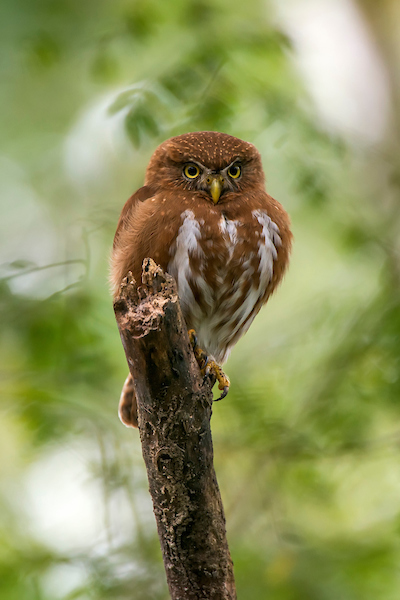
The adult Glaucidium minutissimum is a marvel of avian camouflage, with plumage that blends seamlessly into its forest surroundings. Its upperparts display a rich, mottled brown, while the underparts are lighter with faint streaking. This coloration helps it remain inconspicuous against tree bark and foliage. The owl's round head lacks ear tufts, a feature common in many other owl species.
Juvenile Glaucidium minutissimums resemble adults in pattern but often have a slightly fluffier appearance, with softer feathering that gradually gives way to the sleek plumage of maturity. There is little sexual dimorphism in this species, though females are typically marginally larger than males.
Among other owls, the Glaucidium minutissimum might be confused with the Ferruginous Pygmy Owl due to its small size and coloration. However, the Least Pygmy Owl is distinctly smaller and lacks the false eyespots on the nape that are present in its relative. When in flight, this owl's silhouette is compact, with rapid wingbeats typical of small birds. Its perching posture is upright, often motionless, as it surveys for prey.
Having trouble telling birds apart? Upload a photo to our bird identification tool for an instant species match.
Glaucidium minutissimum Habitat and Range
Preferred Habitat
The Glaucidium minutissimum inhabits dense, tropical lowland forests, where it can find ample cover and food resources. It is most often found in the Amazon Basin, favoring areas with a dense canopy and minimal human disturbance. These forests provide the necessary cover for roosting and nesting, as well as a rich diversity of prey species.
Typically, this owl lives at low elevations, rarely venturing into mountainous regions. It may be found near the edges of forests, where it can access clearings for hunting. Despite its preference for thick forests, the Glaucidium minutissimum occasionally appears in secondary growth areas, particularly if these regions offer similar cover and prey availability.
Unlike some owl species, the Glaucidium minutissimum does not frequently inhabit urban areas, as it relies heavily on the complex structure and resources of forest environments. Seasonal shifts in habitat use are minimal, given the stable climate of its tropical range.
Geographic Range
The Glaucidium minutissimum primarily resides in the northern parts of South America. Its range encompasses the vast expanses of the Amazon Rainforest, covering countries such as Brazil, Peru, and Bolivia. This owl's presence is most concentrated in the Brazilian Amazon, a region known for its high biodiversity and dense forest cover.
While the Glaucidium minutissimum is considered non-migratory, its distribution is somewhat patchy within its range. It tends to inhabit areas where forest density offers sufficient cover and food availability. During the breeding season, these owls might concentrate in areas with abundant nesting sites, although they are generally distributed throughout their range year-round.
Population density hotspots include regions with extensive, undisturbed forest cover. These areas provide optimal conditions for nesting, roosting, and hunting. In some parts of its range, conservation efforts are crucial to maintaining these habitats, ensuring that the Glaucidium minutissimum continues to thrive.
Want to know which birds visit your area? Browse our backyard birds by location guides for region-specific species lists.
What Does the Glaucidium minutissimum Eat?
The diet of the Glaucidium minutissimum primarily consists of insects and small vertebrates, making it an important predator of these groups in its ecosystem. Insects, such as beetles and moths, form the bulk of its diet, especially during the wetter months when these prey are most abundant.
The owl also hunts small vertebrates, including lizards and small rodents, which it captures using its keen eyesight and silent flight. The Glaucidium minutissimum employs a sit-and-wait strategy, perching quietly until suitable prey comes into view, then launching a swift attack.
During the dry season, when insect activity may decrease, the owl might rely more heavily on vertebrate prey. Its ability to adapt its diet seasonally is key to its survival in the varied conditions of the tropical forest. Feeding primarily occurs during crepuscular hours, aligning with peak activity times for many of its prey species.
Glaucidium minutissimum Behavior and Social Structure
The Glaucidium minutissimum exhibits a predominantly solitary lifestyle, aligning with its highly territorial nature. During the breeding season, males become particularly vocal, using a series of high-pitched notes to establish territories and attract females. These calls can be heard echoing through the forest, serving as an auditory signal to potential mates and rivals alike.
Territorial disputes are common, with males often engaging in vocal duels or even physical confrontations to defend their domain. Outside of the breeding season, the Glaucidium minutissimum remains primarily solitary, focusing on hunting and maintaining its territory.
Despite its solitary tendencies, this owl exhibits a high level of alertness to potential predators, including larger birds of prey. When threatened, it uses its small size and camouflage to remain hidden, often opting for concealment over confrontation. Daily activity peaks during crepuscular hours, aligning with the activity of its prey.
Glaucidium minutissimum Nesting and Reproduction
The Glaucidium minutissimum prefers to nest in natural cavities within trees, utilizing the dense forest environment to conceal its nesting site from predators. These cavities are often old woodpecker holes or natural hollows that provide sufficient shelter and protection.
Females lay a clutch of 2 to 4 eggs, with incubation lasting around 28 days. During this period, the female remains with the eggs, while the male is responsible for hunting and bringing food to the nest. After hatching, both parents participate in feeding and caring for the young.
Fledging occurs approximately four weeks after hatching, at which point the young begin to explore their surroundings more independently. The Glaucidium minutissimum typically raises one brood per year, with breeding activity occurring primarily during the warmer months when food resources are abundant.
Glaucidium minutissimum Sounds and Vocalizations
The primary song of the Glaucidium minutissimum is a series of high-pitched, repetitive notes that carry well through the forest. These notes have a rhythmic, almost mechanical quality, providing an effective means of communication over long distances. The song serves both to attract mates and to mark territory boundaries.
In addition to its primary song, this owl emits softer call notes used in close-range communication with mates or during interactions with fledglings. Alarm calls are sharp and piercing, designed to alert nearby owls to potential threats.
During the early morning and evening hours, when the forest is quieter, the Glaucidium minutissimum's calls are most noticeable. Its vocalizations contribute to the ambient soundscape of its tropical forest habitat, a reminder of its presence even when it remains unseen.
Interesting Facts About the Glaucidium minutissimum
- 1The Glaucidium minutissimum is one of the smallest owl species globally, measuring just about 15 cm in length.
- 2Despite its tiny size, the Glaucidium minutissimum is a fierce predator of insects and small vertebrates.
- 3This owl's camouflage is so effective that it can be challenging to spot even when it's just a few feet away.
- 4The Glaucidium minutissimum relies on its acute hearing to locate prey in the dense, noisy rainforest.
- 5Unlike many owls, the Glaucidium minutissimum is active during both dawn and dusk, taking advantage of peak prey activity times.
- 6The Glaucidium minutissimum's call is often mistaken for that of insects due to its high pitch and rhythmic quality.
- 7This owl does not migrate, remaining in its tropical forest habitat throughout the year, showcasing its adaptation to stable tropical climates.
Glaucidium minutissimum Conservation Status
Currently, the Glaucidium minutissimum is classified as Least Concern by the IUCN, reflecting its stable population trend across its range. However, habitat destruction, particularly deforestation in the Amazon Basin, poses a significant threat to its long-term survival. Conservation efforts focus on preserving large tracts of undisturbed forest habitat, which are crucial for maintaining viable populations. Organizations working in the Amazon prioritize habitat protection and restoration to ensure that species like the Glaucidium minutissimum can continue to thrive. Historically, the owl's population has remained relatively stable, though ongoing threats from habitat loss could alter this trend. Continued conservation efforts are essential to prevent future declines and to maintain the ecological integrity of its forest habitat.


