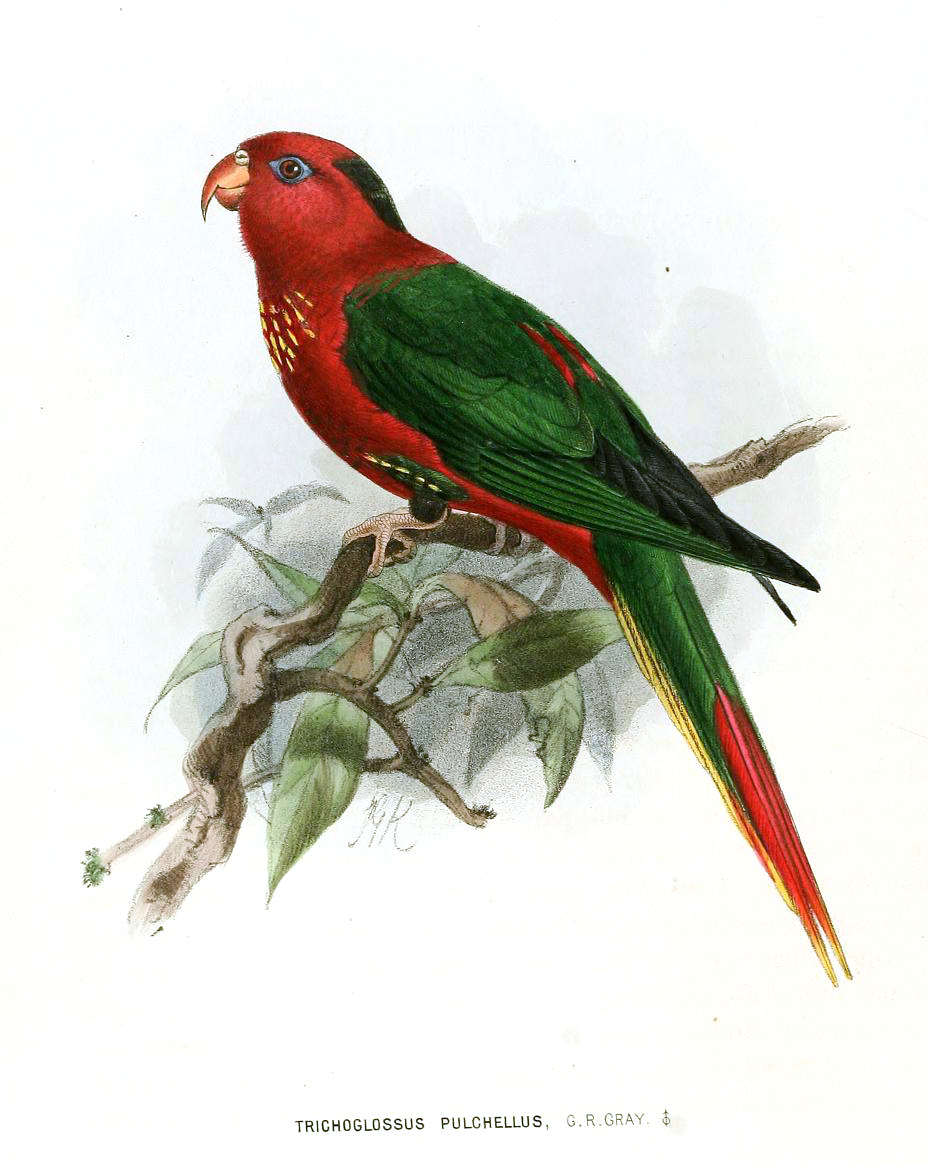
Goldie's Lorikeet
Glossoptilus goldiei
Order: Psittaciformes / Family: Psittaculidae

Wikimedia Commons
About the Goldie's Lorikeet
Goldie's Lorikeet, scientifically known as Glossoptilus goldiei, is a small, visually captivating parrot that inhabits the humid montane forests of New Guinea. Its vibrant plumage, which consists of green, red, and yellow hues, makes it a standout resident of its native ecosystem. Found primarily in Papua New Guinea, Goldie's Lorikeet thrives in the dense canopy of rainforest habitats where it plays a crucial role in pollination and seed dispersal. Often seen flitting among flowering trees, these lorikeets exhibit remarkable agility and a keen ability to forage for nectar and pollen. As a key species within its habitat, Goldie's Lorikeet contributes significantly to the health and diversity of the forest ecosystem.
Goldie's Lorikeet is significant not only for its ecological role but also for its cultural importance among the indigenous peoples of New Guinea. The bird's feathers are sometimes used in traditional adornments, highlighting its value beyond ecological contributions. The lorikeet's presence in the region is representative of the rich biodiversity inherent to New Guinea's montane forests, where it is one of many species that depend on the interconnectedness of the tropical environment. In particular, Goldie's Lorikeet's reliance on flowering trees underscores the importance of preserving these habitats against deforestation and human encroachment.
In their natural habitat, Goldie's Lorikeets are known for their seasonal movements, often following the flowering patterns of trees which dictate their foraging routes. Their movements are not migratory in the traditional sense but are instead driven by the availability of resources within their range. This adaptability allows them to exploit various forest layers, ensuring their survival even when specific food sources are scarce. Goldie's Lorikeet's ability to adapt to these changes underscores its resilience and highlights the dynamic nature of New Guinea's montane ecosystems.
The Goldie's Lorikeet belongs to the family Psittaculidae, within the order Psittaciformes. These birds typically live approximately 10-15 years in the wild, up to 20 years in captivity..
How to Identify a Goldie's Lorikeet
Goldie's Lorikeet is a small parrot, measuring approximately 19 cm in length, with a predominantly green plumage that serves as excellent camouflage among the leaves. The bird's head is adorned with a striking red crown, bordered by a yellow band that extends down the sides of the face. Its breast is a vibrant mix of red and yellow, creating a visually stunning contrast against its green body. Juvenile lorikeets have a more subdued appearance, with less pronounced red on the head and a generally duller overall coloration, which gradually brightens as they mature into adults. Differentiating between male and female Goldie's Lorikeets is challenging due to their similar plumage, but subtle size differences may be observed, with males being slightly larger on average.
When in flight, Goldie's Lorikeet displays a rapid, direct flight pattern characterized by quick wingbeats and short glides. Its wings, while primarily green, show a flash of yellow under the primaries, adding to its distinctive silhouette. On the perch, the lorikeet's upright posture and active demeanor make it a lively presence in the canopy. Confusion with similar species such as the Papuan Lorikeet may occur, but Goldie's Lorikeet's unique combination of red and yellow on the head and breast helps birders distinguish it with ease.
Having trouble telling birds apart? Upload a photo to our bird identification tool for an instant species match.
Goldie's Lorikeet Habitat and Range
Preferred Habitat
Goldie's Lorikeet thrives in the montane rainforests of New Guinea, preferring elevations ranging from 1000 to 2300 meters. These forests, characterized by high humidity and dense canopy cover, provide the ideal environment for the lorikeet's nectarivorous lifestyle. Within these habitats, the lorikeet is most commonly found in areas with abundant flowering trees, which serve as its primary food source.
While Goldie's Lorikeet primarily inhabits remote forested regions, it can occasionally be found in secondary forests and along forest edges, especially in areas where flowering trees are plentiful. Unlike some parrot species, Goldie's Lorikeet shows little adaptation to urban environments, remaining closely tied to its native montane forest habitats.
Geographic Range
Goldie's Lorikeet is endemic to the island of New Guinea, predominantly within the borders of Papua New Guinea. Its distribution includes the eastern parts of the island, where it frequents montane forests across several mountain ranges. The lorikeet does not undertake long-distance migrations, but instead exhibits altitudinal movements in response to the availability of food resources, particularly flowering trees.
While its range is somewhat restricted, within its preferred habitat, the Goldie's Lorikeet can be relatively common, especially in areas with abundant food sources. However, its population density varies across its range, with certain montane regions supporting higher concentrations of these lorikeets due to favorable environmental conditions.
Want to know which birds visit your area? Browse our backyard birds by location guides for region-specific species lists.
What Does the Goldie's Lorikeet Eat?
Goldie's Lorikeet primarily feeds on nectar and pollen, making it a specialized nectarivore well-suited to the rich floral diversity of New Guinea's montane forests. It exhibits a preference for the flowers of eucalyptus, syzygium, and melaleuca trees, among others, which provide essential nutrients and energy. These lorikeets use their brush-tipped tongues to efficiently extract nectar from deep within flowers, a technique that also aids in the pollination of the plants they visit.
In addition to nectar, Goldie's Lorikeet supplements its diet with fruits and, on occasion, small insects and larvae. This varied diet ensures that the lorikeet can adapt to seasonal fluctuations in flower availability, allowing it to maintain a stable food intake throughout the year. The bird typically forages in the morning and late afternoon, avoiding the midday heat and taking advantage of peak nectar production times.
Goldie's Lorikeet Behavior and Social Structure
Goldie's Lorikeet exhibits a highly social and active behavior, often seen in pairs or small flocks that move noisily through the treetops. These flocks are not rigidly structured, with individuals coming and going as they please, depending on the availability of food resources. The lorikeet's social structure is fluid, allowing for flexibility in locating food and avoiding overcrowding.
Territorial behavior is minimal, with Goldie's Lorikeet often sharing feeding sites with other nectarivorous birds. During the breeding season, however, pairs may become more territorial, defending nesting sites from potential intruders. Courtship displays include mutual preening and the exchange of food, strengthening pair bonds.
The lorikeet's response to predators involves a combination of swift flight and vocal alarm calls, alerting flock members to the presence of a threat. While mostly active during the day, these birds exhibit peak activity during the cooler parts of the morning and late afternoon, aligning their feeding schedules with flower nectar production.
Goldie's Lorikeet Nesting and Reproduction
Goldie's Lorikeet typically nests in tree hollows, selecting sites high in the canopy to avoid ground-based predators. These hollows, often formed in older trees through natural decay processes, provide secure and sheltered environments for raising young. The lorikeet's nesting materials consist of chewed wood pulp and leaves, which create a soft lining for the eggs.
A typical clutch consists of two to three eggs, which the female incubates for approximately 23 days. During this period, the male plays a supportive role, providing food for the incubating female. Once hatched, the chicks remain in the nest for about seven to eight weeks, receiving care and feeding from both parents. Goldie's Lorikeet usually raises one brood per year, although in particularly favorable conditions, a second brood may be attempted.
Goldie's Lorikeet Sounds and Vocalizations
The vocalizations of Goldie's Lorikeet are characterized by a series of high-pitched, chattering calls that serve as communication between flock members. Its primary song consists of repetitive, melodic notes, creating a musical quality that resonates through the forest canopy. These calls, often described as tinkling or bell-like, are most pronounced during the dawn chorus when the lorikeets are most active.
In addition to their melodic songs, Goldie's Lorikeets emit harsher alarm calls in response to perceived threats, alerting other birds in the vicinity. These calls are short and sharp, serving as a warning to both flock members and potential predators.
Interesting Facts About the Goldie's Lorikeet
- 1Goldie's Lorikeet can consume up to four times its body weight in nectar daily, highlighting its role as a key pollinator.
- 2The species was named after Andrew Goldie, a Scottish naturalist who first collected specimens in the late 19th century.
- 3Goldie's Lorikeet is one of the few bird species that uses a brush-tipped tongue, which is perfectly adapted for nectar feeding.
- 4Despite their small size, these lorikeets are known for their loud, chattering calls that can be heard over long distances.
- 5In the wild, Goldie's Lorikeets often associate with other lorikeet species, forming mixed-species flocks in search of food.
Goldie's Lorikeet Conservation Status
Goldie's Lorikeet is currently listed as Least Concern by the IUCN, indicating a stable population across its range. However, the species faces potential threats from habitat loss due to logging and land conversion for agriculture. Conservation efforts focus on preserving the integrity of New Guinea's montane forests, which are crucial for the continued survival of this and many other species. Historical population trends suggest that while some local declines have occurred, the overall population remains viable due to the lorikeet's adaptability to changes within its forested environment. Ongoing monitoring and habitat protection are essential to ensure the long-term conservation of Goldie's Lorikeet.