
Gray-crested Tit
Lophophanes dichrous
Order: Passeriformes / Family: Paridae
Wikimedia Commons
About the Gray-crested Tit
The Gray-crested Tit, scientifically known as Lophophanes dichrous, is a captivating bird species within the family Paridae. This small songbird inhabits the high-altitude regions of the Himalayas, predominantly found in countries such as India, Nepal, Bhutan, and parts of China. Its presence in these montane forests is a testament to its adaptability to the rugged and often harsh environments typical of these altitudes. The Gray-crested Tit plays a significant ecological role within its habitat. As an insectivore, it helps to control insect populations, thus maintaining the ecological balance within its environment. During the breeding season, which usually spans from April to June, this bird becomes more territorial and can often be seen engaging in lively displays and vocal communications with its mate and rivals. Its choice of habitat is typically characterized by dense coniferous forests, where it finds ample opportunities for nesting and foraging. In seasonal movements, the Gray-crested Tit may descend to lower altitudes during harsh winter months, although it is generally considered a resident species. This bird's adaptability to different altitudinal zones ensures its survival through the fluctuating climates of its mountainous terrain. Observations of the Gray-crested Tit reveal that it often joins mixed-species foraging flocks, which enhances its foraging efficiency and provides additional protection against predators. This social behavior is particularly noticeable outside of the breeding season, highlighting its flexible survival strategies. The ecological interactions of the Gray-crested Tit with other species, including its participation in mixed-species flocks, underscore its importance in maintaining the biodiversity of its habitat. Understanding these dynamics is crucial for conservation efforts aimed at preserving the delicate ecosystems of the Himalayan region.
The Gray-crested Tit belongs to the family Paridae, within the order Passeriformes. These birds typically live average 2-3 years, with a maximum recorded of 7 years..
How to Identify a Gray-crested Tit
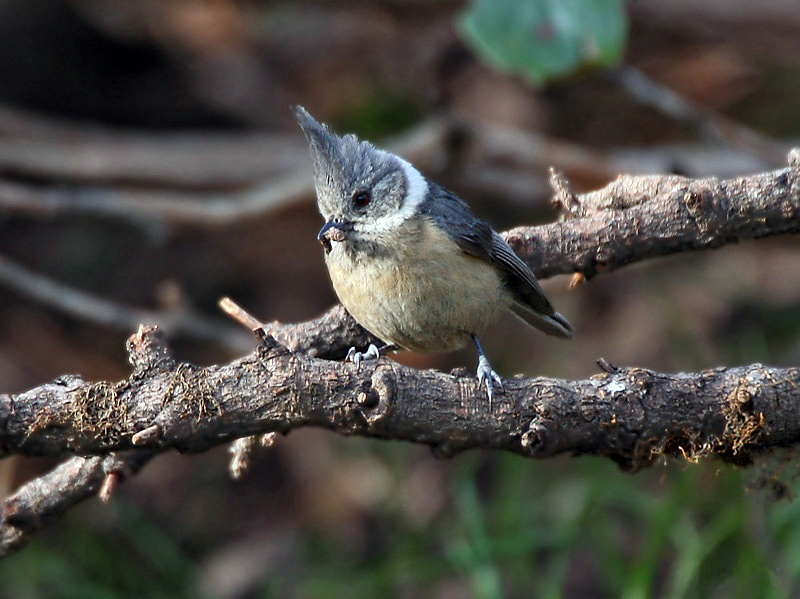
The Gray-crested Tit is a small bird, roughly 13 cm in length, with a distinctive gray crest that gives it its common name. Adults of both sexes display a similar plumage pattern, characterized by a grayish-brown back, pale underparts, and a prominent, darker gray crest and nape. The cheeks and throat are white, contrasting with a narrow black bib. Juvenile Gray-crested Tits resemble adults but have a slightly duller plumage and less defined markings. In terms of sexual dimorphism, there are no significant differences between males and females, which can make field identification reliant more on behavior and vocalizations than on physical characteristics. When perched, the Gray-crested Tit often adopts an upright posture, allowing its crest to remain conspicuous. In flight, its short, rounded wings and relatively long tail give it a distinctive silhouette that can be recognized by experienced birders. The Gray-crested Tit might be confused with similar species like the Coal Tit (Periparus ater) found in overlapping ranges, but it can be distinguished by its larger size and the absence of a white nape spot.
Having trouble telling birds apart? Upload a photo to our bird identification tool for an instant species match.
Gray-crested Tit Habitat and Range
Preferred Habitat
The Gray-crested Tit primarily inhabits montane forests, with a preference for coniferous and mixed woodlands. These habitats are typically found at elevations ranging from 2,400 to 3,600 meters. Within these forests, they favor areas with dense canopy cover, which provides ample foraging opportunities and protection. During winter, some populations may move to slightly lower elevations, taking advantage of less harsh conditions. While primarily a forest dweller, the Gray-crested Tit can occasionally venture into adjacent scrublands or meadows. Although not commonly found in urban settings, it may appear in rural areas close to its natural habitat, especially where gardens or orchards provide additional food resources. Its presence in such areas underscores its adaptability, although it remains primarily associated with remote, forested regions.
Geographic Range
The Gray-crested Tit's range is primarily confined to the Himalayan region, stretching across northern India, Nepal, Bhutan, and southeastern Tibet. Within this range, it occupies suitable habitats at high altitudes, making it a species strongly associated with montane environments. The bird's breeding range aligns closely with its overall distribution, as it does not typically engage in long-distance migrations. However, in response to seasonal changes, particularly harsh winters, some populations may undertake altitudinal migrations, moving to lower elevations to avoid severe weather. Despite this, the Gray-crested Tit is generally considered a resident species within its range. Population densities are highest in areas with mature forest stands, where the availability of food and nesting sites supports larger numbers. While not evenly distributed throughout its range, certain hotspots, such as the central and eastern Himalayas, boast more robust populations.
Want to know which birds visit your area? Browse our backyard birds by location guides for region-specific species lists.
What Does the Gray-crested Tit Eat?
The diet of the Gray-crested Tit primarily consists of insects and other small invertebrates, which it forages for with precision and agility. These birds often feed by gleaning insects from foliage and bark, employing their sharp, conical bills to pick out prey. During the breeding season, the demand for protein-rich food increases, leading to a heightened focus on caterpillars and other larvae. In addition to insects, the Gray-crested Tit supplements its diet with seeds, particularly during the winter months when insects are less abundant. This dietary flexibility allows the bird to thrive across its range, even as food availability fluctuates with the seasons. Foraging typically occurs in the morning and late afternoon, with the bird exhibiting an energetic and acrobatic approach, often hanging upside down to reach food.
Gray-crested Tit Behavior and Social Structure
The Gray-crested Tit exhibits a range of behaviors that reflect its adaptability and social nature. It is known for its active and inquisitive demeanor, often seen exploring various parts of its habitat in search of food. Socially, this bird tends to form small groups outside the breeding season, frequently joining mixed-species flocks. This behavior not only increases foraging efficiency but also provides better protection against predators, as more eyes can detect threats. During the breeding season, the Gray-crested Tit becomes more territorial, with pairs establishing and defending nest sites against intruders. Courtship involves elaborate displays, including vocalizations and physical posturing, aimed at strengthening pair bonds. The bird's response to predators is typically characterized by alarm calls, which alert nearby conspecifics and other species to the presence of a threat. Daily activity patterns show that the Gray-crested Tit is most active during the early morning and late afternoon, times when it engages in foraging and social interactions.
Gray-crested Tit Nesting and Reproduction
The Gray-crested Tit prefers to nest in tree cavities, often choosing sites that provide adequate protection from predators and harsh weather conditions. Natural cavities in old trees or abandoned woodpecker holes are common nesting locations. The nest itself is constructed with an array of materials, including moss, feathers, and animal hair, creating a soft and insulated environment for the eggs. Typically, a clutch consists of 4 to 6 eggs, which are incubated primarily by the female. The incubation period lasts about 14 days, during which the male plays a crucial role in provisioning the female with food. After hatching, both parents participate in feeding the chicks, which fledge roughly 18 to 20 days after hatching. In a single breeding season, the Gray-crested Tit may attempt to raise two broods, depending on environmental conditions and food availability.
Gray-crested Tit Sounds and Vocalizations
The Gray-crested Tit is vocal, with a repertoire that includes various calls and songs. Its primary song consists of a series of clear, high-pitched notes delivered at regular intervals, often described as a 'chee-chee-chee.' These songs serve multiple functions, including territory establishment and mate attraction. In addition to its song, the Gray-crested Tit employs a variety of call notes, such as short, sharp 'tic' sounds used for communication within flocks. Alarm calls, often a harsh 'churr,' are emitted in response to predators, serving to alert other birds in the vicinity. During the dawn chorus, the Gray-crested Tit's vocalizations contribute to the symphony of sounds that characterize early morning in its habitat, blending with the songs of other forest inhabitants.
Interesting Facts About the Gray-crested Tit
- 1The Gray-crested Tit can be found at altitudes as high as 3,600 meters, showcasing its adaptation to high mountain environments.
- 2Despite its small size, the Gray-crested Tit plays a crucial role in controlling insect populations in its native habitats.
- 3The species is known to participate in mixed-species flocks, a behavior that enhances foraging success and predator avoidance.
- 4Gray-crested Tits have a relatively long lifespan for small passerines, often living up to 8 years in the wild.
- 5Their ability to use a variety of nesting sites, including man-made structures, demonstrates significant adaptability.
- 6The Gray-crested Tit often nests in tree cavities, sometimes using old woodpecker holes as secure nesting sites.
- 7They are capable of producing two broods in a single breeding season, a strategy that helps maintain population numbers.
Gray-crested Tit Conservation Status
The Gray-crested Tit is currently classified as a species of Least Concern by the IUCN, reflecting a stable population trend. However, habitat loss due to deforestation and land-use changes poses potential threats to its long-term survival. Conservation efforts in the region focus on preserving forest habitats and promoting sustainable land management practices. Historically, the Gray-crested Tit has maintained stable numbers, although localized declines may occur in areas where habitat fragmentation is severe. Continued monitoring and protection of its montane forest habitat are essential to ensure the species remains widespread and abundant.
Other Paridae Species


Birds Similar to the Gray-crested Tit
These species are often confused with the Gray-crested Tit due to similar appearance or overlapping range.
