
Gray-faced Buzzard
Butastur indicus
Order: Accipitriformes / Family: Accipitridae
Wikimedia Commons
About the Gray-faced Buzzard
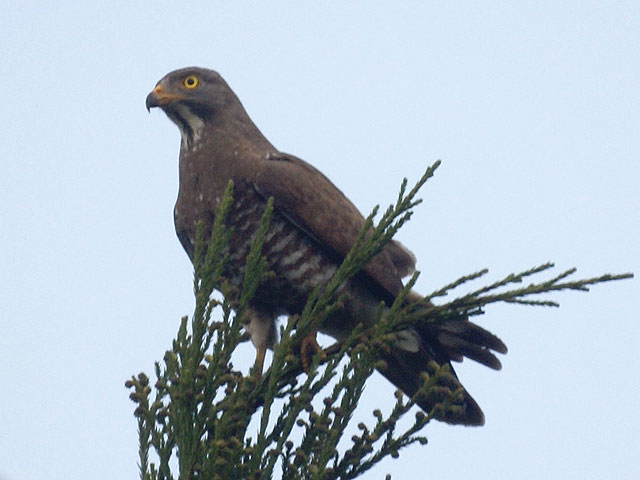
The Gray-faced Buzzard, scientifically recognized as Butastur indicus, holds a respected place in the raptor family, Accipitridae. This medium-sized bird of prey is notable for its striking gray face and sharp yellow eyes. Gray-faced Buzzards are found predominantly in Asia, where they are known for their seasonal migrations between breeding and wintering grounds. During the breeding season, they are primarily located in Japan, Korea, and parts of eastern China. These birds prefer open woodland and forested edges for nesting and rearing young. The Gray-faced Buzzard plays a crucial ecological role as a predator, controlling populations of small mammals, insects, and reptiles. Their presence indicates a healthy ecosystem, as they are sensitive to environmental changes and require ample prey and suitable habitats for survival. In winter, these buzzards migrate to southeastern Asia, including the Philippines, Indonesia, and Malaysia, where they inhabit agricultural lands and wetlands. The seasonal migration of the Gray-faced Buzzard is a remarkable spectacle. Large numbers of these birds travel thousands of kilometers along established flyways. This migration highlights their adaptability and the critical need for conservation of migratory corridors. As insect populations fluctuate throughout the year, the Gray-faced Buzzard exhibits dietary flexibility, shifting its diet according to seasonal availability. This adaptability ensures their survival and underscores their importance in maintaining ecological balance. The Gray-faced Buzzard's significance extends beyond its ecological role. It is a species of cultural importance in many regions, where it is celebrated in local folklore and art. Efforts to preserve this bird and its habitat are vital for maintaining biodiversity and supporting the intricate tapestry of life in the regions it inhabits.
The Gray-faced Buzzard belongs to the family Accipitridae, within the order Accipitriformes. These birds typically live average 10 years, with a maximum recorded of 15 years..
How to Identify a Gray-faced Buzzard
The Gray-faced Buzzard is easily identified by its gray facial plumage, contrasting with its brown and white streaked body. Adult birds exhibit a distinctive pale throat and chest, adorned with fine brown streaks, and their wings show a striking pattern of dark brown and white when seen in flight. Juvenile Gray-faced Buzzards, however, have a more subdued appearance with a less pronounced gray face and more extensive brown streaking on their chest and underparts. Males and females are similar in appearance, though females tend to be slightly larger. One can distinguish the Gray-faced Buzzard from similar species like the Common Buzzard by its slimmer build, longer wings, and the prominent gray face. In flight, the Gray-faced Buzzard shows a unique silhouette with its wings held in a slight dihedral and its long tail. When perched, it often adopts a horizontal posture, scanning its surroundings intently for prey.
Having trouble telling birds apart? Upload a photo to our bird identification tool for an instant species match.
Gray-faced Buzzard Habitat and Range
Preferred Habitat
Gray-faced Buzzards inhabit a variety of environments, ranging from deciduous and mixed forests to open woodlands and agricultural areas. They prefer forest edges and clearings where they can hunt effectively. During the breeding season, they are typically found at elevations up to 1,500 meters in Japan and Korea, utilizing both natural forests and areas modified by human activity. In winter, when they migrate to Southeast Asia, they are commonly spotted in rice fields, wetlands, and lowland forests. This seasonal shift illustrates their adaptability to different environments, though they rely heavily on areas with rich biodiversity. While the Gray-faced Buzzard can occasionally be observed in urban fringes, it predominantly thrives in rural landscapes where it can find ample prey.
Geographic Range
The breeding range of the Gray-faced Buzzard includes Japan, Korea, and eastern China, where they establish territories during the spring and summer months. As the colder months approach, they embark on a long migration to their wintering grounds in Southeast Asia. Countries such as the Philippines, Vietnam, Indonesia, and Malaysia serve as key winter habitats. During migration, these buzzards follow established routes across the East Asian-Australasian Flyway, where they can be seen in large flocks. Population density is highest in their breeding regions, especially in Japan, where they are a common sight in suitable habitats. While they are widespread across these regions, variations in local conditions and habitat availability can influence their density and distribution.
Want to know which birds visit your area? Browse our backyard birds by location guides for region-specific species lists.
What Does the Gray-faced Buzzard Eat?
The diet of the Gray-faced Buzzard primarily consists of small mammals, insects, and reptiles. They exhibit opportunistic feeding behavior, allowing them to adapt to the availability of prey. Insects, particularly grasshoppers and crickets, form a significant portion of their diet during the warmer months. In contrast, they may consume more rodents and small reptiles in other seasons. The Gray-faced Buzzard employs a sit-and-wait hunting strategy, often perching quietly before swooping down to capture its prey with precision. Prey size generally ranges from small insects to mammals equivalent in size to a small rat. Feeding typically occurs during daylight hours, with peak activity in the early morning and late afternoon when prey is more active.
Gray-faced Buzzard Behavior and Social Structure
Gray-faced Buzzards exhibit territorial behavior during the breeding season, with pairs establishing and defending territories vigorously. Courtship involves aerial displays and vocalizations, strengthening the pair bond. Outside the breeding season, they are more solitary, though small groups may form during migration for safety in numbers. These buzzards are diurnal, with most activities concentrated in the daylight hours. Their response to predators includes a series of alarm calls and evasive maneuvers. During migration, Gray-faced Buzzards often join flocks, capitalizing on thermals and updrafts to conserve energy during their long journeys. This social behavior during migration is a fascinating aspect of their life cycle.
Gray-faced Buzzard Nesting and Reproduction
Gray-faced Buzzards build nests in trees, preferring sites that offer a clear view of the surrounding area. Nests are composed of sticks and lined with softer materials such as leaves and grass. The female typically lays a clutch of 2-4 eggs, which both parents incubate for about 28-30 days. Once hatched, the chicks are fed by both parents and remain in the nest for approximately 35-40 days before fledging. During this period, the young are vulnerable to predation, making nest placement critical for their survival. The Gray-faced Buzzard usually raises one brood per year, though they may attempt a second if conditions are favorable.
Gray-faced Buzzard Sounds and Vocalizations
The vocalizations of the Gray-faced Buzzard serve as a vital component of its communication repertoire. Its primary call is a clear, whistling 'kee-kee-kee,' typically delivered during flight or when alarmed. This call is characterized by a rising and falling pitch, resembling a plaintive whistle. During the breeding season, they may also emit a series of sharp, repetitive notes as part of their courtship displays. Alarm calls are more urgent and rapid, alerting others to potential threats. The dawn chorus of the Gray-faced Buzzard is less elaborate than that of songbirds but plays an important role in territory establishment.
Interesting Facts About the Gray-faced Buzzard
- 1The Gray-faced Buzzard migrates over 3,000 kilometers between its breeding and wintering grounds each year.
- 2In Japan, the arrival of the Gray-faced Buzzard in spring is considered a symbolic herald of the season's change.
- 3Unlike many raptors, the Gray-faced Buzzard often hunts from a perch rather than soaring in the sky.
- 4The Gray-faced Buzzard's diet shifts seasonally, demonstrating an impressive adaptability to available food sources.
- 5During migration, these buzzards can be seen forming kettles, where hundreds of birds circle in thermals.
- 6Each year, the Gray-faced Buzzard completes a round-trip migration that covers a significant portion of eastern Asia.
- 7The species plays a vital role in controlling pest populations, benefiting agricultural regions.
Gray-faced Buzzard Conservation Status
The Gray-faced Buzzard is currently listed as Least Concern by the IUCN, with stable population trends across most of its range. However, habitat loss due to deforestation and agricultural expansion poses significant threats. Conservation efforts focus on protecting critical habitats and migratory corridors. Historical data indicate a steady population, but ongoing monitoring is essential to detect potential declines. International agreements and cooperation among range countries aim to ensure the protection of this species and its habitats.
Other Accipitridae Species


Birds Similar to the Gray-faced Buzzard
These species are often confused with the Gray-faced Buzzard due to similar appearance or overlapping range.

