
Greater Wagtail-Tyrant
Stigmatura budytoides
Order: Passeriformes / Family: Tyrannidae
Wikimedia Commons
About the Greater Wagtail-Tyrant
The Greater Wagtail-Tyrant (Stigmatura budytoides) is a small passerine bird belonging to the Tyrannidae family, commonly found in the open woodlands and shrublands of South America. This bird is renowned for its energetic tail-wagging behavior, which it uses as a form of communication and possibly to startle insects into flight. The Greater Wagtail-Tyrant plays a critical ecological role as an insectivore, helping to control populations of various arthropods across its habitat range. This bird predominantly inhabits the countries of Argentina, Bolivia, Brazil, Paraguay, and Uruguay, where it thrives in savanna-like environments and the edges of dry forests. During the breeding season, which typically occurs from September to December in the southern hemisphere, the Greater Wagtail-Tyrant becomes more territorial and active, engaging in elaborate courtship displays. Outside of the breeding season, it may join mixed-species foraging flocks, which enhances its foraging efficiency and provides protection from predators. This bird's adaptability to different habitats, including modified landscapes like agricultural areas and pastures, underscores its resilience. However, habitat loss due to agricultural expansion remains a concern. Observations of the Greater Wagtail-Tyrant can be particularly rewarding due to its active and conspicuous behavior. Birdwatchers often note its presence by listening for its distinctive calls and spotting its characteristic tail movements. Understanding the Greater Wagtail-Tyrant's role within its ecosystem highlights the intricate connections between species and their environments, emphasizing the importance of habitat conservation.
The Greater Wagtail-Tyrant belongs to the family Tyrannidae, within the order Passeriformes. These birds typically live average 4 years, with a maximum recorded of 6 years..
How to Identify a Greater Wagtail-Tyrant
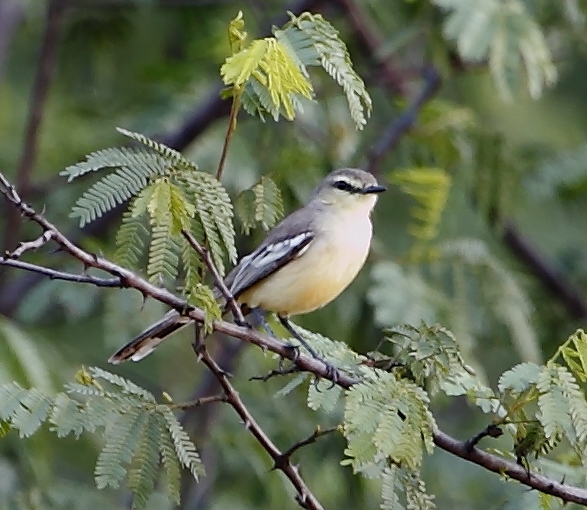
The Greater Wagtail-Tyrant measures about 14 cm in length, making it a small bird. Adults exhibit a predominantly grayish-brown plumage with a contrasting white throat and a pale-yellow belly, which becomes more vibrant during the breeding season. Their distinctive long tail, which they constantly wag, is marked with white on the outer feathers, providing a key field mark for identification. Juveniles resemble adults but tend to have duller plumage and less pronounced tail markings. Males and females appear similar, with no significant differences in plumage or size, making sexing in the field challenging. The species can be confused with the Lesser Wagtail-Tyrant, but the Greater Wagtail-Tyrant is generally larger and has a more vibrant yellow belly. In flight, the Greater Wagtail-Tyrant displays a rapid wingbeat and often fans its tail, showcasing the white outer tail feathers. When perched, it maintains an upright posture, often flicking its tail as a characteristic behavior.
Having trouble telling birds apart? Upload a photo to our bird identification tool for an instant species match.
Greater Wagtail-Tyrant Habitat and Range
Preferred Habitat
The Greater Wagtail-Tyrant primarily inhabits open woodlands, dry forests, and shrublands across South America. It is frequently found in the Chaco region, as well as in the subtropical and tropical dry forests of the Gran Chaco and Cerrado regions. The bird prefers areas with scattered trees and bushes, providing both cover and foraging opportunities. It is commonly found at elevations ranging from sea level up to 1,500 meters. During the breeding season, it seeks out more densely vegetated areas for nesting, although it remains in open habitats for much of the year. The Greater Wagtail-Tyrant adapts well to modified landscapes, including agricultural fields and pastures, where it can find suitable foraging grounds. Its presence in urban areas is limited, as it primarily favors rural environments with ample natural vegetation.
Geographic Range
The Greater Wagtail-Tyrant is a resident species throughout its range, with no significant migratory movements. Its range extends across central and eastern South America. Notably, it occupies the Chaco region, encompassing parts of northern Argentina, western Paraguay, southeastern Bolivia, and southwestern Brazil. The bird is also present in the Brazilian Cerrado, a vast tropical savanna ecoregion. In Argentina, it can be found from the provinces of Salta and Formosa in the north, down to Buenos Aires Province in the south. Population densities are highest in regions with intact natural habitats, although the species can also be found in areas with moderate human disturbance. Despite its adaptability, the Greater Wagtail-Tyrant's range does not extend into the densely forested Amazon Basin, as it prefers more open habitats.
Want to know which birds visit your area? Browse our backyard birds by location guides for region-specific species lists.
What Does the Greater Wagtail-Tyrant Eat?
The diet of the Greater Wagtail-Tyrant primarily consists of insects and other small arthropods. It actively forages by sallying from a perch to catch flying insects or by gleaning prey from foliage. Its favored prey includes beetles, ants, and spiders, which it hunts with agility and precision. During the breeding season, the bird's dietary intake increases to meet the nutritional demands of raising young, leading to a heightened focus on protein-rich prey. The Greater Wagtail-Tyrant adjusts its foraging strategy according to availability, sometimes following mixed-species flocks to exploit areas with abundant insect activity. The bird typically feeds during daylight hours, with peak activity occurring in the early morning and late afternoon when insects are most active.
Greater Wagtail-Tyrant Behavior and Social Structure
The Greater Wagtail-Tyrant exhibits a social structure that varies with the season. During the breeding season, these birds are territorial, with pairs establishing and defending nesting territories through vocalizations and displays. Courtship involves males performing aerial displays and presenting food to females as part of their mate attraction strategy. Outside the breeding season, the Greater Wagtail-Tyrant may form loose flocks, sometimes joining mixed-species groups that enhance foraging efficiency and offer greater protection against predators. Its characteristic tail-wagging behavior serves multiple functions: it may signal alertness to potential threats, attract mates, or flush insects from hiding. The bird's daily activities include periods of active foraging interspersed with rest and preening. The Greater Wagtail-Tyrant remains vigilant, utilizing its keen eyesight and agility to evade predators such as raptors.
Greater Wagtail-Tyrant Nesting and Reproduction
The Greater Wagtail-Tyrant constructs a cup-shaped nest, usually positioned in a shrub or low tree, often well-concealed by foliage. The nest is made from grass, twigs, and plant fibers, and it may be lined with softer materials like feathers or hair to provide insulation for the eggs. Clutch sizes typically range from two to three eggs, with both parents sharing incubation duties over a period of approximately 14 days. After hatching, the altricial chicks remain in the nest for about two weeks before fledging. Both parents contribute to feeding the young, bringing a steady supply of insects to the nest. The species generally produces one or two broods per year, with the possibility of more in regions with extended favorable conditions. Parental care continues for several weeks post-fledging, ensuring the young develop the necessary skills for independent survival.
Greater Wagtail-Tyrant Sounds and Vocalizations
The primary song of the Greater Wagtail-Tyrant is a series of sharp, rapid notes delivered in a rhythmic sequence that can be likened to a repetitive 'chip-chip-chip' sound. This vocalization serves as both a territorial call and a means of attracting a mate. In addition to its song, the bird emits short call notes, often described as a soft 'tik' or 'tick' sound, used for communication between mates or members of a flock. Alarm calls are more urgent, often consisting of a rapid series of notes that increase in frequency and intensity to alert others of potential danger. During the dawn chorus, the Greater Wagtail-Tyrant joins other birds in a lively cacophony, contributing its distinctive calls to the morning soundscape.
Interesting Facts About the Greater Wagtail-Tyrant
- 1The Greater Wagtail-Tyrant's tail-wagging behavior may help in startling insects, making them easier to catch.
- 2Despite its small size, the Greater Wagtail-Tyrant covers large areas when foraging, demonstrating remarkable agility.
- 3The species is known for its adaptability, often thriving in human-modified landscapes such as pastures and farmlands.
- 4Greater Wagtail-Tyrants often join mixed-species flocks, benefiting from increased foraging success and predator vigilance.
- 5This bird is one of the few tyrant flycatchers that exhibits such a consistent and noticeable tail-wagging behavior.
Greater Wagtail-Tyrant Conservation Status
The Greater Wagtail-Tyrant is currently listed as Least Concern by the IUCN, with its population considered stable. Despite facing threats from habitat loss due to agricultural expansion and deforestation, this species has demonstrated adaptability to modified landscapes. Conservation efforts focus on preserving critical habitat regions such as the Chaco and Cerrado, which support diverse avian communities. Historically, populations have fluctuated with habitat changes, but the Greater Wagtail-Tyrant's ability to thrive in secondary growth areas has mitigated some of the negative impacts of land-use changes. Continued monitoring and habitat protection are essential to maintaining stable populations.


