
Green Thorntail
Discosura conversii
Order: Apodiformes / Family: Trochilidae
Wikimedia Commons
About the Green Thorntail
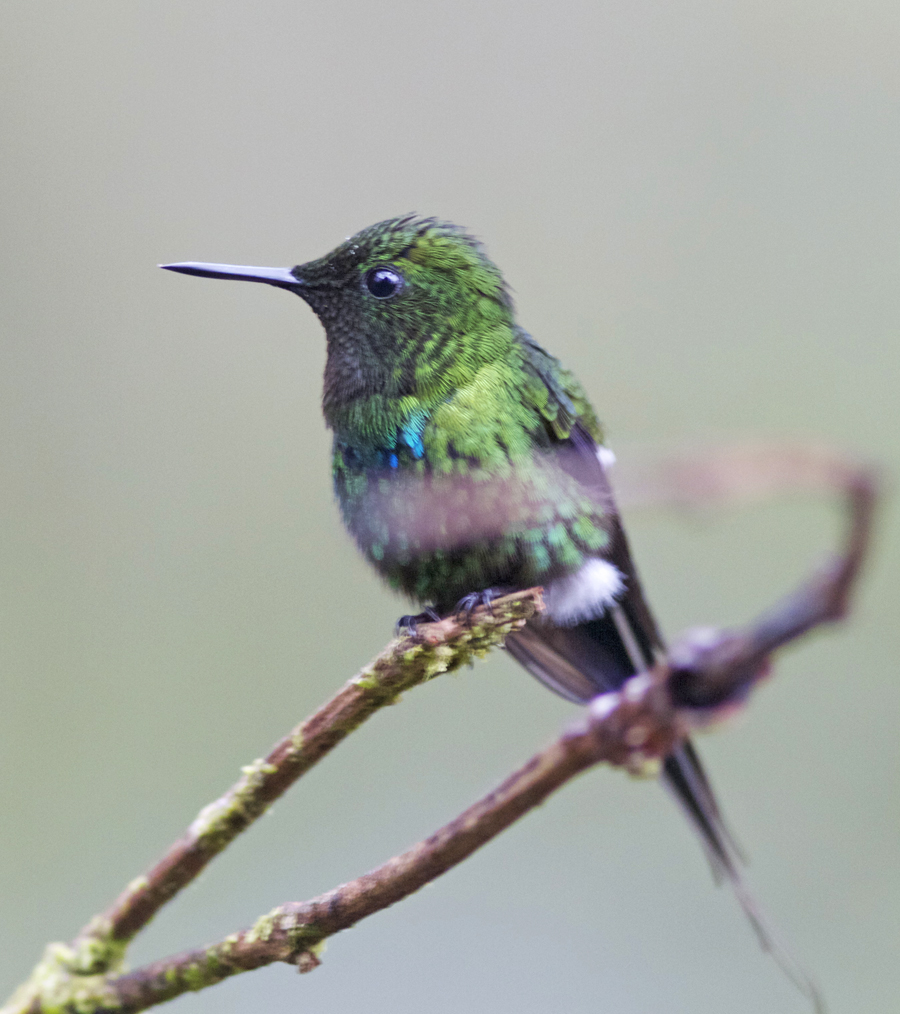
The Green Thorntail (Discosura conversii) is a small hummingbird renowned for its vivid green plumage and unique tail structure. This species is primarily found in the tropical regions of Central and South America, showcasing the rich biodiversity of these areas. From southern Nicaragua through Costa Rica and Panama to the northwestern parts of Ecuador and Colombia, the Green Thorntail inhabits humid lowland and montane forests. Its presence in these regions highlights the ecological significance of tropical forests, which serve as vital habitats for a myriad of species. The Green Thorntail plays an essential role in pollination. By feeding on nectar from various flowering plants, it facilitates the process of pollination, thus promoting plant reproduction and contributing to the overall health of its ecosystem. Its preference for specific flowers, such as those from the Heliconia and Costus genera, underscores its specialized ecological niche. During the wet season, often from May to November, these birds are most active, taking advantage of the abundance of flowers and the increased availability of insects. The Green Thorntail's seasonal behaviors align with the cyclical nature of tropical ecosystems. These birds are often observed in the mid to upper canopy layers of the forest, where they exhibit agile aerial maneuvers while foraging. The distinctiveness of the Green Thorntail lies not only in its appearance but also in its ecological adaptability. Adapted to thrive in dense forested environments, it can also be found in secondary growth and forest edges, showcasing its ability to exploit a range of habitats. This adaptability is crucial as it faces increasing pressures from habitat loss and fragmentation. The species' resilience is testament to the dynamic nature of tropical avian fauna, yet it also serves as a reminder of the fragility of these ecosystems under human influence.
The Green Thorntail belongs to the family Trochilidae, within the order Apodiformes. These birds typically live average 4-6 years, with the oldest known individual reaching 10 years..
How to Identify a Green Thorntail
Adult Green Thorntails are easily recognized by their striking iridescent green body and unique tail feathers, which end in wire-like extensions. Males have a more pronounced tail with longer extensions, whereas females possess a slightly shorter tail, lacking the elongated wires. Both sexes display a bright white band across the rump, a key field mark that aids in differentiation from similar species. Juveniles exhibit a more subdued coloration, with shorter, less defined tail feathers and a duller green plumage compared to adults. In flight, the Green Thorntail presents a distinctive silhouette due to its small size and characteristic tail. Its rapid wingbeats and ability to hover make it a captivating sight. When perched, the bird often sits in an upright position, showcasing its vibrant plumage and distinctive tail. Despite its unique features, it can sometimes be confused with other small hummingbirds in its range, such as the Wire-crested Thorntail, but its more vibrant green coloration and tail structure help in accurate identification.
Having trouble telling birds apart? Upload a photo to our bird identification tool for an instant species match.
Green Thorntail Habitat and Range
Preferred Habitat
The Green Thorntail thrives in tropical and subtropical moist broadleaf forests. It is commonly found at elevations ranging from sea level to about 1,200 meters. These birds are most abundant in forested areas where flowering plants are plentiful. They show a preference for humid lowland forests, montane forests, and forest edges, often venturing into secondary growth and disturbed areas. Although primarily a forest dweller, the Green Thorntail occasionally visits gardens and plantations where suitable floral resources are available. Seasonal habitat shifts are minimal, as these birds are non-migratory and tend to remain within their preferred forest environments year-round.
Geographic Range
The Green Thorntail's range extends from southern Nicaragua through Costa Rica and Panama, reaching into northwestern Colombia and Ecuador. This hummingbird is primarily a resident species within this range, showing little to no migratory behavior. It is most commonly found in the dense forests of Costa Rica, particularly in the regions of the Talamanca Mountains and the Osa Peninsula, where population densities are highest. In Ecuador, it is frequently observed in the Chocó region, a biodiversity hotspot. Although its range is relatively limited, the Green Thorntail is locally common within its preferred habitats. Its non-migratory nature means that it occupies these areas throughout the year, taking advantage of the consistent availability of food resources in tropical climates.
Want to know which birds visit your area? Browse our backyard birds by location guides for region-specific species lists.
What Does the Green Thorntail Eat?
The diet of the Green Thorntail primarily consists of nectar from a variety of flowering plants, including Heliconia, Costus, and other tropical flora. Its slender, slightly curved bill is adapted for accessing nectar deep within flowers. This hummingbird also supplements its diet with small insects and spiders, which provide essential protein. During the wet season, when flowers are abundant, nectar becomes the predominant component of its diet. In contrast, during drier periods, the Green Thorntail may increase its intake of insects to maintain nutritional balance. The bird employs a hovering foraging technique, allowing it to feed on flowers without perching. Its feeding schedule is generally diurnal, with peaks in activity during early morning and late afternoon when nectar production is highest.
Want to attract Green Thorntails to your yard? See our recommended feeders and seed types for the best results.
Green Thorntail Behavior and Social Structure
The Green Thorntail is a relatively solitary bird, often seen alone or in pairs rather than in flocks. It exhibits territorial behavior, particularly males who defend flowering territories from intruders. Courtship displays are subtle, with males performing aerial maneuvers to attract females. These displays involve rapid ascents and descents, showcasing their agility and vibrant plumage. The Green Thorntail's daily activity pattern includes early morning and late afternoon foraging sessions, interspersed with periods of rest and preening. In response to predators, such as hawks and larger birds, the Green Thorntail relies on its agility and speed to evade capture. It is not known for forming large flocks, but during peak flowering periods, several individuals may gather in areas with abundant floral resources.
Green Thorntail Nesting and Reproduction
Green Thorntails construct small, cup-shaped nests, usually on thin branches or in the fork of a tree. The nest is made from plant fibers, lichen, and cobwebs, providing both camouflage and structural integrity. Females typically lay two white eggs per clutch, which she incubates alone for about 14 to 19 days. Once hatched, the chicks are cared for solely by the female, who feeds them through regurgitation. The fledging period lasts approximately 20 to 26 days, after which the young birds leave the nest but remain dependent on the mother for a short period. The Green Thorntail generally raises one to two broods per year, depending on environmental conditions and food availability.
Green Thorntail Sounds and Vocalizations
The Green Thorntail produces a variety of vocalizations, including a rapid series of high-pitched notes that serve as its primary song. These notes are delivered in quick succession, creating a buzzing quality that is distinctive to the species. Additionally, the bird emits sharp, single-note calls, often used as alarm signals when predators are nearby. During the dawn chorus, the Green Thorntail's vocalizations blend with those of other forest species, contributing to the vibrant soundscape of its habitat. Its calls, while not melodious, are an integral part of its communication, particularly in establishing territory and warning of danger.
Interesting Facts About the Green Thorntail
- 1The Green Thorntail's tail feathers can measure up to three times the length of its body, a remarkable adaptation.
- 2Despite its small size, the Green Thorntail can flap its wings up to 80 times per second, allowing it to hover seamlessly.
- 3This hummingbird species is known for its role as a pollinator, visiting up to 1,500 flowers daily.
- 4The Green Thorntail's vibrant green coloration comes from microscopic platelets in the feathers that refract light.
- 5Females are solely responsible for nest building and chick rearing, a common trait among hummingbirds.
- 6The species is named 'thorntail' due to the needle-like appearance of its tail feathers.
- 7Green Thorntails are often found in mixed-species foraging flocks, benefiting from increased protection against predators.
Green Thorntail Conservation Status
The Green Thorntail is currently listed as Least Concern by the IUCN, with a stable population trend. Despite this, the species faces threats from habitat loss and fragmentation due to deforestation and agricultural expansion. Conservation efforts focus on preserving tropical forests and promoting sustainable land-use practices. Protected areas in Costa Rica and Ecuador play a crucial role in safeguarding habitats for the Green Thorntail and other forest-dependent species. The bird's adaptability to secondary growth provides some resilience against habitat changes, but continued conservation measures are vital to ensure its long-term survival.
Attracting Green Thorntails to Your Feeder
The Green Thorntail is a regular visitor to backyard bird feeders across its range. At the Eye On The Fly feeding station, we observe Green Thorntails regularly and capture footage with our feeder cameras.


