
Hangnest Tody-Tyrant
Hemitriccus nidipendulus
Order: Passeriformes / Family: Tyrannidae
Wikimedia Commons
About the Hangnest Tody-Tyrant
The Hangnest Tody-Tyrant (Hemitriccus nidipendulus) is a diminutive member of the Tyrannidae family that captures the interest of bird enthusiasts with its unique nesting behavior and vocal prowess. Found primarily in the Atlantic Forest of eastern Brazil, this bird plays a vital role in the ecosystem by controlling insect populations and serving as prey for larger birds of prey. The Hangnest Tody-Tyrant is an indicator species for the health of its forest habitat, as it requires dense undergrowth for feeding and breeding. Its presence signals a well-maintained forest ecosystem. Seasonal changes affect its behavior, with the bird becoming more vocal during the breeding season. An increase in vocal activity coincides with the availability of mates and nesting opportunities, highlighting its adaptability to environmental cues. In addition to its role in pest control, the Hangnest Tody-Tyrant contributes to seed dispersal through its diet. By consuming small fruits, it aids in germination and plant diversity, further enhancing its ecological significance. The bird's reliance on specific forest conditions makes it vulnerable to habitat destruction due to logging and agricultural expansion. Conservation efforts must prioritize preserving its natural habitat to ensure the survival of this species, which holds ecological significance beyond its small size.
The Hangnest Tody-Tyrant belongs to the family Tyrannidae, within the order Passeriformes. These birds typically live average 3-5 years, with max recorded 6 years.
How to Identify a Hangnest Tody-Tyrant
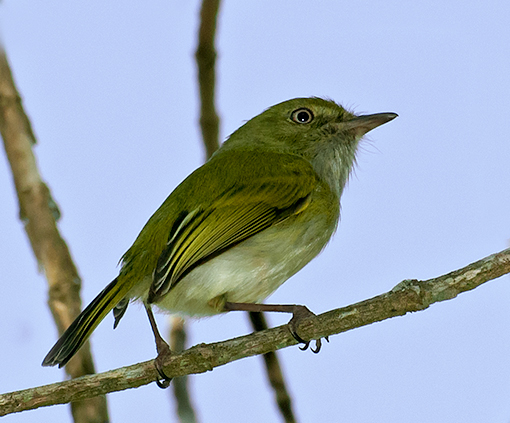
The adult Hangnest Tody-Tyrant possesses a distinct olive-green plumage on its back, contrasting with a paler underbelly. Its wings have a subtle brownish tinge, while the tail is short and slightly rounded. The bird's head is adorned with a faint eye ring and a comparatively large beak for its body size. Juvenile birds resemble adults, though they may exhibit slightly duller plumage. Males and females are similar in appearance, making sex determination in the field challenging. When perched, the Hangnest Tody-Tyrant often holds its tail at an angle, a characteristic feature. In flight, it exhibits rapid, fluttering wingbeats typical of many small passerines. While confusion with other tody-tyrants is possible, its distinct call and specific habitat preferences aid in differentiation.
Having trouble telling birds apart? Upload a photo to our bird identification tool for an instant species match.
Hangnest Tody-Tyrant Habitat and Range
Preferred Habitat
The Hangnest Tody-Tyrant thrives in the dense undergrowth of the Atlantic Forest, favoring areas with rich foliage and abundant insect life. It is often found at elevations ranging from sea level to around 1,200 meters. This bird shows a preference for subtropical or tropical moist lowland forests. Its reliance on forest habitats makes it almost absent from urban settings, though it may occasionally venture into semi-rural areas adjacent to forests. During the breeding season, it requires dense vegetation for nesting, which influences its habitat selection. The bird's presence in secondary forests highlights its adaptability, yet primary forests remain crucial for its long-term survival.
Geographic Range
The Hangnest Tody-Tyrant is endemic to Brazil, specifically occurring in the eastern regions within the Atlantic Forest biome. Its range extends from southern Bahia to the northern parts of Rio de Janeiro. The species does not undertake significant migratory movements, instead remaining within its range year-round. The bird's population density is higher in well-preserved forest areas, with hotspots around protected areas like the Serra do Mar and the Mantiqueira Mountains. The relatively small and fragmented distribution of the Hangnest Tody-Tyrant underscores the importance of habitat conservation in these regions.
Want to know which birds visit your area? Browse our backyard birds by location guides for region-specific species lists.
What Does the Hangnest Tody-Tyrant Eat?
The primary diet of the Hangnest Tody-Tyrant consists of small insects, including beetles, ants, and caterpillars. It employs a foraging technique known as 'sallying,' where it flits out from a perch to catch prey mid-air before returning to the same or nearby perch. This active foraging behavior is especially prevalent during early morning and late afternoon. During certain times of the year, the bird supplements its diet with small fruits and berries, which provides a crucial energy source. Seasonal variations in diet reflect the availability of food resources, with insect consumption peaking during wetter months when insects are more abundant.
Hangnest Tody-Tyrant Behavior and Social Structure
The Hangnest Tody-Tyrant exhibits territorial behavior, often defending its small area of forest vigorously against intruders. Its social structure is primarily monogamous, with pairs forming long-term bonds. Courtship displays include vocal duets and aerial chases. During breeding season, males become more vocal, using a series of sharp, repeated calls to assert dominance and attract females. The species is generally solitary or found in pairs, rarely forming flocks. When confronted by predators, the Hangnest Tody-Tyrant may freeze or engage in distraction displays to protect its nest. Its daily activity patterns include periods of intense foraging interspersed with rest during the hottest part of the day.
Hangnest Tody-Tyrant Nesting and Reproduction
True to its name, the Hangnest Tody-Tyrant constructs a unique hanging nest, usually suspended from a thin branch or vine in dense foliage. These nests are woven from plant fibers, moss, and spider webs, forming a soft yet secure structure. Nesting sites are typically chosen for their concealment, reducing the risk of predation. The clutch size usually consists of two to three eggs, which both parents incubate. The incubation period lasts approximately 14-16 days, followed by a fledging timeline of about 15 days. Both parents share feeding duties, ensuring the young receive adequate nourishment. The species typically produces one brood per year, although favorable conditions may allow for a second.
Hangnest Tody-Tyrant Sounds and Vocalizations
The primary song of the Hangnest Tody-Tyrant is a series of sharp, high-pitched notes delivered in rapid succession. These notes can resemble the repetitive chirping of a cricket, creating a rhythmic and persistent soundscape within its habitat. In addition to its song, the bird emits various call notes that vary in tone and urgency, often used in communication between mates. Alarm calls are sharper and more insistent, signaling potential threats. The Hangnest Tody-Tyrant participates in the dawn chorus, its vocalizations contributing to the symphony of sounds at daybreak, reinforcing its presence in the forest community.
Interesting Facts About the Hangnest Tody-Tyrant
- 1The Hangnest Tody-Tyrant's unique woven nest can hang up to 1.5 meters above the ground, providing protection from ground predators.
- 2Despite its small size, the Hangnest Tody-Tyrant's vocalizations can be heard up to 50 meters away, a testament to its strong territorial nature.
- 3This species can adapt to secondary forests, demonstrating its resilience in the face of habitat changes when compared to other forest-specialist birds.
- 4The Hangnest Tody-Tyrant's diet shifts seasonally, relying heavily on insects in the wet season and supplementing with fruits during drier periods.
- 5The species' name, 'nidipendulus,' refers to its characteristic 'hanging nest,' a distinctive feature among tody-tyrants.
Hangnest Tody-Tyrant Conservation Status
Classified as Least Concern by the IUCN, the Hangnest Tody-Tyrant faces threats primarily from habitat loss due to deforestation and agricultural expansion. Its population trend is stable, although localized declines occur in heavily impacted areas. Conservation efforts focus on protecting remaining Atlantic Forest habitats and promoting reforestation projects. Historical population changes reflect patterns of habitat degradation, underscoring the need for ongoing preservation initiatives to ensure the species' continued survival.


