
Himalayan Flameback
Dinopium shorii
Order: Piciformes / Family: Picidae
Wikimedia Commons
About the Himalayan Flameback
The Himalayan Flameback, Dinopium shorii, is a medium-sized woodpecker that is part of the Picidae family. This bird is a resident of the Indian subcontinent, predominantly found in the forests of the Himalayan foothills. Known for its vibrant golden-yellow plumage, it provides a striking contrast to the green forest canopy. The Himalayan Flameback plays a crucial ecological role in its habitat, serving as both a predator of insects and a disperser of seeds, which promotes forest regeneration. Its presence indicates a healthy forest ecosystem due to its need for mature trees for foraging and nesting. The bird is particularly significant to the biodiversity of regions like Uttarakhand, Sikkim, and West Bengal in India. Seasonal behaviors include slight altitudinal migrations, where the species may move to lower elevations during harsh winter months. However, it largely remains within its native range throughout the year. The Himalayan Flameback is not just a visual delight for birdwatchers but also an integral part of the avian community that contributes to the balance and health of its forest environment. Additionally, this species is often a subject of interest due to its interactions with other forest inhabitants and its potential as a bioindicator for habitat conservation efforts.
The Himalayan Flameback belongs to the family Picidae, within the order Piciformes. These birds typically live average lifespan is 5-8 years, with some individuals living up to 10 years..
How to Identify a Himalayan Flameback
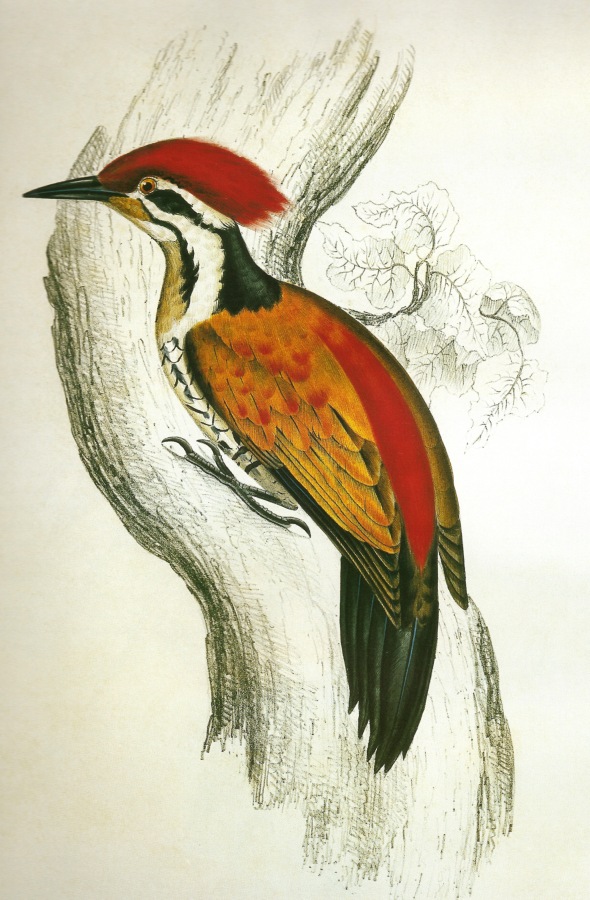
The Himalayan Flameback stands out with its golden-yellow plumage, which covers its back and wings. Adult birds exhibit a vivid red crest, which contrasts sharply with their black throat and face. The underparts are generally whitish, adorned with fine black barring. Males and females are similar in appearance, with males distinguished by a more pronounced red patch extending from the nape to the crest. Juveniles resemble adults but with duller coloration and a less defined red crest. In flight, the Himalayan Flameback presents a distinctive silhouette with rapid, undulating flight typical of woodpeckers. Its perching posture is usually upright against tree trunks, aided by its zygodactyl feet. This species can be confused with the Greater Flameback (Chrysocolaptes guttacristatus), but the latter is larger and has more extensive red on the head. The Himalayan Flameback's unique coloration and size make it relatively easy to identify in its natural habitat.
Having trouble telling birds apart? Upload a photo to our bird identification tool for an instant species match.
Himalayan Flameback Habitat and Range
Preferred Habitat
The Himalayan Flameback primarily inhabits subtropical and temperate forests in the Himalayan foothills. It prefers deciduous and mixed forests where it can find ample supply of old trees for nesting and foraging. The species is typically found at elevations ranging from 500 to 2,500 meters, though it may descend to lower altitudes in winter. The bird can occasionally be spotted in semi-urban areas where mature trees are present, but it is predominantly a forest dweller. Seasonal habitat shifts occur, as some populations move to lower elevations during colder months. The presence of the Himalayan Flameback is a good indicator of forest health due to its reliance on mature trees.
Geographic Range
The Himalayan Flameback is a resident species within the Indian subcontinent, particularly in the northern regions. It is commonly found in the lower Himalayan range, including the states of Uttarakhand, Himachal Pradesh, and West Bengal. Its range extends into parts of Nepal and Bhutan, where it inhabits similar forested environments. This species does not undertake long migrations, but it may exhibit local movement patterns in response to seasonal changes. The bird is more densely populated in areas with abundant forest coverage and less so in fragmented habitats. Conservation efforts focus on protecting these forested regions to ensure the continued presence of the Himalayan Flameback.
Want to know which birds visit your area? Browse our backyard birds by location guides for region-specific species lists.
What Does the Himalayan Flameback Eat?
The diet of the Himalayan Flameback primarily consists of insects and their larvae, which it extracts from tree bark using its strong bill. It employs a technique known as 'pecking and probing' to uncover hidden prey beneath the surface. This woodpecker also consumes fruits and berries, particularly during seasons when insect availability decreases. Its foraging activities often take place in the early morning and late afternoon, aligning with peak insect activity. The Himalayan Flameback targets prey of various sizes, from small ants to larger beetle larvae. This dietary flexibility helps it thrive in its forest environment and contributes to its role in pest control.
Himalayan Flameback Behavior and Social Structure
The Himalayan Flameback exhibits solitary behavior outside of the breeding season, often seen alone or in pairs. It establishes and defends territory through drumming and vocalizations, particularly during the breeding season. Courtship displays involve vocal calls and aerial chases, with males showcasing their red crests prominently. While generally not a flocking species, it may join mixed-species foraging flocks in search of food. In response to predators, the Himalayan Flameback relies on its strong flight and camouflage among the trees. Daily activities include periods of foraging interspersed with rest and preening, primarily during daylight hours.
Himalayan Flameback Nesting and Reproduction
The Himalayan Flameback nests in tree cavities, which it excavates in dead or decaying wood. Nest sites are often located at heights ranging from 3 to 10 meters above ground level. The female lays a clutch of 2 to 4 eggs, which are incubated by both parents for about 11 to 14 days. Following hatching, chicks remain in the nest for approximately 24 to 28 days before fledging. Both parents share responsibilities for feeding and protecting the young. Typically, the species raises only one brood per year, although in ideal conditions, a second brood may occur.
Himalayan Flameback Sounds and Vocalizations
The primary song of the Himalayan Flameback is a series of sharp, resonant calls that rise and fall in pitch, resembling a fast-paced 'wick-a, wick-a, wick-a'. These vocalizations serve both territorial and courtship functions. The bird also produces a variety of call notes, including soft 'chik-chik' sounds used for communication between mates or with fledglings. When alarmed, it emits a harsher, more abrupt call to alert others of potential danger. The Himalayan Flameback participates in the dawn chorus, adding its distinctive voice to the symphony of forest sounds.
Interesting Facts About the Himalayan Flameback
- 1The Himalayan Flameback can excavate nesting cavities in just a few days, showcasing its powerful beak.
- 2This species' drumming can be heard over 200 meters away, serving as a critical communication tool.
- 3The Himalayan Flameback's golden-yellow plumage provides effective camouflage among sunlit leaves.
- 4Though primarily insectivorous, the bird enjoys a diet rich in fruits like figs during the monsoon.
- 5The Himalayan Flameback's red crest plays a vital role in courtship, with males displaying it to attract females.
- 6Despite its striking colors, the Himalayan Flameback remains elusive, often detected only by its distinctive calls.
- 7This woodpecker can hammer wood at an astounding speed of 20 times per second without injury.
Himalayan Flameback Conservation Status
The IUCN currently lists the Himalayan Flameback as a species of Least Concern, with stable population trends. Despite this, habitat destruction due to deforestation poses a long-term threat to its survival. Conservation efforts focus on preserving forest habitats and promoting sustainable forestry practices. Historically, the species has maintained healthy populations across its range, but localized declines have occurred in areas with significant habitat fragmentation. Continued monitoring and habitat protection are essential to ensuring the persistence of the Himalayan Flameback in its native range.


