
Hispaniolan Parrot
Amazona ventralis
Order: Psittaciformes / Family: Psittacidae
Wikimedia Commons
About the Hispaniolan Parrot
The Hispaniolan Parrot (Amazona ventralis) is a vibrant and charismatic member of the Psittacidae family, native to the island of Hispaniola, which encompasses the nations of Haiti and the Dominican Republic. These parrots are a vital part of the island's ecosystem, playing a crucial role in seed dispersal and, consequently, the regeneration of its forested regions. Their presence is particularly significant in the subtropical and tropical moist broadleaf forests, where they contribute to the maintenance of biodiversity.
Throughout the year, the Hispaniolan Parrot resides primarily in dense forest canopies, although it can also be found in semi-deciduous forests and occasionally in mangroves and coastal areas. These birds have also adapted to secondary forests and agricultural lands, which indicates a degree of resilience to habitat alteration. Seasonal variations influence their behavior and distribution, with some populations moving to lower elevations during the breeding season when food resources are more abundant.
Culturally, the Hispaniolan Parrot holds significance for the local human populations, often being featured in local folklore and as a symbol of the island's natural beauty. Despite their adaptability, these parrots face threats from habitat destruction and the illegal pet trade. Conservation efforts are critical in ensuring the survival of this species, with protected areas and breeding programs being established to help mitigate these threats.
The Hispaniolan Parrot belongs to the family Psittacidae, within the order Psittaciformes. These birds typically live typically 20-30 years, with some living up to 40 years in captivity..
How to Identify a Hispaniolan Parrot
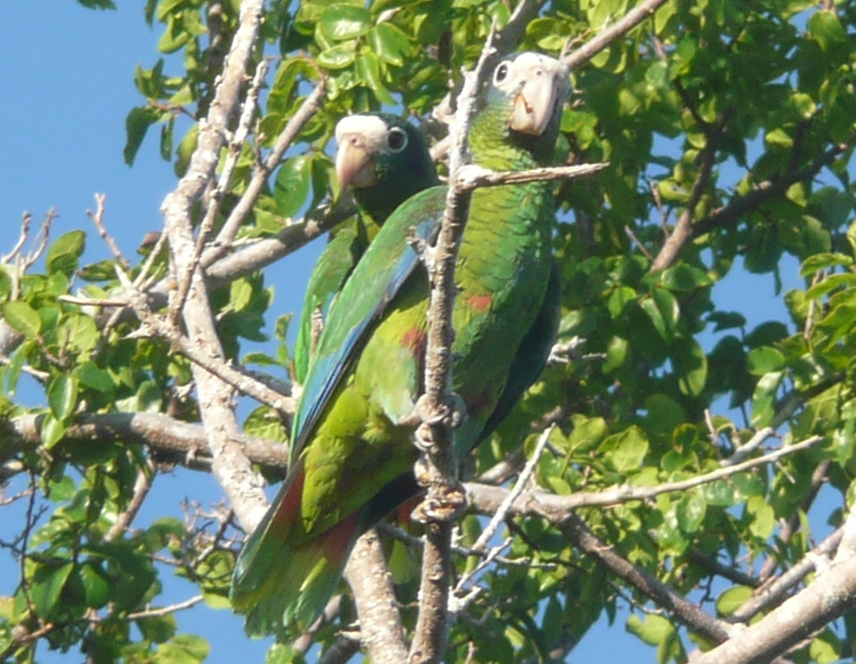
The Hispaniolan Parrot is a medium-sized bird, measuring approximately 28-31 cm in length. Adults exhibit predominantly green plumage, with a distinctive blue tinge on the wings and a rich violet-blue coloring on the head and nape. The forehead is white, providing a striking contrast against the darker head. The eyes are a vivid orange, and they have a robust, hooked beak that is pale in color.
Juveniles resemble adults but display less vivid coloration, often lacking the full intensity of the blue on the head and the white on the forehead. There is minimal sexual dimorphism in this species, with males and females appearing similar, making it challenging to distinguish between them based solely on plumage.
In flight, the Hispaniolan Parrot presents a broad-winged silhouette, with strong wingbeats and a characteristic undulating flight pattern. When perched, they maintain an upright posture, often engaging in social interactions through vocalizations and mutual preening. This species can be confused with the Cuban Parrot (Amazona leucocephala) due to overlapping ranges in the past, yet differences in head coloration are key identifiers.
Having trouble telling birds apart? Upload a photo to our bird identification tool for an instant species match.
Hispaniolan Parrot Habitat and Range
Preferred Habitat
The Hispaniolan Parrot inhabits a variety of ecosystems on Hispaniola, primarily residing in subtropical and tropical moist broadleaf forests. These birds are typically found at elevations ranging from sea level up to 2,000 meters, though they are more commonly seen up to 1,500 meters. Mangrove forests and coastal areas also provide suitable habitats, especially during feeding periods.
While they prefer undisturbed primary forests, Hispaniolan Parrots have shown adaptability to secondary growth areas and agricultural landscapes, such as coffee and cacao plantations. During the dry season, these parrots may move to lower elevations and coastal regions in search of food. Urban presence is limited, as they tend to avoid densely populated human areas.
Geographic Range
The Hispaniolan Parrot is endemic to the island of Hispaniola, and its range includes both the Dominican Republic and Haiti. This species does not engage in long-distance migrations, remaining on the island year-round. Within their range, these parrots exhibit seasonal movements, usually tied to breeding and food availability.
Population density is highest in protected areas like the Sierra de Bahoruco National Park in the Dominican Republic, where conservation efforts focus on preserving forested habitats. Lower population densities are found in regions where deforestation and habitat degradation have occurred, particularly in parts of Haiti where forest cover is significantly reduced.
Want to know which birds visit your area? Browse our backyard birds by location guides for region-specific species lists.
What Does the Hispaniolan Parrot Eat?
The diet of the Hispaniolan Parrot primarily consists of seeds, fruits, nuts, and berries, with a preference for those available in the canopy of their forest habitats. They have a particular affinity for the seeds of the Hispaniolan pine, as well as various fruits from fig and palm species.
Seasonal changes influence their diet, as they adjust to the availability of different food sources. During the wet season, a greater abundance of fruits and flowers allows for a more varied diet. These parrots employ a strong beak and dexterous feet to forage and manipulate food, often hanging upside down to access hard-to-reach fruits. They typically feed in the early morning and late afternoon, spending midday resting or engaging in social activities.
Hispaniolan Parrot Behavior and Social Structure
Hispaniolan Parrots are social birds, often observed in pairs or small flocks, particularly during feeding and roosting times. They exhibit strong pair bonds, with mutual preening and vocal communication being common behaviors. During the breeding season, pairs become more territorial, defending nesting sites vigorously against intruders.
Courtship displays involve aerial acrobatics and intricate vocalizations, serving to strengthen pair bonds and establish territory. Outside of the breeding season, these parrots may join larger flocks, especially when resources are plentiful. Their response to predators includes loud alarm calls and rapid flight to safety, often taking refuge in dense foliage.
Hispaniolan Parrot Nesting and Reproduction
Hispaniolan Parrots typically nest in cavities within large trees, often utilizing old woodpecker holes or natural cavities in the trunks and branches. They rarely construct nests but may modify existing ones with leaves and feathers. Preferred nesting sites are located in mature forests, where large trees are available.
A typical clutch consists of 2-4 eggs, with the female primarily responsible for incubation over a period of approximately 26-28 days. Once hatched, both parents participate in feeding and caring for the chicks. The fledging period lasts about 8 weeks, after which young parrots remain dependent on their parents for several more weeks. Generally, only one brood is raised per year.
Hispaniolan Parrot Sounds and Vocalizations
The vocalizations of the Hispaniolan Parrot are varied and include a series of screeches and squawks, characterized by a harsh, nasal quality. These calls serve multiple functions, including communication between mates and signaling alarm. In contrast, their song, often heard during the dawn chorus, is a more melodic sequence of whistles and chattering notes.
Alarm calls are particularly loud and sharp, meant to alert other parrots to potential dangers. Compared to other parrots, their calls are not as piercing but carry effectively across forested landscapes.
Interesting Facts About the Hispaniolan Parrot
- 1The Hispaniolan Parrot can live up to 30 years in the wild, showcasing remarkable longevity for a medium-sized bird.
- 2These parrots play a crucial ecological role by dispersing seeds across the island, aiding in forest regeneration.
- 3Unlike many parrots, the Hispaniolan Parrot tends to avoid human settlements, preferring remote forested areas.
- 4Parrots of the genus Amazona are known for their intelligence and ability to mimic sounds, including the Hispaniolan Parrot.
- 5During courtship, both males and females participate in vocal duets, strengthening their pair bonds.
- 6Hispaniolan Parrots are one of the few parrot species endemic to the Caribbean, highlighting their unique ecological niche.
- 7Their distinctive bright blue head coloration helps differentiate them from similar parrot species in the region.
Hispaniolan Parrot Conservation Status
Currently, the Hispaniolan Parrot is listed as Vulnerable by the IUCN. The population trend is decreasing, primarily due to habitat loss and illegal pet trade. Deforestation for agriculture and urban development poses significant threats to their habitats. Conservation efforts include habitat restoration, legal protection, and the establishment of protected areas to preserve critical habitats. Captive breeding programs and public awareness campaigns aim to reduce poaching pressures and promote sustainable practices. Historical records indicate that populations have fluctuated significantly, with current estimates lower than historical numbers due to ongoing environmental pressures.


