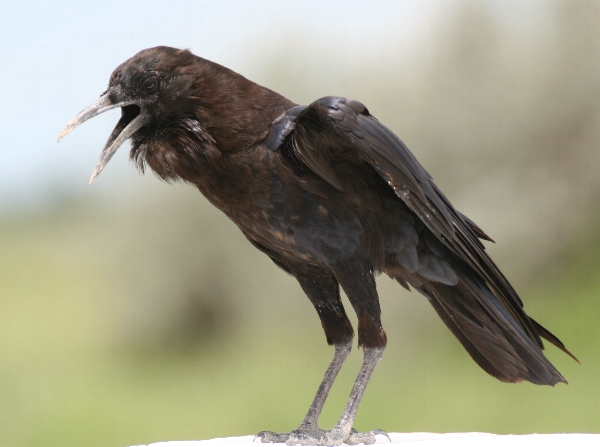
Hooded Crow
Corvus cornix
Order: Passeriformes / Family: Corvidae

Wikimedia Commons
About the Hooded Crow
The Hooded Crow (Corvus cornix) belongs to the family Corvidae and is renowned for its intelligence and adaptability across varied environments. This medium-sized passerine bird, distinguished by its striking two-tone plumage, is widespread across Europe and parts of Western Asia. Its presence is particularly notable in urban settings, where it often coexists with humans in cities like Berlin, Stockholm, and Moscow. In these areas, the Hooded Crow plays a vital ecological role by scavenging waste, thus contributing to urban sanitation.
In contrast to its urban adaptability, the Hooded Crow also thrives in rural and coastal regions. It occupies a variety of landscapes including farmlands, woodlands, and shorelines. In coastal areas, it often forages for marine invertebrates and carrion. This versatility highlights its ecological significance as both a scavenger and a predator of small animals.
Seasonally, the Hooded Crow exhibits intriguing behaviors. In Northern Europe, where winters are harsh, it may migrate short distances southward, though its migrations are typically less extensive than those of many other bird species. During the breeding season, which runs from April to July, these crows become more territorial, often seen driving away intruders from their nesting areas. This species is a testament to the resilience and adaptability typical of corvids, maintaining stable populations despite environmental changes.
The Hooded Crow belongs to the family Corvidae, within the order Passeriformes. These birds typically live typically 10-14 years, with a maximum recorded of 16 years..
How to Identify a Hooded Crow
The Hooded Crow can be recognized by its distinctive bi-colored plumage. Adults exhibit a pale gray body contrasted with black head, wings, tail, and upper breast. This stark contrast makes them easily distinguishable from other crow species. Juveniles have similar markings but their plumage may appear slightly duller until they reach full maturity.
There is little sexual dimorphism in the Hooded Crow. Males and females appear similar in size and coloration, making it difficult to differentiate between the sexes in the field. However, males may appear slightly larger, a common trait among many bird species.
In flight, the Hooded Crow displays broad, rounded wings and a slightly wedge-shaped tail. Its flight pattern is typically steady and direct, with deliberate wing beats interspersed with glides. When perched, it often adopts a hunched posture, especially in colder weather, with its head tucked into its body to conserve heat. This posture, combined with its distinctive colors, helps birders identify it even at a distance.
Having trouble telling birds apart? Upload a photo to our bird identification tool for an instant species match.
Hooded Crow Habitat and Range
Preferred Habitat
The Hooded Crow inhabits a diverse range of environments. It is commonly found in urban areas, where it exploits human-altered landscapes such as parks, gardens, and city streets. Besides urban locales, the crow thrives in rural settings, including agricultural fields, woodlands, and coastal regions.
In terms of elevation, the Hooded Crow is most commonly found from sea level up to approximately 1500 meters, adapting to both lowland and upland habitats. During winter, it may shift habitats slightly, moving from higher elevations to lower, milder areas to avoid harsh conditions.
The contrast between its rural and urban habitat choices underscores the Hooded Crow's adaptability. While it readily uses city environments for feeding and nesting, it does not shy away from more remote areas where natural food sources are abundant.
Geographic Range
The Hooded Crow's range spans across Europe and into parts of Western Asia. It is primarily found in northern and eastern Europe, with populations extending from the British Isles to the Baltic states and Finland. In Russia, its range continues eastward into Siberia, and it is also present in parts of the Middle East.
During the breeding season, the Hooded Crow is widely distributed across these regions, with high population densities in countries like Germany, Poland, and Ukraine. In winter, some northern populations may migrate southward, though this species is largely sedentary compared to other migratory birds.
Despite its broad range, the Hooded Crow's distribution is patchy in some areas due to habitat preferences and competition with related species, such as the Carrion Crow (Corvus corone). However, it remains a common and widespread presence in the regions it inhabits.
Want to know which birds visit your area? Browse our backyard birds by location guides for region-specific species lists.
What Does the Hooded Crow Eat?
The Hooded Crow is an omnivorous feeder with a diverse diet that shifts seasonally. Its primary food sources include insects, small mammals, carrion, and a variety of plant materials such as berries and seeds. In urban areas, it often scavenges human refuse, playing a crucial role in waste reduction.
During the breeding season, the demand for protein-rich food leads the Hooded Crow to focus on insects and small vertebrates. This diet is essential for feeding growing chicks. In coastal areas, it may also consume marine invertebrates and fish washed ashore.
Foraging techniques are varied and can include probing the ground, scavenging, and even caching food for later consumption. The Hooded Crow typically feeds during daylight hours, with increased activity during the early morning and late afternoon.
Hooded Crow Behavior and Social Structure
Hooded Crows are highly social and intelligent birds, often seen in pairs or small family groups. Outside of the breeding season, they may form larger flocks, especially in urban areas or communal roosts during winter.
Territorial behavior becomes prominent during the breeding season, when pairs defend their nesting sites vigorously. Courtship displays include aerial chases and mutual preening, strengthening pair bonds.
The Hooded Crow's response to predators involves both vocalizations and mobbing behaviors. They are known to aggressively harass larger birds of prey or predators that venture too close to their nests. Daily activity patterns show peak foraging during morning and late afternoon, with midday rest periods often spent perched in trees or on buildings.
Hooded Crow Nesting and Reproduction
Hooded Crows build large, bulky nests using twigs, lined with softer materials like grass, moss, and feathers. These nests are typically situated high in trees, though they may also use cliffs or man-made structures such as buildings or towers.
A typical clutch consists of 3-6 eggs, which are pale blue or green with brown speckles. The female primarily incubates the eggs for about 18-20 days, while the male provides food and protection.
Both parents participate in feeding the chicks, which fledge approximately 32-36 days after hatching. The Hooded Crow usually raises one brood per year, although in favorable conditions, they might attempt a second.
Hooded Crow Sounds and Vocalizations
The Hooded Crow's vocal repertoire includes a variety of sounds, the most recognizable being its harsh 'caw-caw' calls. These calls are used for communication within pairs and groups and as alarm signals. Its song, if it can be called that, consists of a series of low, guttural 'kor' sounds, often repeated rhythmically.
Alarm calls are sharper and more intense, serving to alert other crows of potential threats. During the dawn chorus, Hooded Crows contribute their own distinct calls, adding to the diverse soundscape of their habitats.
Interesting Facts About the Hooded Crow
- 1Hooded Crows have been observed using tools, a behavior rare among birds, to obtain food.
- 2In Scandinavia, Hooded Crows are known to cache food for later, showcasing their remarkable memory.
- 3The Hooded Crow's adaptability allows it to thrive in cities like Moscow, where it often scavenges alongside humans.
- 4Unlike many birds, the Hooded Crow has been known to recognize individual human faces, highlighting its intelligence.
- 5In urban areas, Hooded Crows often engage in playful activities, such as sliding down snowy roofs.
- 6Hooded Crows are known to interbreed with the Carrion Crow in overlapping ranges, producing hybrid offspring.
- 7The species' vocalizations are complex, with different calls serving specific social functions within groups.
Hooded Crow Conservation Status
Listed as Least Concern by the IUCN, the Hooded Crow's population is currently stable. This stability is attributed to its adaptability to varied environments, including urban areas where some bird species struggle. The primary threats include habitat destruction and pollution, although these have not significantly impacted overall numbers. Conservation efforts focus on habitat preservation and ensuring that urban planning considers the needs of species like the Hooded Crow, which benefits from green spaces in cities. Historically, populations have remained robust despite environmental changes.
Other Corvidae Species


Birds Similar to the Hooded Crow
These species are often confused with the Hooded Crow due to similar appearance or overlapping range.