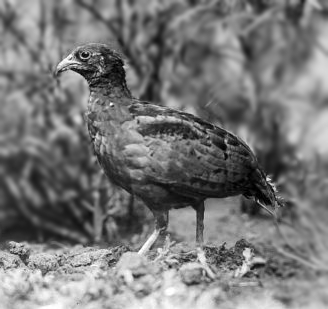
Hose's Partridge
Rhizothera dulitensis
Order: Galliformes / Family: Phasianidae

Wikimedia Commons
About the Hose's Partridge
Hose's Partridge (Rhizothera dulitensis) inhabits the dense montane forests of northern Borneo, specifically in regions like Mount Dulit and Mount Kinabalu. This bird is an integral part of its ecosystem, playing a crucial role in seed dispersal and insect control. Its presence signifies a healthy, undisturbed forest habitat, making it an indicator species for conservation efforts. The Hose's Partridge is primarily active during the early morning and late afternoon, foraging on the forest floor for insects, seeds, and small vertebrates. Its seasonal behaviors include subtle changes in diet and activity patterns, particularly during the breeding season when males engage in elaborate courtship displays. The bird's significance extends beyond ecology, serving as a subject of interest for ornithologists and bird watchers due to its elusive nature and rarity. Conservationists closely monitor its population trends, as habitat destruction poses a significant threat. The Hose's Partridge showcases the rich biodiversity of Borneo's montane forests and underscores the need for sustainable environmental practices. With its unique ecological role and distinctive behaviors, the Hose's Partridge remains a subject of fascination and importance in avian studies.
The Hose's Partridge belongs to the family Phasianidae, within the order Galliformes. These birds typically live estimated 8-12 years in the wild..
How to Identify a Hose's Partridge
Adult Hose's Partridges display a striking plumage, characterized by a mottled brown and gray pattern that offers excellent camouflage within forest undergrowth. Males and females exhibit similar coloration, though males may have slightly more vibrant tones on their wings. Juveniles appear duller, with less defined markings, allowing them to blend into their surroundings more effectively. Key identification features include their robust body, short tail, and stout legs, adapted for a terrestrial lifestyle. The Hose's Partridge can be confused with the Long-billed Partridge, but it can be distinguished by its slightly smaller size and more uniform coloration. In flight, the Hose's Partridge shows a rapid, low trajectory, often flushing directly from the ground when startled. When perched, it maintains a low, crouched posture, remaining motionless to avoid detection.
Having trouble telling birds apart? Upload a photo to our bird identification tool for an instant species match.
Hose's Partridge Habitat and Range
Preferred Habitat
Hose's Partridge prefers the dense, humid montane forests of northern Borneo, specifically thriving at elevations ranging from 900 to 2,500 meters. These forests provide ample cover and a rich supply of food resources. The bird shows little tolerance for urban environments and is rarely seen outside of its natural forest habitat. Seasonal shifts in habitat use are minimal, as the partridge remains within the forest throughout the year, relying on its dense vegetation for shelter and sustenance.
Geographic Range
Hose's Partridge is endemic to Borneo, with its range primarily confined to the northern parts of the island. It is found in regions such as the Malaysian states of Sabah and Sarawak, with population concentrations around Mount Kinabalu and Mount Dulit. The species does not migrate, instead remaining within its preferred montane forest habitats year-round. Population density varies, with localized hotspots in areas of undisturbed forest.
Want to know which birds visit your area? Browse our backyard birds by location guides for region-specific species lists.
What Does the Hose's Partridge Eat?
The diet of Hose's Partridge consists mainly of insects, seeds, and small invertebrates. During the wet season, it consumes a higher proportion of insects, taking advantage of increased availability. The bird employs a foraging technique known as ground scratching, where it uses its feet to uncover hidden prey beneath leaf litter. Prey size varies, but generally includes small insects and seeds. Feeding typically occurs during the cooler parts of the day, such as early morning and late afternoon, when the bird is most active.
Hose's Partridge Behavior and Social Structure
Hose's Partridge exhibits a solitary or small-group social structure, often encountered in pairs or small family units. Territorial behavior includes vocal displays and ground scratching to mark boundaries. During courtship, males perform elaborate displays involving puffing up feathers and calling repeatedly to attract females. Flocking is uncommon, as the bird prefers the cover of dense vegetation. In response to predators, Hose's Partridge relies on its camouflage and quick, low flight to evade threats. Daily activity patterns revolve around feeding and resting, with peak activity occurring at dawn and dusk.
Hose's Partridge Nesting and Reproduction
The Hose's Partridge constructs a simple ground nest, often hidden among dense undergrowth or between tree roots. Nests consist of a shallow depression lined with leaves and other forest debris. The typical clutch size ranges from 3 to 5 eggs. Both parents share incubation duties, which last approximately 21 to 24 days. Once hatched, chicks remain in the nest for a few days before venturing out under parental supervision. Fledging occurs around 2 to 3 weeks after hatching, with both parents continuing to care for the young. Typically, the species raises one brood per year.
Hose's Partridge Sounds and Vocalizations
The primary call of Hose's Partridge is a series of low, resonant whistles, spaced evenly and delivered in a repetitive sequence. These calls serve both territorial and mating purposes, particularly during the breeding season. Alarm calls are sharper and more abrupt, designed to alert nearby birds of potential danger. The dawn chorus features these calls prominently, as the bird establishes its presence in the early morning hours.
Interesting Facts About the Hose's Partridge
- 1Hose's Partridge was first described in 1902 by British ornithologist Charles Hose, after whom the species is named.
- 2This bird is one of only two species in the genus Rhizothera, the other being the Long-billed Partridge.
- 3The Hose's Partridge is rarely seen, making it a prized sighting for birdwatchers visiting Borneo's montane forests.
- 4Unlike many partridges, Hose's Partridge is largely sedentary, with no known migratory behavior.
- 5The species' elusive nature and reliance on dense forest habitats make it a key indicator for assessing forest health.
- 6Hose's Partridge can survive on a varied diet, which helps it adapt to seasonal changes in food availability.
- 7Despite its reclusive habits, the bird's distinctive calls can be heard echoing through the forest, revealing its presence to attentive listeners.
Hose's Partridge Conservation Status
The IUCN currently lists Hose's Partridge as Near Threatened, with populations facing decline due to habitat loss from logging and land conversion. Primary threats include deforestation and the expansion of agricultural land. Conservation efforts focus on habitat preservation and the establishment of protected areas. Historically, populations have fluctuated with changes in land use practices, highlighting the need for sustainable management strategies.
Other Phasianidae Species


Birds Similar to the Hose's Partridge
These species are often confused with the Hose's Partridge due to similar appearance or overlapping range.