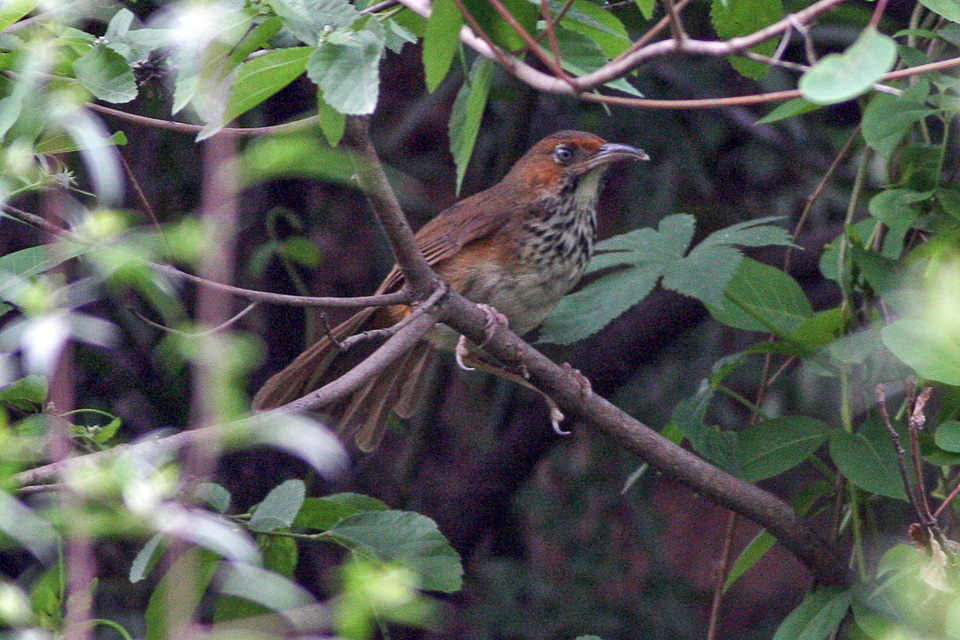
Indian Scimitar-Babbler
Pomatorhinus horsfieldii
Order: Passeriformes / Family: Timaliidae

Wikimedia Commons
About the Indian Scimitar-Babbler
The Indian Scimitar-Babbler, scientifically known as Pomatorhinus horsfieldii, is a captivating bird species prevalent in South Asia. This medium-sized songbird is a member of the Timaliidae family, notable for its melodious vocalizations and social behaviors. Inhabiting the dense undergrowth of tropical and subtropical forests, the Indian Scimitar-Babbler thrives in the Western Ghats, Eastern Ghats, and parts of the central highlands of India. Its presence is also recorded in the forests of Sri Lanka and Bangladesh. The species plays a significant ecological role as an insectivore, aiding in pest control and contributing to the forest ecosystem's health.
The Indian Scimitar-Babbler's adaptability to various forested habitats underscores its ecological significance. It occupies both primary and secondary forests, and can be observed in bamboo thickets and wooded gardens. This bird's ability to thrive in diverse habitats highlights its resilience and importance in maintaining ecological balance. The bird is most active during the breeding season from February to May, when its melodious calls become more frequent and prominent.
Ecologically, the Indian Scimitar-Babbler serves as an important bioindicator due to its sensitivity to habitat changes. Its presence or absence can reveal much about the health of its environment. The bird's seasonal behavior includes forming noisy flocks outside the breeding season. These flocks, often comprising family groups, navigate the forest undergrowth searching for food, maintaining communication through a repertoire of calls. The Indian Scimitar-Babbler's adaptability and role in the ecosystem underscore its significance in the avian community of South Asia.
The Indian Scimitar-Babbler belongs to the family Timaliidae, within the order Passeriformes. These birds typically live average 5-7 years with a max recorded of 9 years..
How to Identify a Indian Scimitar-Babbler
The Indian Scimitar-Babbler can be identified by its strikingly curved, yellowish-orange bill resembling a scimitar, an adaptation for foraging in leaf litter. The adult plumage is predominantly brown with a distinctive white throat and a dark, slightly drooping tail. The head features a subtle grayish-brown hue, with a prominent white supercilium that runs from the bill to the nape. Juveniles resemble adults but display a duller coloration and less pronounced markings.
In terms of sexual dimorphism, males and females appear similar, making differentiation in the field challenging without close observation of behavior, such as nesting duties. The Indian Scimitar-Babbler's field marks can cause confusion with similar species like the White-browed Scimitar-Babbler. However, the latter species typically exhibits a more robust build and a different vocal pattern.
In flight, the Indian Scimitar-Babbler's silhouette is distinctive due to its long, curved bill and rounded wings. It typically prefers short, direct flights between dense cover rather than prolonged aerial journeys. When perching, it exhibits an alert posture, often with the tail slightly drooped, a characteristic stance that aids in quick identification within its habitat.
Having trouble telling birds apart? Upload a photo to our bird identification tool for an instant species match.
Indian Scimitar-Babbler Habitat and Range
Preferred Habitat
The Indian Scimitar-Babbler primarily inhabits tropical and subtropical forests, favoring dense undergrowth and thickets. It is commonly found in the Western and Eastern Ghats' humid forested areas, where it thrives at elevations ranging from sea level to about 2000 meters. These birds prefer areas with rich leaf litter, which facilitates their foraging habits.
Seasonal shifts in habitat preference are minimal, as they tend to remain within forested areas year-round. However, they may move to lower elevations or more open woodlands during non-breeding periods. Unlike some forest birds, the Indian Scimitar-Babbler does not frequently venture into urban areas, although it can occasionally be seen in rural gardens with sufficient tree cover.
The bird's reliance on dense vegetation makes it less visible than other species, but also provides it with ample protection from predators. Its habitat preferences emphasize the importance of conserving forested areas to maintain healthy populations of this and other forest-dependent species.
Geographic Range
The Indian Scimitar-Babbler is predominantly found in the Indian subcontinent. Its breeding range extends across the Western and Eastern Ghats in India, with populations also present in Sri Lanka and parts of Bangladesh. In India, the species is particularly abundant in the states of Kerala, Tamil Nadu, Karnataka, and Andhra Pradesh.
This bird does not undertake long migratory journeys, but it may exhibit local movements influenced by seasonal changes in food availability or breeding conditions. These movements are usually altitudinal, between different elevations within its established range.
Population density hotspots include the moist deciduous and evergreen forests of the Western Ghats, where sightings are common due to the favorable habitat conditions. The species' limited range, primarily confined to specific regions within South Asia, highlights the need for targeted conservation efforts in these areas to preserve its habitats and populations.
Want to know which birds visit your area? Browse our backyard birds by location guides for region-specific species lists.
What Does the Indian Scimitar-Babbler Eat?
Primarily an insectivore, the Indian Scimitar-Babbler forages through the forest understory, using its curved bill to probe leaf litter and crevices for insects and their larvae. Its diet consists largely of ants, beetles, and caterpillars, with occasional consumption of seeds and small fruits when insect prey is scarce.
During the breeding season, the bird increases its intake of protein-rich insects to support egg production and chick rearing. The Indian Scimitar-Babbler employs a methodical foraging technique, often seen turning over leaves and bark in search of hidden prey.
Its feeding schedule is largely diurnal, with peak activity observed during the cooler morning and late afternoon hours. This pattern helps the bird avoid the midday heat, which is a common behavior among understory foragers in tropical regions. The bird's diet and foraging behavior play an integral role in controlling insect populations within its habitat.
Indian Scimitar-Babbler Behavior and Social Structure
The Indian Scimitar-Babbler is a social and vocal bird, often seen in small groups or family flocks. These groups communicate through a series of melodious calls, which serve to maintain contact and coordinate movements through the dense undergrowth.
Territorial behavior is pronounced during the breeding season, with pairs vigorously defending their nesting area against intruders. Courtship displays are subtle, typically involving mutual preening and feeding, strengthening pair bonds.
The species exhibits a well-defined daily activity pattern, beginning with a dawn chorus that signals the start of foraging activities. The Indian Scimitar-Babbler remains active throughout the day, with periods of rest during the hottest hours. When threatened by predators, the bird relies on dense cover for concealment, often freezing in place to avoid detection.
Flocking patterns outside the breeding season involve loose aggregations that forage together, enhancing foraging efficiency and predator vigilance. This behavior underscores the bird's adaptability and social nature, key factors in its survival and success in the diverse forests of South Asia.
Indian Scimitar-Babbler Nesting and Reproduction
The nesting habits of the Indian Scimitar-Babbler involve constructing dome-shaped nests, often concealed within dense vegetation or thickets. These nests are primarily built from twigs, leaves, and grasses, providing a secure environment for eggs and chicks.
Preferred nesting locations include low shrubs or saplings, typically no more than a few meters above the ground. This choice of nesting site offers protection from predators and harsh weather conditions.
The clutch size usually ranges from 2 to 4 eggs, with both parents sharing incubation duties over a period of approximately 14 to 16 days. Once hatched, chicks remain in the nest for about 12 to 15 days before fledging.
Parental roles are balanced, with both male and female participating in feeding and caring for the young. The Indian Scimitar-Babbler generally raises one or two broods per year, depending on environmental conditions and food availability. Their nesting strategy emphasizes protection and care, ensuring high survival rates for their offspring.
Indian Scimitar-Babbler Sounds and Vocalizations
The primary song of the Indian Scimitar-Babbler is a series of melodious, whistling notes, often delivered in a rhythmic pattern. This song is typically used for communication between mates and to establish territory during the breeding season.
Their call notes are varied, including sharp 'chik' sounds and softer, more musical phrases. Alarm calls are distinct and harsher, alerting other members of the group to potential threats.
During the dawn chorus, the Indian Scimitar-Babbler's vocalizations are prominent, contributing to the symphony of sounds in its forest habitat. The song's quality is often compared to a flute, with clear, resonant tones that carry well through the dense vegetation.
These vocal abilities not only facilitate social interactions but also play a critical role in maintaining the bird's territory and reproductive success in the competitive forest environment.
Interesting Facts About the Indian Scimitar-Babbler
- 1The Indian Scimitar-Babbler's bill, shaped like a scimitar, is specially adapted for probing into crevices and leaf litter.
- 2These birds are known to form small flocks during the non-breeding season, enhancing foraging efficiency.
- 3The Indian Scimitar-Babbler's song is often compared to a flute due to its clear and melodious quality.
- 4Despite its relatively small size, the Indian Scimitar-Babbler plays a vital role in controlling insect populations.
- 5Its adaptability to secondary forests highlights the bird's resilience in face of habitat changes.
- 6The Indian Scimitar-Babbler is often heard before it is seen, thanks to its distinctive vocalizations.
- 7This bird exhibits a preference for nesting in low shrubs, providing protection from ground predators.
Indian Scimitar-Babbler Conservation Status
Currently listed as Least Concern by the IUCN, the Indian Scimitar-Babbler's population appears stable, though localized threats persist. Deforestation and habitat fragmentation pose significant risks, particularly in rapidly urbanizing regions. Conservation efforts focus on protecting forest habitats and maintaining connectivity between fragmented areas. Initiatives include promoting sustainable land-use practices and raising awareness about the species' ecological role. Historically, population changes have been linked to habitat loss. However, the Indian Scimitar-Babbler's adaptability to secondary forests has aided its resilience. Continued conservation actions are essential to ensure its long-term survival, particularly in biodiversity hotspots like the Western Ghats. Active monitoring and research contribute to understanding population dynamics and informing conservation strategies. The bird's stable population trend is a positive sign, yet vigilance remains necessary to address ongoing environmental challenges.
Other Timaliidae Species


Birds Similar to the Indian Scimitar-Babbler
These species are often confused with the Indian Scimitar-Babbler due to similar appearance or overlapping range.