Ivory-billed Woodpecker
Campephilus principalis
Order: Piciformes / Family: Picidae
Wikimedia Commons
About the Ivory-billed Woodpecker
The Ivory-billed Woodpecker, Campephilus principalis, holds a mystique like few other birds. As one of the largest woodpeckers in North America, its presence once graced the dense forests of the southeastern United States and parts of Cuba. Known colloquially as the 'Lord God Bird' due to the awe it inspired, this species is critically endangered, if not extinct. Its rarity is compounded by its dependence on mature, old-growth forests, particularly those with an abundance of dead or dying trees. These specific habitat requirements have made it highly susceptible to human-induced habitat changes. Historically, the Ivory-billed Woodpecker's range included the swamps of Arkansas, Louisiana, and Mississippi, with occasional sightings reported in Florida and Texas. The bird's significance extends beyond ornithology; it represents the loss of biodiversity and the impact of unchecked deforestation. The bird played a vital ecological role as it helped control insect populations by feeding on wood-boring beetle larvae, thus contributing to forest health. This woodpecker's seasonal behaviors included nesting in the spring when pairs would excavate large cavities in dead trees, showcasing their powerful bill. The moniker 'Ivory-billed' alludes to its striking white bill, which contrasts sharply against its glossy black plumage. As with many species, the Ivory-billed Woodpecker's existence underscores the intricate web of life within forest ecosystems, where each species plays a critical role.
The Ivory-billed Woodpecker belongs to the family Picidae, within the order Piciformes. These birds typically live unknown due to scarcity, but similar species live 12-15 years..
How to Identify a Ivory-billed Woodpecker
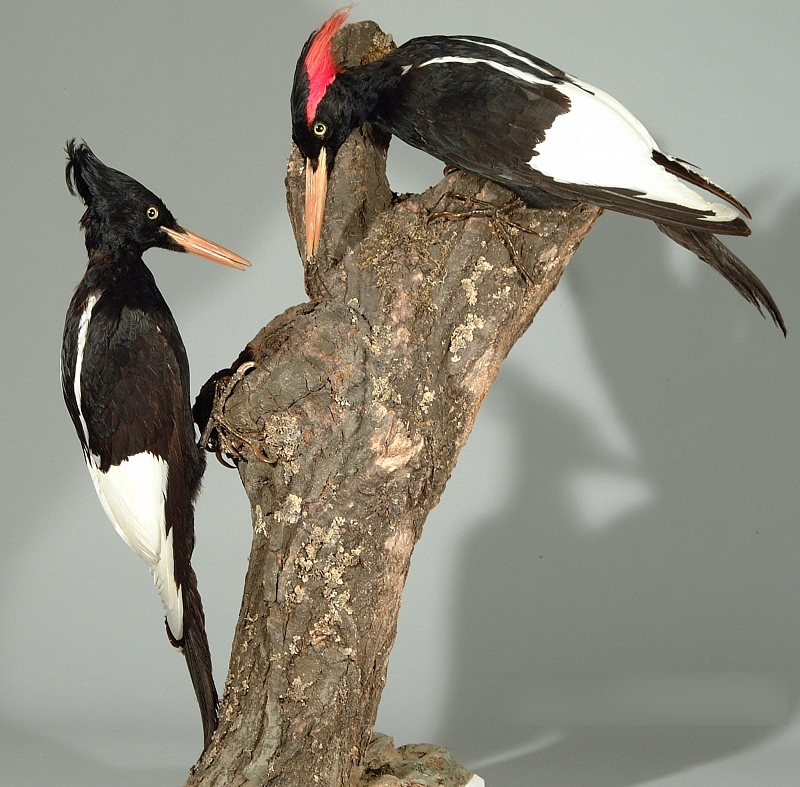
The Ivory-billed Woodpecker boasts a dramatic appearance with a striking black and white plumage. Adults display a glossy black body with large white wing patches visible in flight. The most distinguishing feature is the white trailing edge on the wings, which is prominent when the bird takes to the air. Males can be identified by their vibrant red crest, while females have a black crest. Juveniles resemble adults but with duller coloring and a less pronounced crest. When perched, these woodpeckers maintain an upright posture, often clinging to tree trunks. Confusion may arise with the Pileated Woodpecker, another large woodpecker sharing similar habitats. However, the latter has a more extensive red crest and lacks the distinct white wing patches. The Ivory-billed Woodpecker's flight silhouette is distinctive due to its large wings and relatively slow, direct flight pattern. Observers should also note the bill, which is long and ivory-colored, setting it apart from other woodpeckers.
Having trouble telling birds apart? Upload a photo to our bird identification tool for an instant species match.
Ivory-billed Woodpecker Habitat and Range
Preferred Habitat
The Ivory-billed Woodpecker historically inhabited bottomland hardwood forests, swampy areas, and riparian zones. It favored areas with abundant dead or dying trees, which are crucial for foraging and nesting. These habitats were predominantly found in the southeastern United States, especially in states like Louisiana and Arkansas. The bird's elevation range was generally lowland, reflecting its preference for floodplain forests. Seasonal shifts in habitat were minimal, as the Ivory-billed Woodpecker did not migrate extensively and remained in forested areas year-round. Urban presence was rare given its preference for undisturbed, mature forests. Conservation efforts have focused on preserving and restoring these critical habitats to support any remaining populations.
Geographic Range
The Ivory-billed Woodpecker's breeding range historically spanned the southeastern United States, from Texas to the Carolinas, with a stronghold in the swampy forests of Arkansas, Louisiana, and Mississippi. In Cuba, it was found in the eastern regions, particularly in areas like the Zapata Swamp. The bird was non-migratory, residing in its habitat year-round, though some local movements were noted in response to food availability. Its range contracted significantly due to habitat loss and hunting pressure. Reports of sightings in modern times are sparse and often controversial, stemming from regions like the Big Woods of Arkansas. Population density hotspots, if they exist, would likely be in the least disturbed areas of its historical range, where old-growth forests still persist.
Want to know which birds visit your area? Browse our backyard birds by location guides for region-specific species lists.
What Does the Ivory-billed Woodpecker Eat?
The Ivory-billed Woodpecker primarily fed on wood-boring beetle larvae, serving as a natural pest control agent in its forested habitat. Secondary food sources included various insects, fruits, nuts, and seeds when available. The bird's diet varied with the seasons, showing a preference for beetle larvae during spring and summer, while consuming more fruit and nuts in fall and winter. Foraging techniques involved powerful blows with its bill to strip bark and excavate deep into the wood, exposing cavities where larvae resided. This feeding behavior left distinctive scars on trees, sometimes useful for identifying recent woodpecker activity. The woodpecker's feeding schedule was diurnal, with most foraging occurring during daylight hours, particularly in mornings.
Ivory-billed Woodpecker Behavior and Social Structure
The Ivory-billed Woodpecker exhibited a complex social structure, often forming monogamous pairs that maintained strong bonds. Territoriality was pronounced, with pairs defending large areas of forest against intruders. Courtship displays involved drumming, calling, and aerial chases, reinforcing pair bonds and establishing territory. Flocking patterns were not typical as the bird generally foraged alone or in pairs. In response to predators, the Ivory-billed Woodpecker was vigilant, utilizing its habitat's dense cover to evade detection. Daily activity patterns centered around foraging, with peak activity in the early morning and late afternoon. The bird's large home range and territorial nature required vast tracts of unbroken forest, underscoring the importance of preserving its habitat.
Ivory-billed Woodpecker Nesting and Reproduction
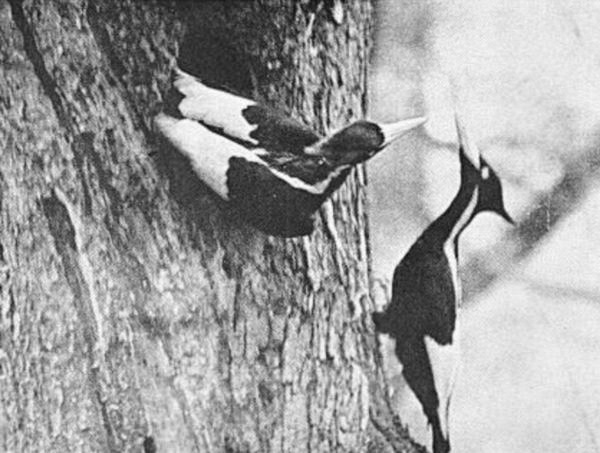
Ivory-billed Woodpeckers were cavity nesters, excavating large nest holes in dead or dying trees, often in remote and undisturbed parts of the forest. Suitable nesting trees included species like bald cypress and Tupelo gum, which provided the necessary size and decay status. The clutch size typically ranged from two to three eggs, with an incubation period of around 20 days. Both parents shared responsibilities, from incubation to feeding and protecting the chicks. Fledging occurred approximately 30-35 days after hatching, with young birds remaining dependent on parents for a few months post-fledging. The species likely produced a single brood per year, reflecting its low reproductive rate and the critical need for nesting success.
Ivory-billed Woodpecker Sounds and Vocalizations
The Ivory-billed Woodpecker's primary vocalization was a distinctive 'kent' call, often described as sounding like a clarinet. This call was repeated in a series, serving both as a contact call between mates and as a territorial display. Alarm calls were sharper and more rapid, signaling the presence of predators. The bird's drumming, a rapid series of taps, was used to communicate presence and establish territory. Known for its powerful drumming, which resonated through the forest, the Ivory-billed Woodpecker's soundscape was unique. The dawn chorus included both vocalizations and drumming, contributing to the auditory tapestry of its swampy habitat.
Interesting Facts About the Ivory-billed Woodpecker
- 1The Ivory-billed Woodpecker is one of the largest woodpeckers in the world, with lengths reaching 48 cm.
- 2Fossil records suggest the Ivory-billed Woodpecker existed for over 50,000 years, thriving in prehistoric America.
- 3The bird's striking 'kent' call is often compared to the sound of a toy trumpet or clarinet.
- 4The Ivory-billed Woodpecker was featured in American folklore and songs, highlighting its cultural impact.
- 5Its dramatic rediscovery claims in 2004 in Arkansas sparked intense scientific and public interest.
- 6The bird's scientific name, 'Campephilus principalis', alludes to its princely status among woodpeckers.
- 7Despite its elusive nature, the Ivory-billed Woodpecker inspired numerous conservation efforts for forest habitats.
Ivory-billed Woodpecker Conservation Status
The Ivory-billed Woodpecker is listed as critically endangered by the IUCN, with ongoing debates about its existence. Historical population declines were drastic, driven by extensive habitat destruction and hunting. Primary threats included logging of old-growth forests and conversion of land for agriculture. Conservation efforts focus on habitat restoration and protection, with organizations like The Nature Conservancy working to preserve potential habitats. Historical population changes highlight the bird's vulnerability to environmental changes, underscoring the need for sustained conservation initiatives. While unconfirmed sightings fuel hope, definitive evidence of its continued existence remains elusive.
Other Picidae Species


Birds Similar to the Ivory-billed Woodpecker
These species are often confused with the Ivory-billed Woodpecker due to similar appearance or overlapping range.