
Japanese Grosbeak
Eophona personata
Order: Passeriformes / Family: Fringillidae
Wikimedia Commons
About the Japanese Grosbeak
The Japanese Grosbeak, scientifically known as Eophona personata, is a striking member of the Fringillidae family. This songbird is primarily found in East Asia, with its presence strongly noted in countries such as Japan, Korea, and parts of China. Its ecological significance is substantial as it plays a vital role in seed dispersion, aiding in the propagation of various plant species. In Japan, the Japanese Grosbeak can often be observed in deciduous forests, particularly during the breeding season, where it takes advantage of the abundance of seeds and insects. Outside the breeding period, these birds are known to inhabit mixed forests and sometimes venture into urban parks and gardens. Seasonal behaviors of the Japanese Grosbeak include a notable migration pattern, where some populations shift from mountainous breeding grounds to lower elevations or more temperate regions during the winter. This movement is crucial for their survival, allowing them access to food sources that would otherwise be scarce in harsher climates. The Japanese Grosbeak exhibits strong flocking behavior during migration and in winter, which not only provides safety in numbers against predators but also enhances their foraging efficiency. The bird's robust beak is specifically adapted for cracking open the hard shells of seeds, which constitutes a major part of its diet. By dispersing seeds, the Japanese Grosbeak contributes significantly to its habitat's ecological balance. Its presence within forests helps maintain plant diversity and supports the broader ecosystem. In Korea, the bird holds cultural significance as well, often featured in traditional art and literature, symbolizing resilience and adaptation. Thus, the Japanese Grosbeak serves as both an ecological keystone and a cultural emblem in its native regions.
The Japanese Grosbeak belongs to the family Fringillidae, within the order Passeriformes. These birds typically live average 5-10 years, with a maximum recorded at 12 years..
How to Identify a Japanese Grosbeak
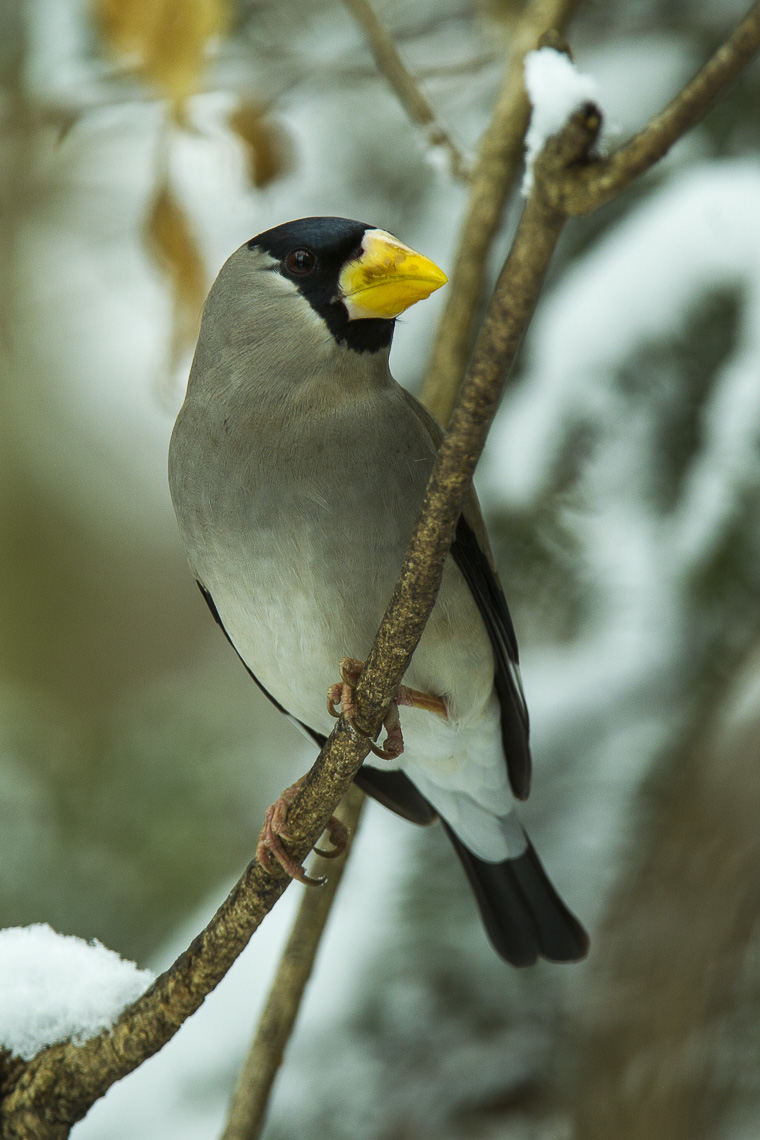
The Japanese Grosbeak is a medium-sized songbird, notable for its stout body and large, powerful bill. Adult plumage is characterized by a pale gray body contrasted with a striking black face mask, which gives the bird its name. The wings and tail feature a mix of black and white, with the wings showing prominent white patches in flight. Males and females are similar in appearance, although females may have slightly duller plumage. Juveniles are distinguishable by their more subdued coloration and the absence of a fully developed black face mask. In flight, the Japanese Grosbeak's silhouette is robust, with strong, steady wingbeats. When perched, it maintains an upright posture, often sitting high in the trees. Similar species confusion may occur with the Hawfinch, but the Japanese Grosbeak's larger beak and distinct facial markings are reliable differentiators.
Having trouble telling birds apart? Upload a photo to our bird identification tool for an instant species match.
Japanese Grosbeak Habitat and Range
Preferred Habitat
The Japanese Grosbeak primarily inhabits deciduous and mixed forests across its range. It favors areas with abundant seed-producing trees such as oaks and beeches. During the breeding season, it tends to stay in higher elevations, often in mountainous regions. However, in the non-breeding season, it may descend to lower elevations and even venture into urban areas, utilizing parks and gardens. This adaptability to various habitats allows the Japanese Grosbeak to thrive across diverse landscapes. Despite its preference for forested environments, it is not uncommon to find this bird in rural orchards and farmland edges, where food is plentiful.
Geographic Range
The Japanese Grosbeak is predominantly found in East Asia, with its breeding range spanning across Japan, Korea, and northeastern China. During the winter months, some populations migrate southward and westward to warmer regions, including southern Japan and parts of the Korean Peninsula. The bird's movement is often dictated by food availability and climate conditions. In its range, the Japanese Grosbeak is generally considered common, with population density hotspots occurring in the mountainous regions of Japan and the forests of Korea. These areas provide ideal breeding and feeding conditions, supporting large flocks during certain times of the year.
Want to know which birds visit your area? Browse our backyard birds by location guides for region-specific species lists.
What Does the Japanese Grosbeak Eat?
The diet of the Japanese Grosbeak consists primarily of seeds, which it adeptly cracks open with its powerful beak. Oak acorns and beech nuts are among its favored food sources. In addition to seeds, the Japanese Grosbeak consumes a variety of insects, especially during the breeding season when protein-rich food is essential for chick development. The bird employs a foraging technique that involves methodically searching through foliage and on the ground, using its strong bill to extract seeds and insects from their hiding places. Seasonal diet changes occur, with a greater reliance on insects and other invertebrates in spring and summer, while seeds dominate its diet in autumn and winter.
Japanese Grosbeak Behavior and Social Structure
Japanese Grosbeaks display a range of intriguing behaviors, particularly in social and feeding contexts. These birds are generally social, often forming small flocks outside the breeding season. Their flocking behavior offers mutual benefits, such as increased vigilance against predators and enhanced foraging success. During the breeding season, however, they establish territories and become more solitary or operate in pairs. Courtship displays are subtle, involving mutual preening and soft calls between mates. The Japanese Grosbeak's response to predators involves alarm calls and retreating to higher branches or dense foliage for cover. They are primarily diurnal, with peak activity occurring during the early morning and late afternoon. This schedule aligns with optimal foraging times, allowing them to exploit food resources efficiently.
Japanese Grosbeak Nesting and Reproduction
The Japanese Grosbeak constructs its nest high in the canopy of deciduous trees, often camouflaged among the leaves to protect against predators. Nests are cup-shaped, crafted from twigs, grass, and other plant fibers, sometimes lined with softer materials for insulation. Clutch size typically ranges from 3 to 5 eggs, with both parents sharing incubation duties over a period of approximately 12 to 14 days. After hatching, the chicks remain in the nest for about two weeks, during which time they are fed by both parents. Parental care extends beyond fledging, with adults continuing to feed and protect the young until they are independent. The Japanese Grosbeak usually raises one brood per year, though favorable conditions may lead to a second brood.
Japanese Grosbeak Sounds and Vocalizations
The Japanese Grosbeak's primary song is a series of melodious, flute-like notes, often repeated in a sequence that is both rhythmic and pleasant to the ear. The call notes are sharp and metallic, serving as contact calls between flock members or as alarm signals. During the dawn chorus, the Japanese Grosbeak's song stands out with its clear, musical quality, often dominating the soundscape in its habitat. Compared to other songbirds, its song is less complex but distinctly more resonant, making it a memorable component of the forest soundscape.
Interesting Facts About the Japanese Grosbeak
- 1The Japanese Grosbeak can exert a force of up to 50 Newtons with its beak, enabling it to crack open hard seeds.
- 2Unlike many songbirds, the Japanese Grosbeak's song is simple yet resonant, often heard over long distances.
- 3Japanese Grosbeaks have been observed using tools, such as twigs, to extract insects from crevices.
- 4In traditional Japanese art, the Japanese Grosbeak symbolizes resilience and adaptability, often depicted in natural settings.
- 5The average lifespan of a Japanese Grosbeak in the wild is around 5 to 7 years, depending on environmental conditions.
- 6Fossil records indicate that ancestors of the Japanese Grosbeak existed around 5 million years ago.
- 7Japanese Grosbeaks have a unique migratory pattern, with some populations remaining resident while others migrate.
Japanese Grosbeak Conservation Status
The Japanese Grosbeak is currently listed as Least Concern by the IUCN, with stable population trends. However, habitat loss due to deforestation and urban expansion poses potential threats. Conservation efforts focus on habitat preservation and monitoring population dynamics to prevent future declines. Historically, the Japanese Grosbeak has maintained a stable population, thanks to its adaptability and wide range, but continued vigilance is necessary to ensure its ongoing survival amidst environmental changes.
Other Fringillidae Species


Birds Similar to the Japanese Grosbeak
These species are often confused with the Japanese Grosbeak due to similar appearance or overlapping range.
