
Japanese Paradise-Flycatcher
Terpsiphone atrocaudata
Order: Passeriformes / Family: Monarchidae
Wikimedia Commons
About the Japanese Paradise-Flycatcher
The Japanese Paradise-Flycatcher, Terpsiphone atrocaudata, is a visually stunning bird that belongs to the family Monarchidae. This medium-sized passerine is renowned for its striking appearance and widespread presence across various regions in Asia. Native to countries such as Japan, Taiwan, the Philippines, and parts of eastern China and Korea, it thrives in subtropical and tropical forest habitats. This bird is of significant interest due to its unique ecological role within these environments, acting as both a predator and a prey species.
As a migratory bird, the Japanese Paradise-Flycatcher displays distinct seasonal behaviors. It breeds primarily in Japan from April to August, after which it migrates to wintering grounds in Southeast Asia, including the Philippines and Indonesia. During the breeding season, males exhibit their remarkable plumage to attract mates, while both sexes engage in raising the young. In winter, their presence in lush forests contributes to the ecological balance, as they control insect populations, aiding in pest management in their habitats.
The Japanese Paradise-Flycatcher holds cultural significance, especially in its breeding regions. In Japan, it is sometimes associated with traditional folklore and is admired for its elegance and the symbolic beauty it brings to the natural landscape. Conservationists monitor its populations due to habitat loss and environmental changes, which could potentially threaten this species. Its role as an insect predator underscores its importance in maintaining healthy forest ecosystems.
The Japanese Paradise-Flycatcher belongs to the family Monarchidae, within the order Passeriformes. These birds typically live average 6 years, with some living up to 10 years.
How to Identify a Japanese Paradise-Flycatcher
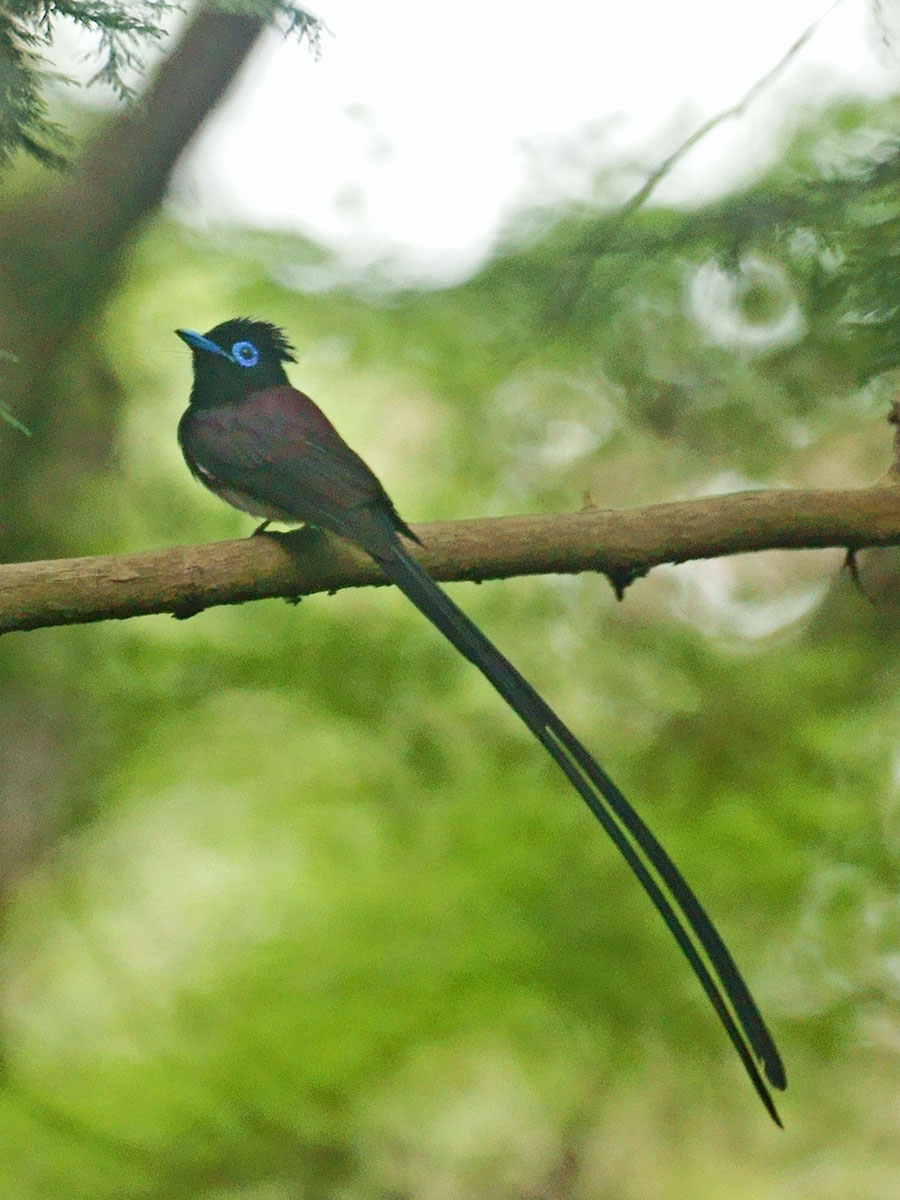
Adult male Japanese Paradise-Flycatchers are unmistakable with their long, ribbon-like tail feathers that can extend up to 30 cm. Their glossy blue-black hoods contrast sharply with their white underparts, while their wings are a rich chestnut. Females, although less dramatic, are equally captivating with a similar color scheme but have shorter tails and a less pronounced blue sheen. Juveniles resemble females but often display duller colors and lack the iridescent quality seen in adults.
In terms of similar species, the Japanese Paradise-Flycatcher may be confused with other members of the genus Terpsiphone, such as the Asian Paradise-Flycatcher. However, its restricted range and specific tail length help distinguish it from its relatives. In flight, the species presents a unique silhouette with its long tail streaming behind, a feature that aids in identification from a distance. When perched, its upright posture and distinctive color pattern make it easily recognizable.
The bird's plumage serves not only as a method of identification but also plays a role in its courtship displays. Males often fan their tails and display their white eye-ring to attract females, adding to their allure during the breeding season.
Having trouble telling birds apart? Upload a photo to our bird identification tool for an instant species match.
Japanese Paradise-Flycatcher Habitat and Range
Preferred Habitat
The Japanese Paradise-Flycatcher primarily inhabits subtropical and tropical forests, preferring dense, moist environments with abundant tree cover. It thrives in lowland areas and can be found at elevations ranging from sea level up to 2000 meters in mountainous regions. During the breeding season, it favors deciduous and mixed forests in Japan, where it finds ample nesting sites and food resources.
Seasonal habitat shifts occur as the species migrates to its wintering grounds in Southeast Asia. In these regions, it remains within forested areas, often seeking out secondary forests and forest edges that provide shelter and food. Despite its affinity for forest habitats, the Japanese Paradise-Flycatcher can occasionally be observed in more urban settings, particularly during migration, when it may visit parks and gardens.
Its ability to adapt to various forest types, from primary to secondary growth, highlights its ecological versatility. However, deforestation and habitat fragmentation pose significant threats, emphasizing the need for conservation efforts to preserve its natural habitats.
Geographic Range
The breeding range of the Japanese Paradise-Flycatcher extends across Japan, including the main islands of Honshu, Kyushu, and Shikoku, as well as the Ryukyu Islands. It also breeds in parts of Korea and eastern China. During the non-breeding season, the species migrates to wintering grounds in Southeast Asia, notably in the Philippines, Taiwan, and parts of Indonesia.
Migration corridors are essential for this species, and it follows well-established routes across the East Asian Flyway. These corridors connect its breeding and wintering habitats, allowing for seasonal movement between the regions. Some individuals may travel thousands of kilometers during migration, showcasing their endurance and navigational abilities.
Population density hotspots are primarily in Japan during the breeding season, where they are more concentrated in suitable forested areas. In contrast, their distribution becomes more scattered in the broader Southeast Asian region during winter, where they blend with local resident bird populations.
Want to know which birds visit your area? Browse our backyard birds by location guides for region-specific species lists.
What Does the Japanese Paradise-Flycatcher Eat?
The Japanese Paradise-Flycatcher primarily feeds on insects and other small invertebrates, making them an important insectivore in their ecosystems. Their diet consists of beetles, flies, caterpillars, and spiders, which they actively hunt within the forest canopy. This bird employs a variety of foraging techniques, such as sallying and gleaning, to capture prey.
Seasonal diet changes occur as they migrate between breeding and wintering grounds. In the breeding season, they focus on abundant insects to support their energy needs and those of their young. During winter, they adapt to available food sources in their new habitats, which may include a wider range of insect prey.
The Japanese Paradise-Flycatcher's foraging schedule is primarily diurnal, with peak activity occurring in the early morning and late afternoon. They can often be seen sallying from perches to catch insects mid-flight, showcasing their agility and precision.
Japanese Paradise-Flycatcher Behavior and Social Structure
The Japanese Paradise-Flycatcher exhibits fascinating behaviors, particularly during the breeding season. Males perform elaborate courtship displays, utilizing their long tails and vivid plumage to attract females. These displays often involve aerial acrobatics and vocalizations that highlight their physical attributes.
Socially, they tend to be solitary or found in pairs, especially during the breeding season when they become territorial. Males defend their territories aggressively, using songs and physical displays to deter rivals. Outside of the breeding season, they may join mixed-species flocks, benefiting from the collective vigilance and foraging success.
Their response to predators involves a combination of concealment and alarm calls. The species is typically active during the day, with peak activity in the cooler hours of morning and evening. This daily pattern allows them to exploit different insect availabilities and manage energy expenditure efficiently.
Japanese Paradise-Flycatcher Nesting and Reproduction
The Japanese Paradise-Flycatcher constructs cup-shaped nests, typically positioned in the forks of tree branches within dense forests. These nests are made from twigs, moss, and other plant materials, bound together with spider webs to ensure stability and camouflage.
A typical clutch consists of 3 to 4 eggs, with both parents sharing incubation duties over a period of approximately 12 to 14 days. After hatching, chicks remain in the nest for about 10 to 12 days before fledging. Both male and female parents participate in feeding and caring for the young, maintaining a high level of parental investment.
The species generally raises one brood per year, although in some regions, an additional brood may occur if conditions are favorable. Nesting success is heavily influenced by habitat quality and predation pressures, emphasizing the importance of conserving suitable breeding environments.
Japanese Paradise-Flycatcher Sounds and Vocalizations
The primary song of the Japanese Paradise-Flycatcher is a melodious series of whistles and chirps, characterized by a rhythmic, fluting quality that is both distinctive and enchanting. This song serves crucial functions in territorial defense and mate attraction during the breeding season. Additionally, the species emits shorter call notes that are less musical but serve as communication between mates or as alerts to potential threats.
Alarm calls are sharper and more urgent, designed to warn of predators and signal other birds to take cover. During the dawn chorus, the Japanese Paradise-Flycatcher's song can be heard blending with those of other forest birds, creating a rich tapestry of sound. Its musicality and complexity make it one of the more recognizable songs among Asian forest birds.
Interesting Facts About the Japanese Paradise-Flycatcher
- 1The Japanese Paradise-Flycatcher can travel over 3000 kilometers during its migratory journey.
- 2Males grow tail feathers up to three times the length of their bodies during the breeding season.
- 3Despite its name, the Japanese Paradise-Flycatcher is also native to parts of China and Korea.
- 4It is one of the few bird species that use spider webs as a primary material for nest construction.
- 5The species exhibits sexual dimorphism, with males sporting longer tails and more vibrant plumage.
- 6Its melodious song has made it a favorite subject in traditional Japanese poetry and art.
- 7The Japanese Paradise-Flycatcher plays a vital role in controlling insect populations within its habitat.
Japanese Paradise-Flycatcher Conservation Status
The Japanese Paradise-Flycatcher is currently classified as Near Threatened on the IUCN Red List, with populations showing a declining trend. The primary threats to this species include habitat loss due to deforestation and land-use changes across its range. In Japan, where it breeds, urban development and forestry practices have reduced suitable nesting sites, while in Southeast Asia, logging and conversion of forests to agriculture impact its wintering habitats. Conservation efforts focus on habitat preservation and restoration, particularly in key breeding and migration areas. Initiatives include protected area designation and community engagement to promote sustainable land-use practices. Historical population changes reflect a decline over the past few decades, correlating with increased habitat pressures. Efforts to mitigate these threats are crucial for the long-term survival of the species.


