
Jerdon's Courser
Rhinoptilus bitorquatus
Order: Charadriiformes / Family: Glareolidae
Wikimedia Commons
About the Jerdon's Courser
Jerdon's Courser (Rhinoptilus bitorquatus) is a critically endangered bird endemic to the sparse scrub forests of the Eastern Ghats in Andhra Pradesh, India. This elusive species was thought to be extinct for over 80 years before being rediscovered in 1986, which sparked significant interest among ornithologists and conservationists. The Jerdon's Courser plays a crucial role in its ecosystem by controlling insect populations, as it primarily feeds on small invertebrates. Its presence indicates a healthy scrub forest habitat, which is a vital ecosystem in need of protection. The bird's elusive nature, combined with its restricted range, underscores its significance as a flagship species for conservation efforts in the region. Jerdon's Courser's habitat consists mainly of undisturbed scrub forests with open patches, where it forages for food during the night. During the day, it remains hidden under thick vegetation to avoid predators. The bird's nocturnal habits and cryptic plumage make it challenging for birdwatchers and researchers to observe, contributing to its mystique and rarity. Seasonally, Jerdon's Courser does not undertake long migrations but may move locally in response to monsoons and food availability. The monsoon season transforms its habitat, encouraging abundant growth and a surge in insect populations, providing ample food resources. Preservation of its habitat is crucial for the survival of this species, as agricultural expansion and development pose significant threats. Conservation initiatives focus on habitat preservation and community engagement to prevent further habitat destruction. As Jerdon's Courser is a symbol of the unique biodiversity in the Eastern Ghats, its conservation has broader implications for preserving the entire ecosystem.
The Jerdon's Courser belongs to the family Glareolidae, within the order Charadriiformes. These birds typically live average lifespan is unknown, but likely around 8-10 years..
How to Identify a Jerdon's Courser
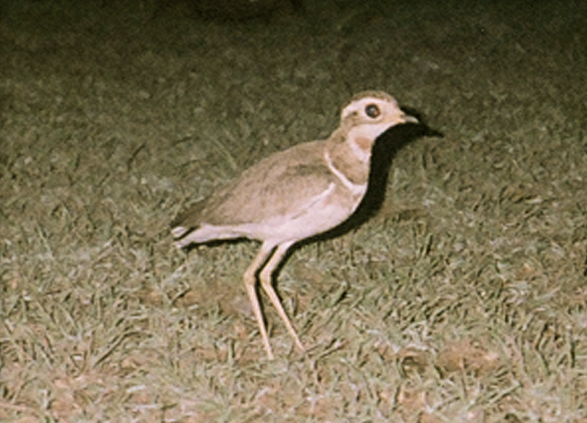
Jerdon's Courser is a medium-sized bird characterized by its cryptic brown plumage, which provides excellent camouflage in its scrub forest habitat. Adults have a distinct white throat and breast band, which contrasts sharply with their otherwise brown and rufous coloration. The upperparts are mottled with shades of brown and black, while the underparts are a paler buff color. This bird's large eyes are adapted for nocturnal activity, allowing it to detect prey in low-light conditions. Juveniles resemble adults but have slightly duller plumage, lacking the distinct contrast of the white throat and breast band. There is no significant sexual dimorphism, so males and females appear similar in the field. When observed in flight, Jerdon's Courser displays a broad, rounded wing shape with a distinctive white wing bar, which can be a useful identification mark. Its flight is low and direct, often staying close to the ground. When perching, it tends to remain motionless, relying on its plumage to blend into the background. Similar species like the Indian Courser may cause confusion, but Jerdon's Courser's nocturnal habits and specific geographic range help differentiate it from other coursers.
Having trouble telling birds apart? Upload a photo to our bird identification tool for an instant species match.
Jerdon's Courser Habitat and Range
Preferred Habitat
Jerdon's Courser inhabits dry scrub forests and thorny bushes, primarily found in the Eastern Ghats of Andhra Pradesh, India. These habitats are characterized by sparse tree cover, open sandy patches, and dense undergrowth, providing the perfect environment for this ground-dwelling bird. The typical elevation range for Jerdon's Courser is between 200 and 500 meters above sea level. It prefers areas with minimal human disturbance, as agricultural expansion and habitat fragmentation pose significant threats. Unlike some bird species, Jerdon's Courser does not adapt well to urban environments and remains confined to rural areas. Seasonal rainfall during the monsoon leads to habitat shifts, with birds possibly moving to areas with increased food availability. The preservation of these scrub forests is critical, as they provide the necessary cover and foraging grounds essential for the survival of Jerdon's Courser.
Geographic Range
Jerdon's Courser is restricted to a very limited range in southern India, specifically within the Eastern Ghats of Andhra Pradesh. Its known distribution is highly localized, with confirmed sightings primarily around the Lankamalai and Velikonda hills. This range lies within the Kadapa and Nellore districts. Unlike many other bird species, Jerdon's Courser does not undertake extensive migrations. It remains a resident of its restricted range, with possible local movements influenced by seasonal changes in climate and food resources. Historically, its range may have been broader, but habitat loss has significantly reduced its distribution. Population density hotspots are few, with the bird predominantly occupying protected areas where conservation efforts are actively underway. The limited range and declining habitat quality make Jerdon's Courser one of the most threatened bird species, necessitating focused conservation interventions.
Want to know which birds visit your area? Browse our backyard birds by location guides for region-specific species lists.
What Does the Jerdon's Courser Eat?
Jerdon's Courser primarily feeds on a diet of small invertebrates such as insects and their larvae. Its diet includes ants, beetles, and termites, which it skillfully captures using its keen eyesight and quick reflexes. This bird forages on the ground, often at night, using a technique known as 'gleaning', where it picks prey from the ground and vegetation. During the monsoon season, when insect populations surge, Jerdon's Courser benefits from an abundant food supply, allowing it to thrive and maintain its energy requirements. The bird's feeding schedule is largely nocturnal, optimizing the cooler temperatures and reduced predator presence at night. Prey size ranges from small ants to medium-sized beetles, with the bird showing remarkable adaptability in its foraging strategy. Occasionally, it may consume seeds or small plant material, but this forms a minor part of its diet.
Jerdon's Courser Behavior and Social Structure
Jerdon's Courser exhibits solitary or paired territorial behavior, rarely forming flocks. This elusive bird is predominantly nocturnal, foraging at night and resting during the day. Territorial displays are subtle and often involve vocalizations and posturing rather than overt aggression. Courtship behavior includes displays of plumage and calls to attract mates, with pairs forming long-term bonds. In response to predators, Jerdon's Courser relies on its cryptic plumage and tendency to remain motionless as the first line of defense. If threatened, it may fly low to the ground to escape danger. Daily activity patterns revolve around feeding at dusk and dawn, while resting during the hottest parts of the day. The bird's elusive nature and specific habitat preferences make detailed behavioral observations challenging, contributing to its enigmatic status among birdwatchers and researchers.
Jerdon's Courser Nesting and Reproduction
Jerdon's Courser nests on the ground, creating a simple scrape lined with leaves and small twigs. The preferred nesting sites are well-concealed under bushes or dense vegetation, offering protection from predators. The clutch size typically consists of two eggs, which are pale brown with darker speckles, blending seamlessly with the surroundings. Both parents share incubation duties, which last approximately 19 to 21 days. After hatching, chicks are precocial, able to leave the nest shortly after and rely on camouflage for protection. They are cared for by both parents, who provide food and guidance until the fledging period, which occurs around three weeks post-hatching. Jerdon's Courser may raise one or two broods per year, depending on environmental conditions and food availability. Nesting success is heavily influenced by habitat quality and disturbance levels.
Jerdon's Courser Sounds and Vocalizations
Jerdon's Courser's primary song consists of a series of soft, repetitive 'whit' notes delivered in a slow, rhythmic pattern. These calls are most often heard at night, during the bird's active period. The calls serve as both territorial markers and contact calls between pairs. Alarm calls are sharper, more abrupt, and louder, designed to alert mates of potential threats. Dawn chorus activity is minimal, as the bird's nocturnal habits mean vocalizations are primarily nocturnal. The sound is somewhat reminiscent of a distant cricket or frog, blending into the nighttime soundscape of the scrub forest. These vocalizations are crucial for communication in the dense, dimly lit habitat where visual cues are less reliable.
Interesting Facts About the Jerdon's Courser
- 1Jerdon's Courser was rediscovered in 1986 after being considered extinct for over 80 years.
- 2The bird's elusive nature makes it one of the least observed birds in its range, adding to its mystique.
- 3Jerdon's Courser is named after Thomas C. Jerdon, a British surgeon-naturalist who first described it in 1848.
- 4Despite its limited range, this bird is a flagship species for the conservation of the Eastern Ghats' biodiversity.
- 5The cryptic plumage of Jerdon's Courser allows it to blend seamlessly into its scrub forest habitat.
- 6It relies on its nocturnal lifestyle to avoid predators and exploit the cooler night temperatures for foraging.
- 7The bird's presence indicates a healthy scrub forest ecosystem, making it an important species for ecological studies.
Jerdon's Courser Conservation Status
The International Union for Conservation of Nature (IUCN) lists Jerdon's Courser as Critically Endangered. The primary threats to its survival include habitat destruction due to agricultural expansion, infrastructure development, and deforestation. Population trends indicate a decline, exacerbated by the small and fragmented habitat range. Conservation efforts focus on habitat protection, legal enforcement against land conversion, and awareness campaigns among local communities. The rediscovery of the bird in 1986 highlighted the need for habitat preservation efforts. Conservationists emphasize the importance of protected areas and community involvement to ensure the survival of Jerdon's Courser. Ongoing research aims to better understand its ecology and inform conservation strategies to stabilize and eventually increase the population.

