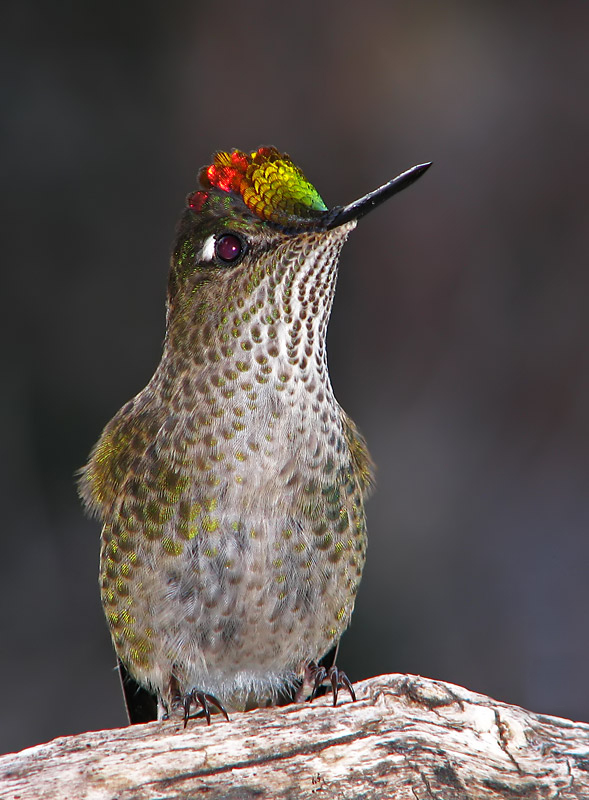
Juan Fernandez Firecrown
Sephanoides fernandensis
Order: Apodiformes / Family: Trochilidae

Wikimedia Commons
About the Juan Fernandez Firecrown
The Juan Fernandez Firecrown (Sephanoides fernandensis) is an exceptional hummingbird species native to the Juan Fernandez Archipelago, located off the coast of Chile. This critically endangered bird, unique to Robinson Crusoe Island, is revered for its stunning iridescent plumage and ecological significance. The firecrown plays a vital role as a pollinator within its restricted habitat, aiding in the reproduction of various endemic plant species. Its presence highlights the delicate balance of the island's ecosystem and the unique biodiversity found there.
Endemic to the Juan Fernandez Islands, the firecrown thrives in the archipelago's temperate forests, which are characterized by a mix of native and introduced vegetation. The dense canopy and understory provide essential foraging and nesting grounds. Despite its limited range, the firecrown exhibits remarkable adaptability to the island's diverse microhabitats, from coastal regions to higher elevations reaching 500 meters. Seasonal behaviors include altitudinal movements in response to blooming cycles of favored plant species, ensuring a continuous food supply.
As an ecological linchpin, the Juan Fernandez Firecrown's decline signals broader environmental challenges. Habitat destruction due to human activities and the introduction of invasive species pose significant threats. Conservation efforts are underway to restore and protect the firecrown's natural habitat, crucial for maintaining the island's unique ecological balance. The bird's plight draws attention to the need for sustainable practices and increased awareness of the environmental pressures faced by isolated ecosystems.
The Juan Fernandez Firecrown belongs to the family Trochilidae, within the order Apodiformes. These birds typically live average 5-7 years, with some living up to 10 years..
How to Identify a Juan Fernandez Firecrown
The Juan Fernandez Firecrown is a medium-sized hummingbird, measuring approximately 11 cm in length. Males exhibit a striking iridescent orange-red crown and throat, which catch the light with a vivid brilliance. Their upperparts shimmer with a bronze-green hue, while the underparts remain a lighter, more muted green. In contrast, females display a more subdued coloration, with a greenish crown and throat, accompanied by whitish underparts with green speckling. Juvenile firecrowns resemble females but are generally duller in coloration.
Field identification of the Juan Fernandez Firecrown requires careful attention to its distinctive crown coloration, which differentiates it from other hummingbird species. Observers should note the bird's swift, agile flight, characterized by rapid wingbeats that produce a distinctive humming sound. When perched, the firecrown adopts an upright posture, often on exposed branches where its vibrant plumage can be easily observed.
While there are no similar hummingbird species on the Juan Fernandez Islands, the firecrown could be confused with its closest relative, the Green-backed Firecrown (Sephanoides sephaniodes), found on mainland Chile. However, the Green-backed Firecrown lacks the brilliant orange-red crown of the Juan Fernandez species, making identification straightforward when plumage details are visible.
Having trouble telling birds apart? Upload a photo to our bird identification tool for an instant species match.
Juan Fernandez Firecrown Habitat and Range
Preferred Habitat
The Juan Fernandez Firecrown inhabits the temperate forests of Robinson Crusoe Island, favoring areas with dense vegetation. These forests, comprising both endemic and introduced plant species, provide critical resources such as nectar and nesting materials. The firecrown occupies elevations from sea level up to 500 meters, exhibiting flexibility in habitat selection within this range.
The island's unique microhabitats support various life stages of the firecrown. During the breeding season, the bird often selects areas with abundant flowering plants, ensuring an ample food supply. Seasonal habitat shifts are influenced by flowering cycles, prompting the firecrown to move between coastal regions and higher elevations as necessary.
In contrast to many hummingbird species, the Juan Fernandez Firecrown shows limited presence in urban areas, primarily due to the isolated nature of its habitat. Conservation efforts focus on preserving natural forest environments, which are crucial for the bird's survival and the overall health of the island's ecosystem.
Geographic Range
The Juan Fernandez Firecrown is endemic to the Juan Fernandez Archipelago, specifically Robinson Crusoe Island, situated approximately 670 kilometers west of mainland Chile. This limited distribution confines the bird to a single island, highlighting its vulnerability to habitat changes and human impacts.
The firecrown's range extends across the island's varying elevations, from coastal plains to forested uplands, without any migratory behavior. The bird's sedentary nature restricts its movement to areas within Robinson Crusoe Island, making localized conservation efforts paramount to its survival.
Population density hotspots are found in regions with high concentrations of flowering plants, which provide essential nectar resources. These areas are critical for supporting breeding populations, as they offer both food and suitable nesting sites. Efforts to preserve and restore these habitats are central to maintaining the firecrown's limited range and preventing further population declines.
Want to know which birds visit your area? Browse our backyard birds by location guides for region-specific species lists.
What Does the Juan Fernandez Firecrown Eat?
The Juan Fernandez Firecrown primarily feeds on nectar from a variety of flowering plants, including both endemic and introduced species. Its specialized feeding technique involves hovering in front of flowers, using its long, slender bill to extract nectar while simultaneously pollinating the plants.
The firecrown's diet varies seasonally, coinciding with the blooming periods of its preferred food sources. During times of floral abundance, it focuses on high-nectar plants such as Dendroseris and Rhaphithamnus species. In addition to nectar, the firecrown consumes small insects and spiders, providing essential protein for growth and reproduction.
Foraging activity peaks during the early morning and late afternoon, aligning with the availability of nectar. The bird exhibits territorial behavior around prime feeding sites, often defending preferred flowers from intruders. Its role as a pollinator is crucial for the reproductive success of many endemic plant species, underscoring its ecological importance.
Juan Fernandez Firecrown Behavior and Social Structure
The Juan Fernandez Firecrown is a solitary and territorial bird, displaying aggressive behavior to defend its feeding and nesting territories. Males, in particular, are known for their combative interactions, using aerial displays and vocalizations to establish dominance. These displays often involve rapid, zigzag flights and sharp, high-pitched calls.
During the breeding season, courtship displays become more pronounced, with males showcasing their vibrant plumage to attract females. The male firecrown performs elaborate aerial maneuvers, sometimes accompanied by vocalizations, to demonstrate his fitness and secure a mate.
Daily activity patterns include a mix of foraging, preening, and territorial defense. The firecrown remains active throughout daylight hours, with peak activity occurring during early morning and late afternoon. Its response to predators involves quick evasive flights and the use of dense vegetation for cover. Despite its solitary nature, the firecrown's role as a pollinator and its interactions with other species are vital for maintaining the ecological balance of its habitat.
Juan Fernandez Firecrown Nesting and Reproduction
The Juan Fernandez Firecrown constructs cup-shaped nests using plant fibers, moss, and spider silk to provide elasticity and strength. These nests are strategically placed on slender branches or tree forks, often at heights ranging from 1 to 5 meters above ground, to protect against predators and weather elements.
Females are solely responsible for nest construction, incubation, and the care of young. A typical clutch consists of two white eggs, with the incubation period lasting approximately 16-19 days. Following hatching, the female continues to care for the chicks, feeding them a diet rich in regurgitated nectar and insects.
The fledging timeline spans around 20-26 days, after which the young firecrowns leave the nest but remain within the vicinity for continued parental support. The species typically raises one brood per year, although favorable conditions may occasionally allow for a second. The nesting period aligns with peak floral abundance, ensuring an ample food supply for the growing chicks.
Juan Fernandez Firecrown Sounds and Vocalizations
The Juan Fernandez Firecrown's primary song features a series of rapid, high-pitched notes with a rhythmic, chattering quality. These vocalizations serve both territorial and courtship purposes, often increasing in intensity during the breeding season.
In addition to its song, the firecrown emits sharp, single-note calls used as alarm calls or to communicate with other hummingbirds. The bird's vocal repertoire is essential for maintaining territories and attracting mates, with dawn often featuring a chorus of vocal activity as males establish dominance.
The firecrown's calls bear resemblance to those of other hummingbirds but are distinguished by their faster tempo and higher pitch, making them a unique identifier in the field. Listeners can often hear these calls echoing through the island's forests, adding to the vibrant soundscape of its habitat.
Interesting Facts About the Juan Fernandez Firecrown
- 1The Juan Fernandez Firecrown is one of the rarest hummingbirds in the world, with an estimated population of fewer than 500 individuals.
- 2Males and females of the Juan Fernandez Firecrown exhibit sexual dimorphism, with males showcasing vibrant orange-red crowns.
- 3The firecrown's role as a pollinator is vital for the survival of several endemic plant species found only on Robinson Crusoe Island.
- 4Despite its small range, the Juan Fernandez Firecrown can be observed year-round on Robinson Crusoe Island, adapting to seasonal changes in floral abundance.
- 5The firecrown's nests are made with spider silk, providing elasticity and strength to withstand the island's windy conditions.
- 6The species was first described in 1830, highlighting the long-standing recognition of its unique status among hummingbirds.
- 7Conservationists have implemented programs to control invasive species on the island, aiming to improve habitat conditions for the firecrown.
Juan Fernandez Firecrown Conservation Status
The Juan Fernandez Firecrown is currently classified as critically endangered by the IUCN, with a population trend that remains in decline. Habitat loss due to deforestation, invasive species, and human activities pose significant threats to its survival. Conservation efforts focus on habitat restoration and management, including the removal of invasive plants and the protection of native forests. These initiatives aim to create a more stable environment for the firecrown and other endemic species. Historical population declines highlight the urgent need for continued conservation action and public awareness. Organizations are working to monitor the firecrown population and implement sustainable land-use practices. These efforts are crucial for reversing the bird's decline and preserving the unique biodiversity of the Juan Fernandez Islands.
Other Trochilidae Species


Birds Similar to the Juan Fernandez Firecrown
These species are often confused with the Juan Fernandez Firecrown due to similar appearance or overlapping range.