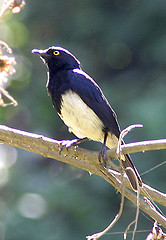
Kenrick's Starling
Poeoptera kenricki
Order: Passeriformes / Family: Sturnidae

Wikimedia Commons
About the Kenrick's Starling
Kenrick's Starling, known scientifically as Poeoptera kenricki, is a captivating bird species belonging to the family Sturnidae. This medium-sized starling is renowned for its brilliant iridescent plumage, with colors that shift between vibrant blues and greens depending on the light. Native to the montane forests of East Africa, it inhabits regions such as the Eastern Arc Mountains in Tanzania and the highland forests of Kenya. These birds thrive in dense forest canopies, where they play an essential role in the local ecosystem as both insect predators and seed dispersers. Kenrick's Starling exhibits seasonal behaviors, often forming small flocks during the breeding season, which typically occurs from September to December. During this time, they engage in intricate courtship displays that highlight their vivid feathers. Outside the breeding season, they may join mixed-species flocks, contributing to their ecological role as a forest pest control agent. The significance of Kenrick's Starling extends beyond its visual appeal. As a species endemic to a specific region, it serves as an indicator of forest health, with its presence signaling a well-preserved environment. The bird's diet primarily consists of insects, fruits, and seeds, making it a crucial participant in seed dispersal and pest regulation. Their feeding habits help maintain the delicate balance of their forest habitats by controlling insect populations and aiding in the regeneration of native vegetation. Conservation efforts focus on preserving the habitat of Kenrick's Starling, as deforestation and habitat fragmentation pose significant threats to its survival. Ongoing studies aim to understand the population dynamics and ecological requirements of this species, ensuring its continued presence in its native range. By protecting the montane forests of East Africa, conservationists aim to secure the future of Kenrick's Starling alongside other endemic species that share its habitat. In summary, Kenrick's Starling is not only a stunning addition to the avifauna of East Africa but also an important ecological player whose conservation is vital for the health of its native montane forest ecosystems.
The Kenrick's Starling belongs to the family Sturnidae, within the order Passeriformes. These birds typically live average 5-7 years, max recorded 9 years.
How to Identify a Kenrick's Starling
Kenrick's Starling can be identified by its distinctive iridescent plumage, which features striking blue and green hues that shimmer in the light. The adult plumage is primarily metallic blue with a greenish sheen on the head and upper body, giving the bird a unique and captivating appearance. The underparts are typically a darker shade, providing a contrasting backdrop to the more vibrant upper body. Juvenile individuals are less vivid, displaying a more muted coloration with brownish tones, which gradually transitions to the adult plumage as they mature. Both male and female Kenrick's Starlings are similar in appearance, although males may show slightly more intense coloration during the breeding season. This lack of sexual dimorphism makes field identification based on plumage alone challenging. However, the bird's unique color patterns help distinguish it from other starling species in its range. In flight, Kenrick's Starling exhibits a streamlined silhouette with pointed wings and a relatively short tail, typical of the Sturnidae family. When perched, it maintains an upright posture, often showcasing its vibrant plumage against the backdrop of the forest canopy. Confusion with other starling species is minimized due to its distinctive color and habitat preference, as it is typically found in montane forests rather than open or urban areas.
Having trouble telling birds apart? Upload a photo to our bird identification tool for an instant species match.
Kenrick's Starling Habitat and Range
Preferred Habitat
Kenrick's Starling primarily inhabits the montane forests of East Africa, with a particular preference for dense, evergreen forests found at elevations ranging from 1,200 to 2,500 meters. These birds favor the lush, canopy-rich environments of the Eastern Arc Mountains and the highland forests of Kenya and Tanzania. Within these habitats, they often occupy the upper canopy layer, where they forage and nest. Seasonal habitat shifts are minimal, as Kenrick's Starling is a resident species, although some local movements may occur in response to food availability. Unlike some other starling species, Kenrick's Starling is not typically found in urban or suburban areas, preferring the seclusion and richness of its native forest environment. Its presence in these habitats underscores the importance of conserving montane forest ecosystems, which support a wide range of endemic and specialized species.
Geographic Range
Kenrick's Starling has a relatively restricted range, being endemic to the montane regions of East Africa. Its primary breeding range includes the Eastern Arc Mountains of Tanzania and the highland forests of Kenya. Within this range, the starling is typically found at elevations between 1,200 and 2,500 meters, favoring the dense canopy of montane forests. The bird does not undertake long-distance migrations, instead remaining a resident species throughout its range. However, some local movements may occur in response to seasonal changes in food availability or environmental conditions. Population density hotspots are often associated with areas of well-preserved forest, where the quality of habitat meets the ecological needs of the species. As a result, efforts to map and monitor these hotspots are crucial for understanding the population dynamics of Kenrick's Starling and ensuring its conservation.
Want to know which birds visit your area? Browse our backyard birds by location guides for region-specific species lists.
What Does the Kenrick's Starling Eat?
Kenrick's Starling's diet primarily consists of insects, fruits, and seeds, reflecting its role as both a predator and a seed disperser within its montane forest habitat. Insects, such as beetles and caterpillars, form a significant portion of their diet, providing essential protein and nutrients. They forage actively in the upper canopy, often observed gleaning insects from leaves and branches. Fruit consumption is also a critical aspect of their diet, with the birds favoring a variety of native fruiting trees and shrubs. This fruit-eating behavior aids in seed dispersal, as seeds are carried away from the parent plant and deposited elsewhere in the forest. Seasonal diet changes occur depending on the availability of food sources, with the birds shifting focus based on fruiting cycles and insect abundance. Kenrick's Starling typically feeds during the day, with peak foraging activity occurring in the early morning and late afternoon. Their feeding schedule and diverse diet underscore their adaptability and importance in maintaining the ecological balance of their native habitats.
Kenrick's Starling Behavior and Social Structure
Kenrick's Starling exhibits a complex array of behaviors that reflect its social structure and ecological role. These birds are generally social, often seen in small flocks, particularly during the breeding season. During this time, they engage in courtship displays that involve elaborate posturing and vocalizations, showcasing the vibrant plumage of the males. The species is not strongly territorial, as they often tolerate the presence of conspecifics and other bird species within their range. Flocking behavior extends beyond the breeding season, with Kenrick's Starling sometimes joining mixed-species flocks to forage, which offers protection against predators and increases foraging efficiency. Their response to predators includes alarm calls and evasive flight maneuvers, often retreating to dense foliage for cover. Daily activity patterns of Kenrick's Starling typically involve active foraging during the cooler parts of the day, with periods of rest or preening during the midday heat. Their behavior as both a social and ecological participant highlights the interconnectedness of species within their habitat.
Kenrick's Starling Nesting and Reproduction
Kenrick's Starling constructs its nests in the upper canopy of montane forests, often utilizing natural cavities in trees or abandoned woodpecker holes. The nest is typically lined with leaves, grass, and feathers, providing a soft environment for the eggs and chicks. Clutch size generally ranges from two to four eggs, with an incubation period of about 14 to 16 days. Both parents share responsibilities in incubating the eggs and feeding the nestlings, demonstrating a cooperative breeding strategy. After hatching, the young birds remain in the nest for approximately three weeks before fledging. Parental care continues post-fledging, as the young are often seen accompanying their parents during foraging trips, learning essential survival skills. Kenrick's Starling typically raises one or two broods per year, depending on environmental conditions and food availability. Their nesting habits reflect their adaptation to the montane forest environment and the importance of cavity availability in their reproductive success.
Kenrick's Starling Sounds and Vocalizations
Kenrick's Starling's vocal repertoire includes a primary song characterized by a series of melodious notes with a rhythmic and slightly metallic quality. The song serves as a territorial call and a courtship display, often heard during the breeding season. In addition to their song, these starlings produce a variety of call notes, including sharp chirps and whistles used for communication within flocks. Alarm calls are distinct and harsh, serving to alert other birds to the presence of predators. The dawn chorus, a prominent feature of their vocal behavior, involves a rich blend of songs and calls, contributing to the vibrant soundscape of their montane forest habitat. Comparatively, their song is less harsh than that of the European Starling, with a more melodic and fluid nature.
Interesting Facts About the Kenrick's Starling
- 1Kenrick's Starling is named after Sir George Kenrick, a noted entomologist and naturalist from the 19th century.
- 2During courtship, Kenrick's Starlings perform synchronized flights, showcasing their iridescent plumage to potential mates.
- 3These starlings are known for their role in controlling insect populations, particularly targeting pests like caterpillars and beetles.
- 4Kenrick's Starling plays a pivotal role in seed dispersal, aiding in the regeneration of its montane forest habitat.
- 5Unlike many starling species, Kenrick's Starling is not commonly found in urban areas, preferring the solitude of forest canopies.
Kenrick's Starling Conservation Status
Kenrick's Starling is currently listed as Near Threatened on the IUCN Red List, with populations facing pressures from habitat loss and fragmentation. Deforestation, primarily for agriculture and logging, poses a significant threat to their montane forest habitat. Despite these challenges, conservation efforts are underway to protect critical habitats and promote sustainable land-use practices. Population trends indicate a decline, correlating with the degradation of forest ecosystems. Historical population changes highlight the resilience of the species, although ongoing threats necessitate continued conservation focus. Protecting the montane forests of East Africa is crucial for the survival of Kenrick's Starling and other endemic species.
Other Sturnidae Species


Birds Similar to the Kenrick's Starling
These species are often confused with the Kenrick's Starling due to similar appearance or overlapping range.