
Kopje Warbler
Euryptila subcinnamomea
Order: Passeriformes / Family: Cisticolidae
Wikimedia Commons
About the Kopje Warbler
The Kopje Warbler, known scientifically as Euryptila subcinnamomea, is a small passerine bird endemic to Southern Africa, particularly prevalent in Namibia and parts of Botswana. This bird plays a vital ecological role by controlling insect populations, showcasing its importance in the ecosystem. It thrives in rocky outcrops and semi-arid savannas, where its cryptic plumage provides excellent camouflage against predators.
Kopje Warblers are fascinating for their adaptability to harsh environments. During the dry season, they rely on their keen sense of hearing to locate insects hidden beneath foliage and rocks. Their presence is a good indicator of healthy, undisturbed habitats, serving as a critical bioindicator species. In addition to their insect control role, they contribute to the local food web, serving as prey for larger birds and small mammals.
The bird's ecological significance extends beyond its immediate environment. As a member of the Cisticolidae family, the Kopje Warbler contributes to the diversity and richness of bird life across its range. Despite its plain appearance, its lively song and agile movements make it a favorite among birdwatchers and researchers studying avian behavior and ecology.
The Kopje Warbler belongs to the family Cisticolidae, within the order Passeriformes. These birds typically live average 2-3 years with a maximum recorded of 5 years..
How to Identify a Kopje Warbler
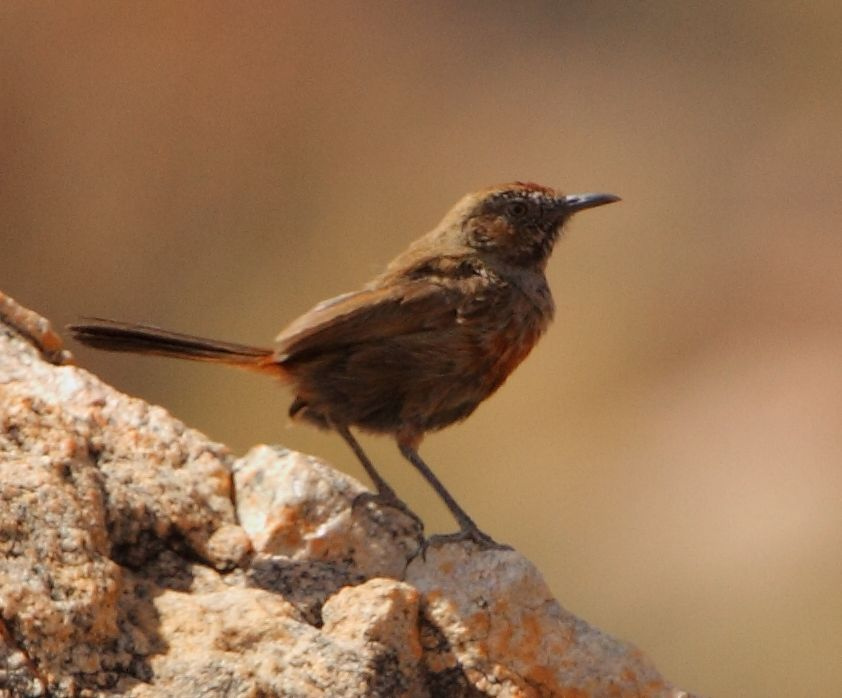
The Kopje Warbler is a small bird, measuring approximately 12 cm in length, with a wingspan of about 15 cm. Its plumage is predominantly cinnamon with subtle variations in tone across its body. The upperparts are a warm cinnamon-brown, while the underparts are lighter, featuring a washed-out buff. The bird's head displays a slight contrast with a distinct, though not prominent, eye stripe.
There is little sexual dimorphism in the Kopje Warbler, making male and female birds challenging to differentiate in the field. Juvenile birds resemble adults but tend to have fresher plumage with less wear. In flight, the Kopje Warbler presents a quick and undulating pattern, which, combined with its small size, can make it challenging to spot among the rocky outcrops it inhabits.
This warbler may be confused with other small passerines in its range, such as the Cisticola species, but its unique song and preference for rocky habitats help in its identification. Observers should note the bird's perching posture, often upright with a slight tilt forward, which is characteristic of this species.
Having trouble telling birds apart? Upload a photo to our bird identification tool for an instant species match.
Kopje Warbler Habitat and Range
Preferred Habitat
The Kopje Warbler primarily inhabits rocky outcrops known as kopjes, which are scattered across the arid and semi-arid regions of Southern Africa. These formations provide both shelter and nesting sites, crucial for the bird's survival in its harsh environment. In Namibia, for instance, these birds are often found in the iconic Namib Desert's isolated rocky areas.
Their elevation range typically spans from sea level up to about 1500 meters, depending on the availability of suitable rocky environments. Unlike many other warblers, they do not migrate extensively, instead adapting to the seasonal changes within their local habitats.
Though predominantly found in rural and wild landscapes, the Kopje Warbler can occasionally be spotted on the fringes of urban areas, particularly where natural rock formations remain intact. Seasonally, they may shift slightly within their range to exploit areas with better food availability, but they generally remain close to their preferred rugged habitats.
Geographic Range
The breeding range of the Kopje Warbler spans primarily across Southern Africa, with significant populations found in Namibia, Botswana, and parts of South Africa. This bird is largely sedentary, with minimal long-distance migration, instead undertaking local movements in response to environmental conditions.
Within Namibia, the Kopje Warbler is particularly common in the central and northern regions, where its preferred rocky habitats are abundant. Botswana hosts stable populations as well, especially in the Kalahari region, where it can be found in isolated rocky outcrops.
While the species does not engage in large-scale migration, it may move between elevations and microhabitats within its range to optimize for food and breeding conditions. Population density hotspots are often correlated with the presence of extensive kopje systems, underscoring the bird's reliance on these unique geological formations.
Want to know which birds visit your area? Browse our backyard birds by location guides for region-specific species lists.
What Does the Kopje Warbler Eat?
The diet of the Kopje Warbler consists primarily of insects, which it adeptly hunts among rocks and vegetation. Its foraging technique involves short, rapid movements to catch prey such as ants, beetles, and small caterpillars, relying heavily on both sight and sound.
During the dry season, when insects become scarce, the Kopje Warbler may expand its diet to include small seeds and plant material. This dietary flexibility helps it to survive when typical prey items are less abundant. The bird's small size necessitates frequent feeding throughout the day, with peak foraging activity occurring in the early morning and late afternoon.
Prey size is generally small, reflective of the warbler's own diminutive stature, and the bird employs a methodical approach to glean insects from crevices and under leaves. The Kopje Warbler's diet not only supports its energy needs but also plays a role in pest control, indirectly benefiting the ecosystems it inhabits.
Kopje Warbler Behavior and Social Structure
The Kopje Warbler exhibits a solitary or paired social structure, often seen alone or with a mate rather than in large groups. Territorial behavior is pronounced, with males vigorously defending their chosen rocky territories through song and displays.
Courtship displays involve males singing from prominent perches to attract females, coupled with fluttering flights and wing displays. These behaviors play a crucial role in pair formation and territory establishment. Once paired, the bond is typically monogamous and may last several breeding seasons.
Daily activity patterns align with peak insect activity, with the Kopje Warbler being most active during dawn and dusk. While not particularly shy, they remain cautious, often retreating to dense cover or crevices when threatened by predators such as birds of prey or snakes. Their alertness and agility are key to their survival in the rugged environments they inhabit.
Kopje Warbler Nesting and Reproduction
The nesting habits of the Kopje Warbler are intricately linked to its rocky habitat. Nests are typically built in crevices or under overhangs in rock formations, providing protection from predators and harsh weather. The nest itself is a cup-shaped structure made from grass, twigs, and lined with softer materials like feathers and plant down.
Clutch size generally ranges from two to four eggs, which are pale and speckled, blending well with their surroundings. The incubation period lasts approximately 12 to 14 days, with both parents sharing the responsibility of keeping the eggs warm.
After hatching, the altricial chicks require constant attention, with both parents involved in feeding and caring for the young. The fledging timeline is about 14 to 16 days, after which the juveniles remain under parental supervision for a short period before becoming independent. The Kopje Warbler typically raises one or two broods per year, depending on environmental conditions.
Kopje Warbler Sounds and Vocalizations
The primary song of the Kopje Warbler is a series of rapid, high-pitched trills, often delivered from an elevated perch. The rhythm is consistent and can vary slightly in pace but maintains a musical quality distinct among warblers. These songs serve both to defend territory and to attract mates.
Call notes include sharp, metallic 'tink' sounds, used as contact calls between mates or family groups. Alarm calls are more abrupt and serve to alert other birds of potential predators.
During the dawn chorus, the Kopje Warbler's song can be heard prominently, adding to the morning symphony of bird song in its habitat. The sound is reminiscent of a finely tuned musical instrument, standing out due to its clarity and persistence.
Interesting Facts About the Kopje Warbler
- 1The Kopje Warbler's name derives from the Afrikaans word 'kopje,' meaning small hill, reflecting its preferred rocky habitat.
- 2Despite its modest size, the Kopje Warbler's song can carry over considerable distances, up to 100 meters in open terrain.
- 3Kopje Warblers have a unique adaptation allowing them to thrive in low-water environments by extracting moisture from their insect prey.
- 4They are often one of the first bird species to establish territory in recently disturbed rocky areas, indicating ecological resilience.
- 5Kopje Warblers exhibit a fascinating behavior of sunbathing on rocks, which helps in thermoregulation and parasite control.
- 6This species is an example of convergent evolution, sharing similar ecological niches with rock-dwelling birds in other continents.
- 7The longevity of a Kopje Warbler in the wild can reach up to 6 years, which is relatively long for a bird of its size.
Kopje Warbler Conservation Status
The Kopje Warbler is currently classified as a species of Least Concern by the IUCN, with stable population trends. However, ongoing threats such as habitat loss due to mining and agriculture pose potential risks to its population. Conservation efforts focus on preserving natural habitats and mitigating the impact of human activities in key regions. Despite stable numbers, continuous monitoring is necessary, particularly to ensure that the species does not become threatened in the future. Historically, the Kopje Warbler has maintained stable populations due to its adaptability, but the growing pressure on its habitat underscores the need for proactive conservation measures.


