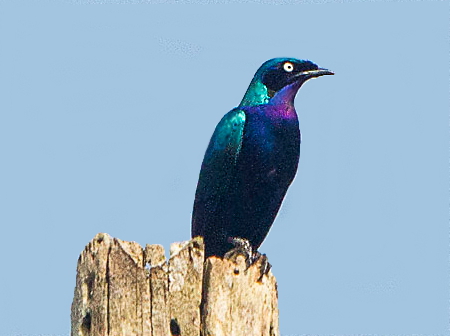
Blue-eared Starling
Lamprocolius sycobius
Order: Passeriformes / Family: Sturnidae

Wikimedia Commons
About the Blue-eared Starling
The Blue-eared Starling (Lamprocolius sycobius) is a striking member of the Sturnidae family, known for its vibrant iridescent blue feathers, which shimmer in the sunlight. This species primarily inhabits sub-Saharan Africa, with a significant presence in countries such as Kenya, Uganda, and Tanzania. Its habitat preference includes open savannas and woodland edges, where its glossy plumage provides a stunning contrast against the dry, tawny landscapes. The ecological significance of the Blue-eared Starling extends beyond its captivating appearance. As a frugivore, it plays a crucial role in seed dispersal, aiding the regeneration of native vegetation. This bird often feeds on a variety of fruits and insects, contributing to the control of insect populations and the propagation of plant species. These starlings exhibit seasonal behaviors influenced by the availability of food resources and breeding opportunities. During the wet season, they take advantage of the abundance of insects and fruits, which supports their breeding activities. The Blue-eared Starling tends to form monogamous pairs during the breeding season, displaying a range of courtship behaviors that include synchronized flights and vocalizations. In contrast, the dry season sees these birds forming larger flocks, a behavior thought to increase foraging efficiency and provide protection against predators. Beyond their ecological role, Blue-eared Starlings are important cultural symbols in some local communities, where their presence is considered a sign of good fortune. Their adaptability to human-altered landscapes, such as agricultural fields and urban areas, underscores their resilience in the face of habitat changes. However, ongoing threats such as habitat destruction and fragmentation pose significant challenges to their populations. Conservation efforts aimed at preserving the natural habitats of the Blue-eared Starling are crucial for maintaining their numbers and ensuring the health of ecosystems where they serve as both consumers and seed dispersers.
The Blue-eared Starling belongs to the family Sturnidae, within the order Passeriformes. These birds typically live average lifespan is 6-8 years, with the potential to live up to 12 years..
How to Identify a Blue-eared Starling
The Blue-eared Starling is easily recognizable by its iridescent blue plumage, which glimmers with shades of green in the right light. Adult starlings measure approximately 22 cm in length, with a wingspan that extends to about 45 cm. Both males and females exhibit similar coloration, although males may display slightly more vibrant hues. Juveniles, on the other hand, have duller plumage, with a more muted grayish-brown appearance that lacks the distinctive sheen of adults. One of the key identification features of this species is its bright yellow eye, which contrasts starkly with the blue head and body. This starling's stout, dark bill is another characteristic feature, aiding in the identification process. In flight, the Blue-eared Starling showcases a robust and steady silhouette, with broad wings and a short, squared tail. When perched, it maintains an upright posture, often tilting its head inquisitively as it surveys its surroundings. Observers may sometimes confuse the Blue-eared Starling with the similar-looking Greater Blue-eared Starling (Lamprotornis chalybaeus), but the latter generally has a slightly larger build and more uniform coloration across its body. Careful attention to plumage sheen and eye color can help avoid misidentification.
Having trouble telling birds apart? Upload a photo to our bird identification tool for an instant species match.
Blue-eared Starling Habitat and Range
Preferred Habitat
The Blue-eared Starling predominantly inhabits open savannas and the edges of woodlands. It thrives in these environments, where scattered trees and shrubs provide both food and nesting opportunities. In regions such as the Serengeti and Amboseli National Parks, these birds are a common sight, often seen flitting between acacia trees or foraging on the ground. Although primarily associated with natural habitats, the Blue-eared Starling exhibits a remarkable adaptability to human-altered landscapes. It frequents agricultural fields, where it can often be spotted searching for insects among crops. In urban settings, particularly in smaller towns and villages, these starlings have been observed taking advantage of the abundance of food scraps and nesting sites offered by buildings and gardens. The Blue-eared Starling does not typically venture into dense forests or high-altitude regions, preferring the more open and sunlit areas that align with its ecological needs. Seasonal shifts in habitat use are evident, with starlings moving to areas with higher fruit availability or water sources during dry spells, highlighting their reliance on specific habitat conditions for survival.
Geographic Range
The range of the Blue-eared Starling encompasses much of sub-Saharan Africa, with populations spread across countries including Kenya, Tanzania, Uganda, and parts of southern Ethiopia. This bird is a resident breeder in these regions, displaying limited migratory behavior. However, some local movements are observed, particularly in response to seasonal changes in food availability. In Kenya, the Blue-eared Starling is a common sight in national parks like Amboseli and Maasai Mara, where it contributes to the avian diversity. In Uganda, it is prominent in the savannas of Queen Elizabeth National Park. The bird's presence in Tanzania extends to the Serengeti and Ngorongoro regions, where it thrives amidst the grasslands and scattered woodlands. While not considered a migratory species, the Blue-eared Starling does exhibit some altitudinal movements, often descending to lower elevations during colder months to avoid temperature extremes and seek out food resources. Population density tends to be higher in areas that offer abundant food and nesting sites, such as riverine woodlands and agricultural zones.
Want to know which birds visit your area? Browse our backyard birds by location guides for region-specific species lists.
What Does the Blue-eared Starling Eat?
The Blue-eared Starling primarily feeds on a diet of fruits and insects, making it an essential component of its ecosystem as both a seed disperser and insect controller. During the wet season, when fruits like figs and berries are abundant, these starlings consume significant quantities, aiding in the distribution of seeds across their habitat. Insects also form a crucial part of their diet, particularly during the breeding season when the nutritional needs for raising young are high. The starlings employ various foraging techniques, including ground gleaning and aerial hawking, to capture prey. Their robust bill is well-suited for cracking open tough fruit skins and extracting insects from bark or leaves. Seasonal changes in diet are apparent, with a heavier reliance on insects during periods when fruit is scarce. This adaptability in foraging behavior allows the Blue-eared Starling to thrive in a range of environments, from natural savannas to human-modified landscapes. Their feeding schedule is diurnal, with peak activity observed in the early morning and late afternoon when temperatures are cooler and prey is more active.
Blue-eared Starling Behavior and Social Structure
Social by nature, the Blue-eared Starling often forms flocks, particularly outside the breeding season. These flocks can range from small family groups to larger congregations of several dozen birds. Such social structures facilitate efficient foraging and provide protection against predators. Territorial behavior becomes more pronounced during the breeding season when pairs aggressively defend nesting sites against intruders. Courtship displays include synchronized flights and vocal exchanges, with males often seen puffing out their chest feathers and spreading their wings to attract females. The starlings exhibit a hierarchical social structure within flocks, where dominant individuals often secure the best foraging spots and nesting sites. When faced with predators, such as raptors, these birds employ mobbing behavior, collectively harassing the threat to deter it. Daily activity patterns see the Blue-eared Starling engaging in foraging during the cooler parts of the day, while midday is often spent resting in shaded areas. Communication among flock members is facilitated through a range of vocalizations, which include contact calls and alarm signals, ensuring group cohesion and safety.
Blue-eared Starling Nesting and Reproduction
The Blue-eared Starling nests in cavities, often using tree holes or abandoned nests of other birds. They may also adapt to human-made structures, utilizing crevices in buildings or nest boxes where available. Nest construction involves both male and female, who gather materials such as grass, leaves, and feathers to line the cavity. Clutch size typically ranges from 2 to 4 eggs, which the female incubates for about two weeks. During this period, the male plays a supportive role, providing food for the female and guarding the nest. Once hatched, the chicks remain in the nest for approximately three weeks before fledging. Parental care continues post-fledging, with both parents involved in feeding and protecting the young until they become independent. The Blue-eared Starling generally raises one brood per year, although in regions with extended favorable conditions, a second brood is possible. Nesting success heavily depends on the availability of suitable sites and the absence of predators, emphasizing the importance of habitat preservation for this species.
Blue-eared Starling Sounds and Vocalizations
The Blue-eared Starling produces a variety of sounds, with its primary song characterized by a melodious series of whistles and clicks. The rhythm is moderately paced, with a unique mixture of high-pitched notes and softer, rolling trills. These songs serve to establish territory and attract mates. Call notes are shorter and more abrupt, often used for communication between flock members. Alarm calls are distinct, sharp, and urgent, designed to alert others to potential danger. During the dawn chorus, the Blue-eared Starling's vocalizations contribute to the rich tapestry of morning sounds in the African savanna, often starting just before sunrise when bird activity peaks. Experienced birders liken the starling's song to a flute-like melody interspersed with occasional harsh notes, making it a recognizable component of its soundscape.
Interesting Facts About the Blue-eared Starling
- 1The Blue-eared Starling's iridescent plumage results from microscopic structures that refract light, not pigments.
- 2During courtship, males perform aerial displays that include spirals and dives to impress potential mates.
- 3A Blue-eared Starling's diet consists of up to 60% fruits during the wet season, showcasing its role in seed dispersal.
- 4These starlings can mimic the calls of other birds, adding complexity to their vocalizations.
- 5Despite their social nature, Blue-eared Starlings can become aggressive when defending a nest site.
- 6They are known to have symbiotic relationships with large mammals, feeding on insects disturbed by the animals.
- 7Blue-eared Starlings are adept at using human-modified landscapes, often nesting in urban areas and agricultural zones.
Blue-eared Starling Conservation Status
Currently, the Blue-eared Starling is classified as a species of Least Concern by the IUCN, with populations generally stable across its range. However, habitat destruction and fragmentation pose ongoing threats, particularly in areas where agricultural expansion is prominent. Conservation efforts focus on preserving key habitats, such as savannas and woodlands, which are crucial for the starling's survival. Community-based conservation initiatives have shown promise in regions like Kenya, where local involvement in habitat restoration has been encouraged. Historical data indicate that Blue-eared Starling populations have remained relatively stable over the past few decades, although localized declines have been noted in areas undergoing rapid land use changes. Continued monitoring and habitat protection are essential to ensure the long-term viability of this species.
Other Sturnidae Species


Birds Similar to the Blue-eared Starling
These species are often confused with the Blue-eared Starling due to similar appearance or overlapping range.