Little Eagle
Hieraaetus morphnoides
Order: Accipitriformes / Family: Accipitridae

Wikimedia Commons
About the Little Eagle
The Little Eagle (Hieraaetus morphnoides) is a small yet powerful raptor native to Australia and parts of Papua New Guinea. As a member of the Accipitridae family, it plays a vital role in managing prey populations, particularly small mammals and birds. This eagle is revered for its adaptability to a range of habitats, from open woodlands to semi-arid savannas. The Little Eagle often nests in regions with sparse tree cover, using these vantage points to hunt effectively. Its ecological role extends to pest control in agricultural areas, where it helps maintain the balance of local ecosystems.
In Australia, the Little Eagle can be observed in regions such as New South Wales, Queensland, and Victoria. It thrives in habitats that offer clear visibility for soaring and hunting. During the breeding season, typically from July to October, the Little Eagle displays remarkable territorial behavior, often seen engaging in aerial displays to establish dominance and attract mates. As a top predator in its ecological niche, the Little Eagle helps regulate the populations of its prey species, thus contributing to biodiversity.
This eagle is remarkable for its ability to adapt to human-altered landscapes, including farmlands where it is sometimes seen perched on fence posts or utility poles. Its presence in both rural and urban-adjacent areas highlights its ecological flexibility. Despite potential threats from habitat destruction and human encroachment, the Little Eagle maintains a stable population, thanks to its adaptability and diverse diet. Seasonal behaviors include partial migration in response to climatic conditions, with some individuals moving northward during colder months.
The Little Eagle belongs to the family Accipitridae, within the order Accipitriformes. These birds typically live typically 10-15 years, with some reaching up to 20 years..
How to Identify a Little Eagle
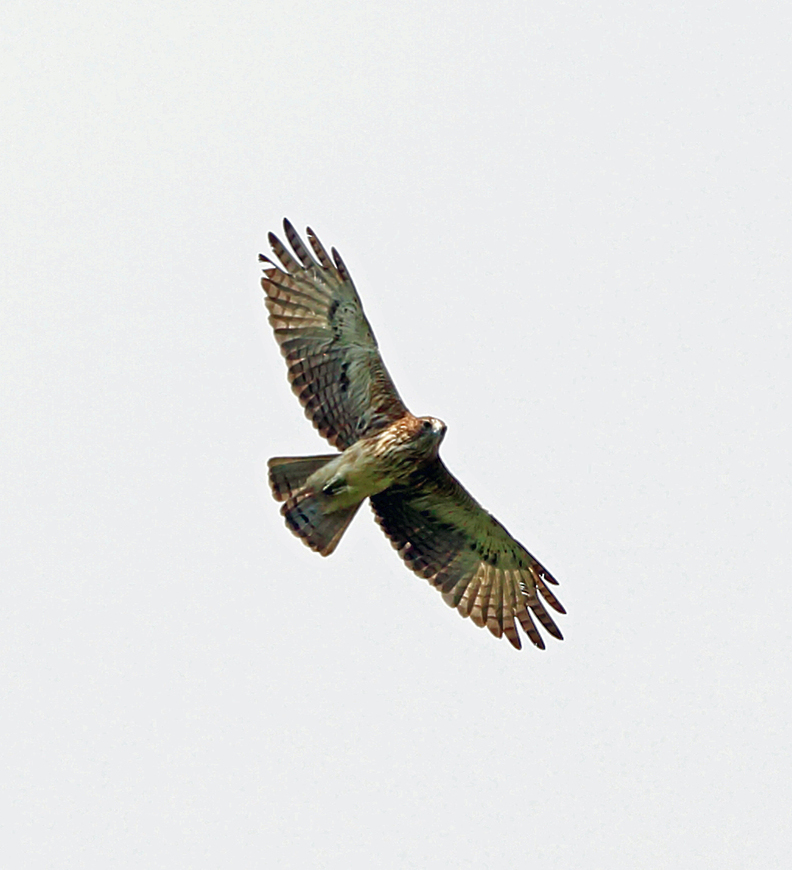
The Little Eagle is a medium-sized raptor, with adults exhibiting a wingspan of approximately 100-135 cm. It is characterized by its variable plumage, typically displaying a mix of brown and white patterns. A key feature for identification is the underwing pattern, which includes a conspicuous pale middle section bordered by darker trailing edges. Juveniles are generally paler than adults, with more pronounced streaking on the breast and a less defined underwing pattern.
Males and females of the species are similar in appearance, though females are slightly larger, as is common in raptors. The Little Eagle's silhouette in flight is distinct, with broad, rounded wings and a short, square tail. When perched, it maintains an upright posture, often scanning the surroundings for potential prey.
Confusion with other raptors is possible, particularly with the Wedge-tailed Eagle and the Whistling Kite. However, the Little Eagle is noticeably smaller than the Wedge-tailed Eagle and lacks the distinctive wedge-shaped tail. Compared to the Whistling Kite, the Little Eagle has a more robust build and different flight behavior, often soaring higher with less frequent wingbeats.
Having trouble telling birds apart? Upload a photo to our bird identification tool for an instant species match.
Little Eagle Habitat and Range
Preferred Habitat
The Little Eagle inhabits a wide range of environments, primarily favoring open woodlands and forest edges where tree coverage is sparse enough to allow for soaring and hunting. It can also be found in arid and semi-arid regions, grasslands, and agricultural landscapes. This species is adaptable to various elevations, typically from sea level up to 1,000 meters.
In urban areas, the Little Eagle occasionally nests in parks or reserves, taking advantage of tall trees for nesting and hunting perches. Seasonal shifts in habitat use are observed, with some individuals migrating to more temperate regions during colder months. Rural areas with mixed open and wooded habitats provide optimal conditions for nesting and foraging.
The adaptability of the Little Eagle to different habitats has contributed to its widespread presence across its range. While it generally avoids densely forested areas where hunting visibility is limited, it thrives in transitional zones where open spaces meet scattered trees.
Geographic Range
The Little Eagle is primarily found across mainland Australia, with its range extending into southern Papua New Guinea. It is well-distributed across regions such as New South Wales, Queensland, Victoria, South Australia, and Western Australia. This species is largely sedentary, with some populations exhibiting partial migration based on climatic conditions.
During the breeding season, the Little Eagle's range is concentrated in areas with suitable nesting sites, such as open woodlands and lightly forested areas. In winter, some individuals may move northwards to warmer regions, though many populations remain year-round residents within their established territories.
Population density varies, with higher concentrations in regions that offer optimal foraging and nesting opportunities. Hotspots include the Murray-Darling Basin and coastal regions of eastern Australia. Despite its extensive range, the Little Eagle is not typically found in Tasmania, as the island lacks the open habitats preferred by the species.
Want to know which birds visit your area? Browse our backyard birds by location guides for region-specific species lists.
What Does the Little Eagle Eat?
The diet of the Little Eagle is diverse, primarily consisting of small mammals such as rabbits and hares, as well as birds like pigeons and starlings. It also preys on reptiles and occasionally insects, especially during the warmer months when such prey is more abundant.
Foraging techniques involve soaring high above open landscapes, using keen eyesight to detect movement below. Once prey is spotted, the Little Eagle executes a swift stoop to capture its target. The size of prey ranges from small mammals weighing a few hundred grams to birds of similar size.
Seasonal diet changes reflect availability, with a higher intake of reptiles during summer and increased reliance on birds and small mammals in winter. This dietary flexibility enables the Little Eagle to thrive across diverse habitats and varying environmental conditions. Feeding often occurs during daylight hours, with peak activity in the early morning and late afternoon.
Little Eagle Behavior and Social Structure
Little Eagles exhibit solitary or paired social structures, particularly during the breeding season when they establish and defend territories. Territorial behavior is pronounced, with individuals engaging in aerial displays to ward off intruders and attract mates. These displays include soaring, diving, and calling.
Courtship involves mutual soaring and talon-locking displays, which are a prelude to nesting. Outside the breeding season, Little Eagles may be seen alone, though loose aggregations can form around abundant food sources. These gatherings are typically temporary and dissolve as soon as the food supply diminishes.
Daily activity patterns include active foraging during daylight, with peak hunting periods occurring in the early morning and late afternoon. The Little Eagle remains vigilant against predators, though adult birds have few natural enemies. Nestlings and juveniles face threats from larger raptors and terrestrial predators. When alarmed, Little Eagles emit sharp calls to alert each other of danger.
Little Eagle Nesting and Reproduction
The Little Eagle constructs large stick nests, typically situated high in trees to provide safety from ground predators. Preferred nesting sites include tall eucalyptus or other native trees, often located on the edges of woodlands or near open fields. Nests are reused and added to each year, sometimes reaching considerable sizes.
A typical clutch consists of 1-3 eggs, with incubation lasting around 35-40 days. Both parents share incubation duties, though the female spends more time on the nest. After hatching, the young remain in the nest for about 60-65 days before fledging.
Parental roles are well-defined, with the female primarily responsible for brooding while the male supplies food. The Little Eagle typically raises one brood per year, though in optimal conditions, a second brood may be attempted. Fledglings remain dependent on their parents for several weeks post-fledging before becoming fully independent.
Little Eagle Sounds and Vocalizations
The Little Eagle's vocalizations include a series of high-pitched, whistling notes often described as 'kee-kew.' These calls are most commonly heard during the breeding season, serving as territorial and courtship signals. Alarm calls are sharp and more abrupt, used to signal the presence of potential threats.
While the Little Eagle is not known for a complex song, its calls are distinct and recognizable within its range. The dawn chorus may include these calls, though the species is generally less vocal than some of its raptor relatives.
Comparatively, the Little Eagle's calls are higher in pitch than the deeper, more resonant calls of larger raptors like the Wedge-tailed Eagle, aiding in field identification through sound.
Interesting Facts About the Little Eagle
- 1The Little Eagle can spot prey from over a kilometer away, showcasing its exceptional eyesight.
- 2Despite its name, the Little Eagle is not the smallest eagle in Australia, as the Booted Eagle holds that title.
- 3Little Eagles often use the same nest for several years, gradually increasing its size with each breeding season.
- 4During courtship, Little Eagles may lock talons in mid-air, a behavior observed in many raptor species.
- 5The Little Eagle has been recorded flying at altitudes of over 1,000 meters, making it among the highest-soaring eagles in Australia.
- 6Little Eagles contribute to pest control by preying on rodents and rabbits, balancing local ecosystems.
- 7The species is known for its adaptability, often thriving in human-modified landscapes like farmland and urban edges.
Little Eagle Conservation Status
The Little Eagle is currently listed as Least Concern by the IUCN, with stable population trends across much of its range. Primary threats include habitat loss due to agriculture and urban expansion, as well as potential competition with larger raptors. Conservation efforts focus on preserving critical habitats, particularly nesting and foraging areas. Historical population changes have been minimal, with the species maintaining a stable presence in suitable environments. Ongoing monitoring and habitat protection are crucial to ensure the Little Eagle remains a thriving component of Australia's avian diversity. Public awareness and education also play roles in mitigating human impacts.
Other Accipitridae Species


Birds Similar to the Little Eagle
These species are often confused with the Little Eagle due to similar appearance or overlapping range.