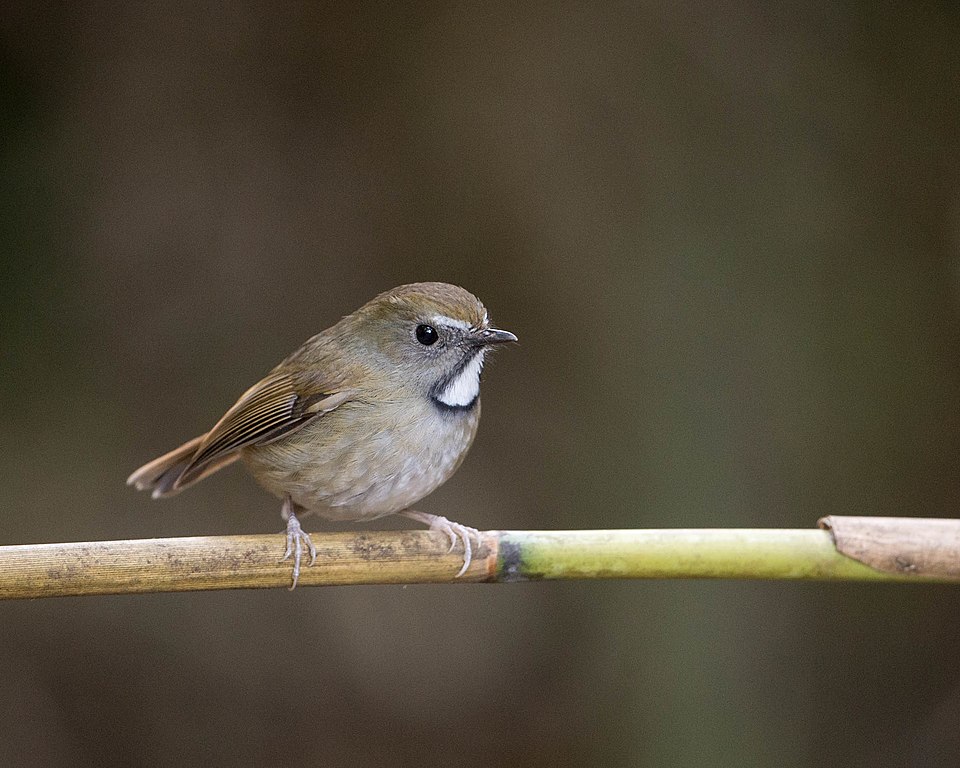
Little Flycatcher
Muscicapa epulata
Order: Passeriformes / Family: Muscicapidae

Wikimedia Commons
About the Little Flycatcher
The Little Flycatcher, scientifically known as Muscicapa epulata, is a small passerine bird that belongs to the Muscicapidae family. This species is widely distributed across various regions of Southeast Asia, particularly thriving in the lush forests of Indonesia, Malaysia, and the Philippines. A quintessential inhabitant of tropical lowland forests, the Little Flycatcher plays a vital ecological role by controlling insect populations, effectively maintaining the health of the forest ecosystem. Its presence in these habitats not only showcases its adaptability but also highlights its significance in the broader biodiversity context. Observations indicate that the Little Flycatcher exhibits seasonal altitudinal migrations, often moving to lower elevations during the wet season to exploit the abundance of insect prey. This movement also underscores its adaptability to changing environmental conditions, thus ensuring its survival in diverse ecological niches. During the dry season, these birds can be found in higher elevation montane forests, where they access different insect populations, showcasing their ability to thrive across varied forest types. The Little Flycatcher's ecological role extends beyond pest control; it is also a vital component of the food web, serving as prey for larger avian predators and some mammals. This complex interplay of predator-prey relationships underscores the species' importance in maintaining ecological balance. Moreover, the Little Flycatcher is often considered an indicator species, as its presence or absence can reflect changes in forest health and integrity. As a bird that relies heavily on insect populations, any decline in its numbers could signal underlying issues within its habitat, necessitating conservation interventions. The adaptable nature of the Little Flycatcher allows it to inhabit mixed forest edges and secondary growth areas, making it a resilient species amidst the increasing challenges of habitat fragmentation and human encroachment. However, continued efforts are necessary to preserve its primary forest habitats to ensure the long-term survival of the species. In conclusion, the Little Flycatcher is not just a charming resident of Southeast Asian forests but also a critical player in the intricate web of life that sustains these ecosystems. Its adaptability and ecological contributions make it a species of interest for both ornithologists and conservationists alike.
The Little Flycatcher belongs to the family Muscicapidae, within the order Passeriformes. These birds typically live 3-6 years, with a maximum recorded of 8 years..
How to Identify a Little Flycatcher
The Little Flycatcher is a small bird, measuring approximately 11 to 13 centimeters in length. Its plumage is predominantly olive-brown on the upper parts, providing excellent camouflage amidst the forest foliage. The underparts are a paler, more subdued white, with a subtle wash of yellow on the belly, which can be a key distinguishing feature in the field. The bird's wings are marked with faint white wing bars, aiding in its identification during flight. Males and females are similar in appearance, though females may exhibit slightly duller plumage. Juveniles resemble adults but often display more streaking on the underparts, which fades as they mature. The Little Flycatcher's small size, coupled with its rapid, agile flight, makes it difficult to spot in dense forest canopies. However, its behavior of sallying out from a perch to catch insects in mid-air provides opportunities for observation. Confusion with other small flycatchers, such as the Asian Brown Flycatcher, can occur, but the Little Flycatcher's more vibrant yellowish underparts and distinctive call notes help differentiate it. In flight, this bird exhibits a compact silhouette with quick, fluttering wingbeats, contrasting with the more direct flight of similar species. When perched, it often adopts an upright posture, scanning its surroundings for prey.
Having trouble telling birds apart? Upload a photo to our bird identification tool for an instant species match.
Little Flycatcher Habitat and Range
Preferred Habitat
The Little Flycatcher primarily inhabits tropical and subtropical lowland forests, often frequenting the edges and clearings where insect activity is high. These birds are most commonly found at elevations ranging from sea level up to 1,500 meters, with occasional sightings in higher altitudes during certain seasons. Their preference for dense, humid forest environments makes them well-suited to regions like Borneo's rainforests and the Philippine archipelago's varied forest types. During the wet season, the Little Flycatcher may shift to lower elevations, taking advantage of the increased insect abundance. In contrast, the dry season sees them moving back to higher elevations and more closed-canopy forests, where moisture levels remain relatively stable. While primarily a forest-dwelling species, the Little Flycatcher can occasionally be found in secondary growth areas and plantation edges, particularly where natural forests have been disturbed. Unlike some other flycatcher species, the Little Flycatcher is rarely found in urban areas, maintaining a strong preference for natural, undisturbed habitats. This habitat specificity highlights the importance of conserving primary forest areas to ensure the survival of this species.
Geographic Range
The Little Flycatcher is endemic to the Southeast Asian region, with its range extending across countries such as Indonesia, Malaysia, and the Philippines. In Indonesia, it is particularly prevalent on the islands of Sumatra, Java, and Borneo, where extensive tracts of lowland and montane forests provide ideal habitats. In Malaysia, the bird is commonly found in both peninsular regions and the states of Sabah and Sarawak on Borneo. The Philippines hosts this species across several islands, including Luzon, Mindanao, and Palawan, where it occupies forested areas ranging from lowland to montane zones. The Little Flycatcher is a resident breeder in these regions, showing little evidence of long-distance migration. However, its altitudinal movements within its range are well-documented, allowing it to exploit different habitats seasonally. Although not considered migratory in the traditional sense, these movements ensure that the species remains in optimal conditions for feeding and breeding throughout the year. Population densities tend to be higher in undisturbed primary forests, though the species can also be found in secondary growth and regenerating forests. This adaptability to different forest conditions allows it to maintain stable populations despite habitat fragmentation in some areas. Nonetheless, regions like Borneo and the Philippines, with their rich biodiversity and relatively intact forest ecosystems, remain hotspots for the Little Flycatcher.
Want to know which birds visit your area? Browse our backyard birds by location guides for region-specific species lists.
What Does the Little Flycatcher Eat?
The Little Flycatcher primarily feeds on insects, making it an integral part of its ecosystem's pest control. Its diet consists mainly of small flying insects such as flies, mosquitoes, and various beetles, which it adeptly catches in mid-air. This insectivorous diet is supplemented by spiders and occasionally small caterpillars found on leaves. During the wet season, when insect populations peak, the Little Flycatcher takes advantage of the abundance, often engaging in more frequent and energetic foraging bouts. In contrast, the dry season may see a slight shift in diet composition, with an increased reliance on less mobile prey found within the forest undergrowth. The Little Flycatcher employs a 'sallying' technique, where it perches on a branch before launching into flight to snatch passing insects. This method not only demonstrates its agility and precision but also minimizes energy expenditure by returning to the same or nearby perch after each catch. Prey size typically varies from a few millimeters to over a centimeter, depending on availability and the bird's hunting success. Feeding usually occurs during the cooler parts of the day, such as early morning and late afternoon, aligning with peak insect activity times. This schedule ensures that the Little Flycatcher maximizes its food intake while avoiding the midday heat.
Little Flycatcher Behavior and Social Structure
The Little Flycatcher exhibits a solitary lifestyle, often seen alone or in pairs rather than in large flocks. Territorial behavior is pronounced during the breeding season, with individuals defending their chosen areas vigorously against intruders. This territoriality ensures access to sufficient food resources and optimal nesting sites. During courtship, males perform subtle displays, involving fluttering flights and soft calls to attract potential mates. Once paired, both sexes contribute to territorial defense. The Little Flycatcher is diurnal, with peak activity observed during the early morning and late afternoon when insect prey is most abundant. Its foraging behavior involves short flights from perches to capture insects mid-air, after which it returns to the same or nearby perch. While generally shy and retiring, the Little Flycatcher becomes more conspicuous during the breeding season, as males sing to establish and defend territories. In response to predators, these birds rely on their cryptic coloration and quick flight to evade capture, often retreating to dense cover. Alarm calls, although infrequent, serve to alert nearby conspecifics of potential threats. The Little Flycatcher does not typically engage in flocking behavior like some other flycatchers, reinforcing its preference for a solitary existence.
Little Flycatcher Nesting and Reproduction
The Little Flycatcher constructs its nest in a variety of locations, often opting for a secure site on a tree branch or in a tree fork. The nest itself is a compact cup composed of moss, lichen, and fine plant fibers, with spider silk used to bind the materials together and attach the nest securely to its substrate. This careful construction offers protection against the elements and potential predators. Clutch size varies from two to four eggs, with three being the most common. The eggs are pale with fine speckling, blending well with the nest materials. Incubation lasts approximately 12 to 14 days, with both parents sharing the responsibilities, though the female may take on a slightly larger role. After hatching, the altricial chicks remain in the nest for about 12 to 15 days, during which both parents are actively involved in feeding and caring for the young. Fledging occurs when the chicks are adequately developed, though they continue to rely on parental support for a few weeks post-fledging. The Little Flycatcher typically raises one to two broods per year, depending on environmental conditions and food availability. Nest site fidelity can vary, with some pairs returning to the same site in subsequent years, especially if previous nesting attempts were successful.
Little Flycatcher Sounds and Vocalizations
The Little Flycatcher is known for its distinctive, high-pitched song, which consists of a series of rapid, melodious notes delivered in a rhythmic sequence. This song serves both to establish territory and to attract mates during the breeding season. The pitch is typically high, and the quality is often described as clear and ringing, making it audible over considerable distances in the dense forest. In addition to its primary song, the Little Flycatcher emits various call notes, including soft 'chip' sounds used for communication between mates and family members. Alarm calls are sharper and more insistent, designed to alert nearby birds of potential dangers. During the dawn chorus, the Little Flycatcher is one of the early risers, contributing to the morning symphony with its persistent and lively song. This behavior not only marks its presence but also reinforces its territorial claims against other males. The bird's vocalizations are a key tool for identification, particularly in dense habitats where visual contact is challenging.
Interesting Facts About the Little Flycatcher
- 1The Little Flycatcher can spot and catch prey in mid-air with remarkable precision, thanks to its rapid, agile flight.
- 2Despite its small size, the Little Flycatcher can be heard from up to 100 meters away due to its high-pitched, clear song.
- 3Insect larvae make up a significant portion of the Little Flycatcher's diet, highlighting its role in pest control.
- 4This bird often uses spider silk to construct its nests, enhancing the nest's durability and stability.
- 5The Little Flycatcher's preference for dense forest habitats makes it an indicator species for forest health.
- 6During the breeding season, the Little Flycatcher's song serves a dual purpose: mate attraction and territory defense.
- 7Known for its solitary behavior, the Little Flycatcher rarely forms flocks, maintaining its independence even in diverse habitats.
Little Flycatcher Conservation Status
The Little Flycatcher is currently classified as Least Concern by the IUCN, owing to its wide distribution and stable population trends across its range. However, like many forest-dependent species, it faces threats from habitat loss due to deforestation and land conversion for agriculture and urban development. Conservation efforts focus on preserving primary forest habitats and promoting sustainable land use practices to mitigate these impacts. Protected areas in regions like Borneo and the Philippines play a crucial role in safeguarding populations of the Little Flycatcher by maintaining essential habitats. Historical population changes have been minimal, with some local declines linked to habitat degradation. Despite these challenges, the Little Flycatcher's adaptability to secondary growth areas offers some resilience against habitat changes. Continued monitoring and habitat preservation are vital to ensuring the long-term survival of the species, particularly in areas experiencing rapid environmental change.