
Madagascar Blue-Pigeon
Alectroenas madagascariensis
Order: Columbiformes / Family: Columbidae
Wikimedia Commons
About the Madagascar Blue-Pigeon
The Madagascar Blue-Pigeon (Alectroenas madagascariensis) is a remarkable avian species endemic to the island of Madagascar. Known for its vibrant blue feathers, this medium-sized pigeon is a distinctive member of the Columbidae family. It plays a crucial role in its ecosystem, particularly in seed dispersal, due to its fruit-based diet. Found primarily in Madagascar's eastern rainforests, this species has adapted well to its environment, showcasing the island's unique biodiversity.
The Madagascar Blue-Pigeon is significant not only for its ecological role but also as an indicator of forest health. Its presence in an area often signals a well-preserved habitat, as it relies on dense forest cover for feeding and nesting. The bird's reliance on forested areas underscores the importance of conservation efforts aimed at protecting Madagascar's unique and threatened habitats.
Ecologically, this pigeon contributes to the regeneration of its forest habitat by dispersing seeds of various fruiting trees. As these birds consume fruits, they later excrete the seeds at different locations, thus facilitating the growth of new plants and maintaining the forest's biodiversity. Seasonal behaviors of the Madagascar Blue-Pigeon are largely influenced by the availability of food resources. During the rainy season, when fruits are abundant, these birds are more active and visible, often engaging in social interactions and foraging in groups.
The Madagascar Blue-Pigeon belongs to the family Columbidae, within the order Columbiformes. These birds typically live average 10 years, with a maximum recorded of 15 years..
How to Identify a Madagascar Blue-Pigeon
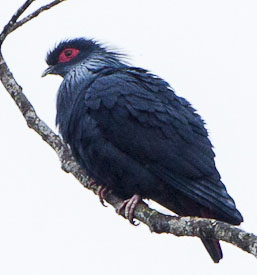
The Madagascar Blue-Pigeon is easily identifiable by its vibrant plumage, which is a striking shade of blue. Adult birds display a rich, blue-gray coloration throughout their body, with a slight iridescence visible in good lighting. The head and neck feathers are slightly longer, giving them a distinctive tufted appearance. Juveniles, on the other hand, exhibit a duller, more subdued blue, lacking the iridescence seen in adults.
Males and females are similar in appearance, making it difficult to distinguish between the sexes in the field. However, subtle differences in size may be observed, with males typically being slightly larger than females. The Madagascar Blue-Pigeon can be confused with the Comoro Blue-Pigeon, but the latter species is found on the Comoros Islands and has a more uniform blue coloration without the tufted neck feathers.
In flight, the Madagascar Blue-Pigeon displays a silhouette characterized by broad wings and a relatively short tail, contributing to its agile flight through dense forest canopies. When perched, these birds often adopt an upright posture, which, combined with their unique coloration, makes them a striking sight against the green backdrop of the forest.
Having trouble telling birds apart? Upload a photo to our bird identification tool for an instant species match.
Madagascar Blue-Pigeon Habitat and Range
Preferred Habitat
The primary habitat of the Madagascar Blue-Pigeon encompasses the island's eastern rainforests, where it favors dense, humid, and elevated forest regions. Typically found at elevations ranging from sea level up to 1,500 meters, this pigeon thrives in areas with abundant fruit-bearing trees.
It is most commonly associated with primary forests, but it can also be observed in secondary growth areas, provided these habitats offer sufficient food resources and cover. The Madagascar Blue-Pigeon is less frequently found in urbanized regions, as it prefers the undisturbed forest environment.
Seasonal shifts in habitat usage are minimal, as the bird remains within forested areas year-round. However, slight altitudinal movements may occur in response to food availability, particularly during drier seasons when fruits are less abundant in certain elevations.
Geographic Range
The Madagascar Blue-Pigeon is endemic to Madagascar, with its range limited to this island nation. It primarily occupies the eastern part of the island, where lush rainforests provide the habitat it requires. There is no evidence of significant migratory behavior in this species, as it remains within the forested regions year-round.
Breeding and feeding activities are concentrated in areas where fruiting trees are abundant, with population densities being highest in well-preserved forest stretches. Though its range is restricted compared to more widespread species, the Madagascar Blue-Pigeon is not considered migratory.
As a result, conservation efforts focus on protecting the forested areas within this range, ensuring that the species has sufficient habitat to support its population. The pigeon is notably absent from the drier, less vegetated regions of Madagascar, underscoring its reliance on specific ecological conditions.
Want to know which birds visit your area? Browse our backyard birds by location guides for region-specific species lists.
What Does the Madagascar Blue-Pigeon Eat?
The diet of the Madagascar Blue-Pigeon is primarily frugivorous, with a strong preference for a variety of fruits found in its rainforest habitat. The bird's feeding habits play a key role in seed dispersal, aiding in the regeneration of forest vegetation.
Throughout the year, the pigeon consumes fruits from trees such as figs and other native species, adjusting its diet based on seasonal availability. During the rainy season, an abundance of fruit allows for more varied consumption, while in drier periods, the pigeon may rely on fewer fruit sources or supplement its diet with seeds.
Foraging typically occurs during the cooler parts of the day, in the morning and late afternoon, when the birds are most active. The Madagascar Blue-Pigeon is an adept forager, using its strong bill to pluck fruit from branches or from the ground, ensuring a steady intake to sustain its energy needs.
Madagascar Blue-Pigeon Behavior and Social Structure
The Madagascar Blue-Pigeon exhibits fascinating behavioral patterns, particularly in its social structure and territoriality. While generally solitary or found in pairs, these pigeons may form small flocks, especially around abundant food sources. This social gathering allows the birds to communicate and protect each other from predators.
During the breeding season, which coincides with fruit abundance, males perform courtship displays that include soft cooing and physical displays to attract females. Once paired, the birds exhibit strong pair bonds, often seen perched closely together.
Territorial behavior is marked by vocalizations and posturing to ward off intruders. If threatened by predators, such as birds of prey or snakes, the Madagascar Blue-Pigeon will employ rapid, erratic flight to escape. Daily activity patterns involve periods of active foraging, interspersed with rest and preening during the heat of the day.
Madagascar Blue-Pigeon Nesting and Reproduction
Nesting habits of the Madagascar Blue-Pigeon involve constructing simple nests composed of twigs and leaves, typically placed in the fork of a tree branch. These nests are built at moderate heights, providing protection from ground predators while remaining accessible for the adult birds.
The typical clutch size consists of a single egg, which both parents incubate for about 18-20 days. This shared responsibility continues after hatching, with both male and female participating in feeding the chick through regurgitation. The fledging period lasts approximately three weeks, after which the young pigeon becomes more independent but may remain close to the parents for additional feeding and protection.
The species generally raises one brood per year, although in favorable conditions, a second brood may be attempted. Nesting success is closely tied to the availability of food and the presence of safe nesting sites.
Madagascar Blue-Pigeon Sounds and Vocalizations
The primary song of the Madagascar Blue-Pigeon is a low, resonant cooing sound, often described as a 'hoo-hoo-hoo' sequence. This rhythmic vocalization is most commonly heard during the early morning and late afternoon, serving both territorial and mate attraction purposes.
In addition to its song, the pigeon emits various calls, including soft clucks and grunts, used for communication between mates or alerting each other to potential threats. Alarm calls are louder and more abrupt, designed to warn conspecifics of danger.
The dawn chorus of the Madagascar Blue-Pigeon is a subtle yet defining feature of the Madagascar rainforest, with its coos blending into the broader symphony of forest sounds. These vocalizations, while not as varied as those of songbirds, are integral to the bird's behavioral repertoire.
Interesting Facts About the Madagascar Blue-Pigeon
- 1The Madagascar Blue-Pigeon's iridescent feathers make it one of the most visually striking birds in the region.
- 2Unlike many pigeons, the species has a unique tuft of feathers on its neck, enhancing its distinctive profile.
- 3These pigeons have a specialized gizzard that aids in digesting their primarily fruit-based diet.
- 4The Madagascar Blue-Pigeon can consume a variety of fruits, adapting its diet based on seasonal availability.
- 5While not migratory, the species may exhibit altitudinal movements in search of fruiting trees.
- 6Their role in seed dispersal is vital for maintaining the diversity and regeneration of their rainforest habitat.
- 7Madagascar Blue-Pigeons can live up to 12 years in the wild, contributing to long-term forest dynamics.
Madagascar Blue-Pigeon Conservation Status
The Madagascar Blue-Pigeon is currently listed as Near Threatened on the IUCN Red List, with population trends showing a decline due to habitat loss and fragmentation. The primary threat to the species is deforestation, driven by agricultural expansion, logging, and human settlement. Conservation efforts are focused on preserving remaining forest habitats through protected area designations and community-based conservation initiatives. Restoring degraded forests and implementing sustainable land-use practices are crucial for maintaining the ecological conditions necessary for the species' survival. Historically, the pigeon was more widespread, but ongoing habitat destruction has limited its range, emphasizing the need for continued conservation attention. Despite these challenges, the species remains resilient, with certain protected regions offering hope for its continued existence.


