
Masked Saltator
Saltator cinctus
Order: Passeriformes / Family: Thraupidae
Wikimedia Commons
About the Masked Saltator
The Masked Saltator (Saltator cinctus) is a captivating species of bird found primarily in the Andean regions of South America. Belonging to the family Thraupidae, this bird is often a subject of interest for ornithologists and birdwatchers alike due to its unique appearance and ecological role. It inhabits the subtropical or tropical moist montane forests and is typically found at elevations ranging from 1,800 to 3,000 meters. Its presence in these ecosystems is significant as it contributes to seed dispersal and the maintenance of healthy forest dynamics. The Masked Saltator exhibits distinct seasonal behaviors, with some local movements within its habitat range in response to food availability and climatic conditions. During the breeding season, these birds become more territorial, establishing and defending breeding sites. Outside of the breeding season, they may form small flocks, which allows them to forage more efficiently and reduces the likelihood of predation. As a member of the passerine order, the Masked Saltator plays a vital role in the ecosystem. It acts as both a seed disperser and a regulator of insect populations, contributing to the overall health of the forest. The bird's diet consists mainly of fruits, seeds, and insects, which it forages for both in the canopy and on the forest floor. By consuming a wide variety of plant and animal matter, the Masked Saltator helps maintain the balance of its ecosystem. Additionally, its interactions with other bird species, as well as its role as prey for larger predators, integrate the Masked Saltator into the complex food web of the montane forests. Conservation efforts for this species focus on habitat preservation, as deforestation and habitat fragmentation pose significant threats to its population. Despite these challenges, the Masked Saltator remains an emblematic species of the Andean forests, symbolizing the intricate connections within these biodiverse environments.
The Masked Saltator belongs to the family Thraupidae, within the order Passeriformes. These birds typically live average 4-6 years, with a maximum recorded of 9 years..
How to Identify a Masked Saltator
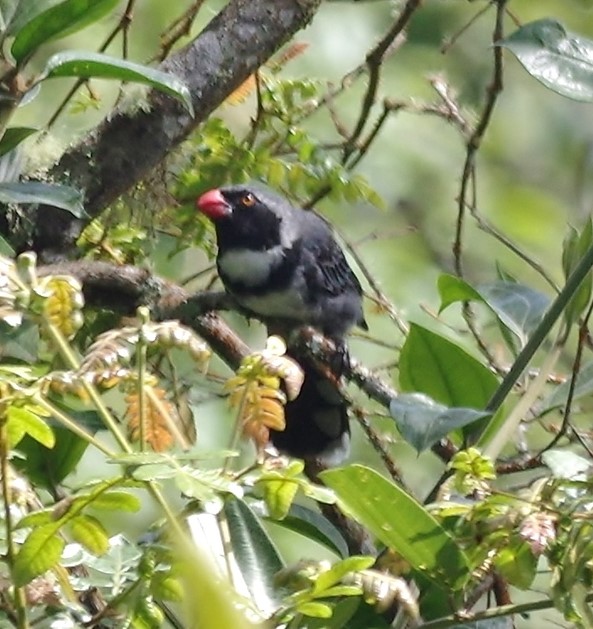
The Masked Saltator is a medium-sized songbird with a length of approximately 23 to 25 centimeters. One of its most distinguishing features is the black mask-like facial markings that contrast sharply with its otherwise olive-green plumage. The head displays a distinct black crown that extends to the nape, while the throat is a lighter gray, offering a striking contrast. The wings and back are primarily olive-green, which helps the bird blend into its leafy surroundings. Juveniles exhibit a duller coloration compared to adults, with less pronounced facial markings and a more muted plumage overall. Male and female Masked Saltators are similar in appearance, though females may have slightly less vibrant coloration. This similarity in plumage can make sex differentiation challenging without close observation. When in flight, the Masked Saltator reveals its relatively broad wings and long tail, which help in maneuvering through dense forest canopy. Its perching posture is often upright, and its presence on branches is characterized by a deliberate and cautious movement. Confusion with similar species, such as the Buff-throated Saltator, can occur, but the Masked Saltator's distinctive mask and overall darker appearance aid in accurate identification.
Having trouble telling birds apart? Upload a photo to our bird identification tool for an instant species match.
Masked Saltator Habitat and Range
Preferred Habitat
The Masked Saltator thrives in subtropical and tropical moist montane forests, particularly those found in the Andean regions of Peru and Bolivia. These habitats, characterized by dense vegetation and a rich supply of food resources, offer the ideal environment for the Masked Saltator to thrive. The bird is typically found at elevations between 1,800 and 3,000 meters, where the temperature and humidity are conducive to its survival. While it is primarily associated with forested areas, the Masked Saltator can occasionally be observed in scrublands or secondary growth forests, especially when searching for food. Seasonal habitat shifts are influenced by food availability, and the bird may venture into lower elevations during certain times of the year. Although urban sightings are rare, the Masked Saltator may occasionally be seen in rural gardens or orchards that border its natural forest habitats.
Geographic Range
The Masked Saltator's range is predominantly confined to the Andean regions of central and southern Peru and northern Bolivia. It occupies a relatively narrow band of montane forest within these countries, thriving in the moist and biodiverse environments that define these areas. This bird does not undergo long-distance migrations; instead, it engages in local movements within its established range, primarily driven by food availability and climatic conditions. Population density hotspots are found in well-preserved forest areas where the ecosystem remains largely intact. As such, regions like the Manu National Park in Peru and the Amboró National Park in Bolivia are crucial for the conservation of this species. The restricted range and habitat specialization of the Masked Saltator make its populations vulnerable to habitat loss, emphasizing the importance of conservation efforts in these key areas.
Want to know which birds visit your area? Browse our backyard birds by location guides for region-specific species lists.
What Does the Masked Saltator Eat?
The Masked Saltator has an omnivorous diet primarily consisting of fruits, seeds, and insects. Fruits and seeds make up the bulk of its diet, with a preference for those found within its montane forest habitat. During the breeding season, the bird may increase its intake of protein-rich insects to support the energy demands of raising young. It forages both in the forest canopy and on the ground, displaying a versatile approach to feeding. The Masked Saltator employs a variety of foraging techniques, such as gleaning insects from leaves and branches or plucking fruits directly from trees. Its strong, conical beak is well-adapted for cracking open seeds and accessing the nutritious contents within. Prey size varies but typically includes small insects and arthropods, which are consumed more frequently in times of fruit scarcity. The bird is most active during the early morning and late afternoon, aligning its feeding schedule with periods of cooler temperatures and reduced competition.
Masked Saltator Behavior and Social Structure
The Masked Saltator exhibits a range of intriguing behaviors. Socially, it is generally seen alone or in pairs during the breeding season. The bird becomes more territorial and vocal, defending its chosen nesting area from intruders. Territorial disputes are often resolved through vocalizations and displays rather than physical confrontations. Outside of the breeding season, Masked Saltators may join small mixed-species flocks, enhancing foraging efficiency and predator vigilance. Courtship displays involve a combination of vocalizations and physical posturing, where the male showcases his vibrant plumage to attract a mate. In response to predators, the Masked Saltator employs a variety of alarm calls to warn conspecifics of danger. It is known for its agile flight within the dense forest canopy, which aids in evading predators. Daily activity patterns show peaks of activity in the morning and late afternoon, with periods of rest during the hottest parts of the day.
Masked Saltator Nesting and Reproduction
The Masked Saltator constructs a cup-shaped nest using a variety of materials, including twigs, grass, and leaves. These nests are typically located in the fork of a tree or shrub, providing both stability and concealment from predators. Clutch size generally ranges from two to three eggs, which are incubated for approximately 14 days. Both parents share incubation duties, though the female often assumes a larger role. Once hatched, the altricial young are fed by both parents, who diligently provide a diet rich in insects and small fruits. The fledging period lasts about 12 to 14 days, after which the young birds continue to rely on parental support for a short period before gaining independence. The Masked Saltator typically raises one brood per year, though in favorable conditions, a second brood may be attempted.
Masked Saltator Sounds and Vocalizations
The Masked Saltator's song is a melodious series of clear, whistling notes that vary in pitch and rhythm. This vocalization serves both territorial and mate attraction purposes, with males often singing from prominent perches. Call notes are less complex, consisting of sharp 'chip' sounds used for communication between mates or within flocks. Alarm calls are more rapid and harsh, alerting other birds to potential threats. During the dawn chorus, the Masked Saltator's song can be heard echoing through the forest, contributing to the rich acoustic landscape of its habitat. The bird's vocalizations are a vital component of its behavior, facilitating social interactions and enhancing its ability to navigate the complex forest environment.
Interesting Facts About the Masked Saltator
- 1The Masked Saltator was first described in 1859 by the renowned ornithologist Philip Sclater.
- 2This bird's striking black mask is thought to play a role in species recognition and social interactions.
- 3Despite its limited range, the Masked Saltator has adapted to various microhabitats within montane forests.
- 4The Masked Saltator's song can vary significantly between individuals, showcasing its diverse vocal repertoire.
- 5In certain regions, the Masked Saltator serves as an indicator species, reflecting the health of montane ecosystems.
- 6During the rainy season, the Masked Saltator's diet shifts to include more insects, aiding in population control.
- 7The Masked Saltator is closely related to other saltator species, sharing similar ecological roles and behaviors.
Masked Saltator Conservation Status
Currently, the Masked Saltator is classified as of Least Concern by the IUCN. However, its populations are experiencing pressures from habitat loss due to deforestation and land conversion for agriculture. While the overall population trend remains stable, continued habitat destruction poses a significant threat. Conservation efforts focus on protecting critical habitats within its range, particularly in areas like national parks and reserves. Historical records indicate a more extensive distribution, highlighting the impact of human activities on its current range. Local conservation initiatives, alongside international efforts, aim to preserve the remaining habitats and promote sustainable land use practices.


