
Mountain Wren
Troglodytes solstitialis
Order: Passeriformes / Family: Troglodytidae
Wikimedia Commons
About the Mountain Wren
The Mountain Wren, Troglodytes solstitialis, is a small yet intriguing member of the Troglodytidae family, well-adapted to the high-elevation cloud forests of the Andes. Known for its lively and melodious song, this bird plays a vital role in the ecosystems of countries like Colombia, Ecuador, Peru, and Bolivia. These regions feature a unique blend of biodiversity where the Mountain Wren thrives, contributing to seed dispersal and insect population control. The Mountain Wren's presence in such ecologically rich environments makes it a key indicator species for the health of these montane forests. Seasonal behaviors of the Mountain Wren include an increase in territorial singing during the breeding season, typically from October to December, which coincides with the onset of the rainy season in many parts of its range. This wren is adept at exploiting the dense understory of the cloud forest, where it flits through the foliage in search of insects and other small invertebrates. Its role in the ecosystem is multifaceted, as it not only helps control insect populations but also aids in pollination and seed dispersal through its interactions with various plant species. The Mountain Wren's ecological significance extends beyond its immediate environment; its health can reflect broader environmental changes, making it an important species for conservationists to monitor. Despite its small size, the Mountain Wren's impact on its habitat is considerable, contributing to the complex web of life that defines the Andean cloud forests.
The Mountain Wren belongs to the family Troglodytidae, within the order Passeriformes. These birds typically live average 6 years with a maximum recorded of 9 years.
How to Identify a Mountain Wren
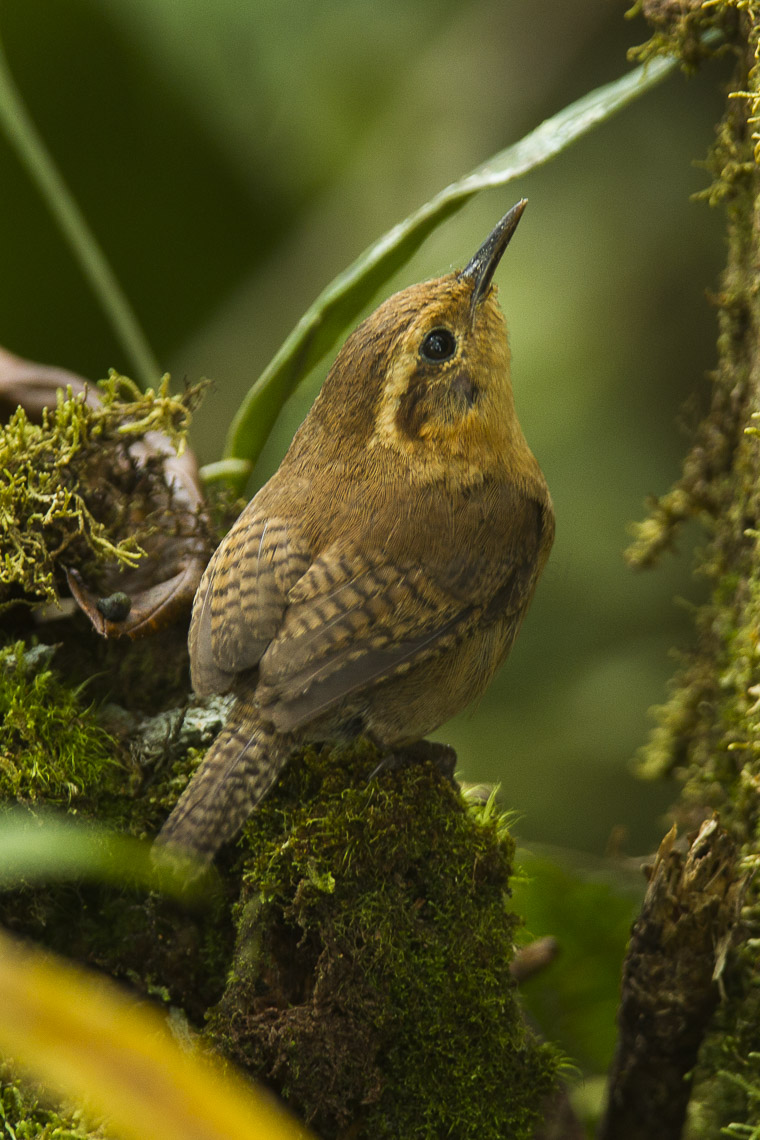
The Mountain Wren, Troglodytes solstitialis, is easily identified by its small size and distinct coloration. Adults display a rich brown plumage on the back with a lighter, buffy underbelly that aids in camouflage against the forest floor. The wings and tail are subtly barred, providing additional identification markers. Juveniles tend to have a slightly duller appearance, lacking the full richness of adult plumage, but they share the characteristic barred pattern. Both male and female Mountain Wrens look similar, making visual differentiation challenging without behavioral observation during the breeding season. Confusion with similar species such as the House Wren can occur, but the Mountain Wren's more vibrant song and preference for high-altitude habitats help distinguish it. In flight, the Mountain Wren exhibits a rapid, undulating motion, typical of wrens, with short bursts of wing flapping interspersed with brief glides. While perched, it often adopts an upright posture, flicking its tail in a characteristic wren-like manner. Its small size, coupled with its energetic movements, makes it a delightful subject for ornithologists and birdwatchers alike.
Having trouble telling birds apart? Upload a photo to our bird identification tool for an instant species match.
Mountain Wren Habitat and Range
Preferred Habitat
Mountain Wrens inhabit the dense cloud forests of the Andes, thriving at elevations between 2,000 and 3,500 meters. These forests, characterized by high humidity and frequent mist, provide an ideal environment with abundant insect life. In Colombia, they are predominantly found in the Central and Eastern Andes. In Ecuador, they are common in the eastern slopes, while in Peru, they are frequently observed in the northern regions. Seasonal habitat shifts are minimal for the Mountain Wren, as it remains resident year-round, maintaining territories within its preferred montane forest habitat. The species is rarely found in urban environments, as it favors the dense, undisturbed forests where it can find ample food and nesting sites. The Mountain Wren's habitat preference underscores the importance of conserving cloud forest ecosystems, which are increasingly threatened by deforestation and climate change.
Geographic Range
The range of the Mountain Wren, Troglodytes solstitialis, is confined to the Andean region of South America. Its breeding range spans the cloud forests of Colombia, Ecuador, Peru, and Bolivia, where it occupies elevations from 2,000 to 3,500 meters. This species is not migratory, remaining within its montane habitat throughout the year. In Colombia, population densities are higher in the Central and Eastern Andes, while in Ecuador, the eastern slopes of the Andes host significant populations. In Peru, the species is prevalent in the northern Andes, although it can be found in suitable habitats throughout the country. Bolivia represents the southernmost extent of its range, where it continues to occupy cloud forest habitats. Population density hotspots are often located in areas with minimal human disturbance, underscoring the importance of remote, protected areas for the conservation of this species.
Want to know which birds visit your area? Browse our backyard birds by location guides for region-specific species lists.
What Does the Mountain Wren Eat?
The Mountain Wren's diet primarily consists of insects and other small invertebrates, which it gleans from the dense understory of its cloud forest habitat. Its foraging technique involves quick, darting movements through foliage, capturing prey such as beetles, spiders, and caterpillars. During the breeding season, the demand for high-protein food sources increases, and the Mountain Wren becomes more active in its search for insects to feed its young. The bird's diet may also include small quantities of fruit and seeds, particularly during times when insect availability is lower. This opportunistic feeding behavior ensures that the Mountain Wren can sustain itself throughout the year, even in changing environmental conditions. The size of prey tends to be small, with most items measuring less than 1 cm, allowing the wren to efficiently consume its meals. Feeding typically occurs throughout the day, with peaks in activity during the early morning and late afternoon.
Mountain Wren Behavior and Social Structure
The Mountain Wren exhibits a range of behaviors that reflect its adaptation to life in the cloud forests. Socially, it is primarily solitary or found in pairs, especially during the breeding season. Territorial behavior is pronounced, with males singing persistently to defend their territory and attract mates. The Mountain Wren's courtship displays include a combination of song and physical displays, such as fluttering flights and tail flicking. Flocking behavior is uncommon, although outside of the breeding season, small family groups may form as juveniles remain with their parents for some time. In response to predators, the Mountain Wren employs a series of alarm calls and may engage in distraction displays to protect its nest. Daily activity patterns revolve around foraging, with peak activity in the cooler hours of the morning and late afternoon, aligning with the times when insect prey is most active. The Mountain Wren's adaptability and resourcefulness are key to its survival in the variable conditions of the cloud forest.
Mountain Wren Nesting and Reproduction
Mountain Wrens construct cup-shaped nests, typically located in the dense undergrowth or within cavities in trees. The nests are crafted from moss, leaves, and fine twigs, providing excellent insulation and camouflage. Preferred nesting sites are well-concealed, reducing the risk of predation. Clutch size varies, generally consisting of 3 to 5 eggs. The incubation period lasts about 14 days, with both parents participating in the process. After hatching, the young remain in the nest for approximately 15 to 17 days before fledging. Parental roles are shared, with both male and female Mountain Wrens involved in feeding and caring for the chicks. The species typically has one or two broods per year, depending on environmental conditions and food availability. The careful selection of nesting sites and diligent care provided by the parents contribute to the successful rearing of their young.
Mountain Wren Sounds and Vocalizations
The Mountain Wren's song is a delightful series of high-pitched, melodious notes, often described as a complex cascade of whistles and trills. This song serves as both a territorial and mating call, resonating through the cloud forests during the breeding season. Call notes are sharp and distinct, used primarily for communication between mates and signaling alarm. The Mountain Wren's alarm calls are rapid and repetitive, alerting others to potential threats. During the dawn chorus, the Mountain Wren's song stands out for its clarity and persistence, adding a vibrant layer to the morning soundscape of the Andes. The quality of the song, with its rhythmic intricacies, can be likened to the tinkling of a clear mountain stream, captivating those who listen.
Interesting Facts About the Mountain Wren
- 1The Mountain Wren's song can carry over long distances, making it audible even amid dense vegetation.
- 2Despite its small size, the Mountain Wren is a prolific insectivore, consuming hundreds of insects daily.
- 3The Mountain Wren's preference for high-altitude habitats makes it less susceptible to urbanization impacts.
- 4This species is known to participate in mixed-species foraging flocks, enhancing its foraging efficiency.
- 5Mountain Wrens are monogamous, forming strong pair bonds that often last several breeding seasons.
- 6The Mountain Wren has adapted to survive in the thin air of high elevations, where oxygen levels are lower.
- 7Its camouflaged plumage allows the Mountain Wren to blend seamlessly into the forest floor, avoiding predators.
Mountain Wren Conservation Status
The Mountain Wren is currently listed as Least Concern by the IUCN, with stable population trends across most of its range. However, primary threats include habitat loss due to deforestation and the expansion of agriculture. Conservation efforts focus on protecting cloud forest habitats through the establishment of reserves and national parks. Historical population changes are not well-documented, but ongoing habitat degradation poses a significant risk to the species' long-term survival. Continued monitoring and habitat conservation are vital to ensuring that the Mountain Wren remains an integral part of the Andean ecosystem.


