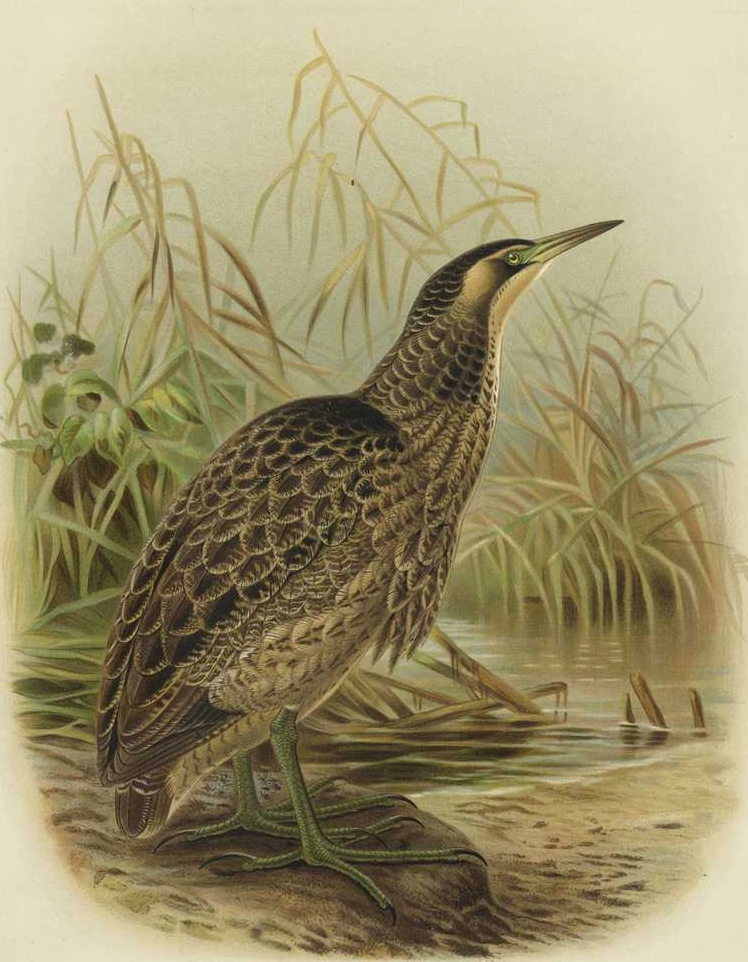
New Zealand Bittern
Ixobrychus novaezelandiae
Order: Pelecaniformes / Family: Ardeidae

Wikimedia Commons
About the New Zealand Bittern
The New Zealand Bittern, Ixobrychus novaezelandiae, belongs to the family Ardeidae and is a rare and elusive bird native to New Zealand. Historically found in both the North and South Islands, its numbers have drastically declined, leading to its classification as extinct. This bittern was a master of camouflage, blending seamlessly into reed beds and wetlands where it once thrived. The New Zealand Bittern played a crucial ecological role in these habitats, acting as both predator and prey. As a predator, it helped control populations of fish and insects, while as prey, it supported predator species higher up the food chain. Its presence indicated a healthy wetland ecosystem, and its absence signals significant ecological changes in its native regions. The bird's preferred habitats included freshwater marshes, swamps, and reed beds, where it could hunt and nest away from human disturbance. These environments were characterized by dense vegetation, providing the necessary cover for the bittern to hide from predators and to stalk its prey. Seasonal behaviors of the New Zealand Bittern would have included breeding activities during the austral spring and summer months, which are essential for species continuity. During these times, males performed elaborate courtship displays to attract females. Despite its extinction, the New Zealand Bittern remains an emblematic species for conservationists striving to protect and restore New Zealand's unique wetland ecosystems.
The New Zealand Bittern belongs to the family Ardeidae, within the order Pelecaniformes. These birds typically live Unknown, as the species is extinct..
How to Identify a New Zealand Bittern
The New Zealand Bittern was a small heron, roughly 60 centimeters in length, with a wingspan of about 80 to 100 centimeters. It had a distinctive plumage that aided in camouflage, featuring a mottled mix of browns, blacks, and whites, which mirrored the reeds and rushes of its wetland habitat. Adult plumage displayed more pronounced streaks and spots compared to the juveniles, whose feathers were typically duller and more uniformly brown. Males and females were similar in appearance, although males were slightly larger. Confusion with similar species, such as the Australasian Bittern, Botaurus poiciloptilus, was possible, but the New Zealand Bittern was smaller and had more intricate plumage patterns. In flight, it presented a compact silhouette with a retracted neck and slow, deliberate wingbeats. When perching, it adopted a vertical posture, often aligning its body with reeds to remain inconspicuous.
Having trouble telling birds apart? Upload a photo to our bird identification tool for an instant species match.
New Zealand Bittern Habitat and Range
Preferred Habitat
The New Zealand Bittern inhabited freshwater wetlands, swamps, and reed beds, particularly favoring areas with dense vegetation and standing water. These habitats were primarily located in lowland areas, although the bird could be found at various elevations depending on the availability of suitable wetland environments. Seasonal habitat shifts were minimal due to the bird's non-migratory nature, but it would have moved locally in response to water levels and food availability. In terms of urban presence, the New Zealand Bittern stayed clear of human settlements, preferring the tranquility and cover of rural and undeveloped wetlands.
Geographic Range
The range of the New Zealand Bittern was once widespread across New Zealand, including both the North and South Islands. It was primarily a resident species, with little in the way of long-distance migration. However, habitat loss and predation have led to its decline and eventual extinction. Historically, population density hotspots included large wetland areas such as the Whangamarino Wetland and Lake Ellesmere. These areas provided the necessary resources for feeding, breeding, and shelter. Today, efforts to restore wetland habitats aim to support other native species that shared the range with the New Zealand Bittern.
Want to know which birds visit your area? Browse our backyard birds by location guides for region-specific species lists.
What Does the New Zealand Bittern Eat?
The New Zealand Bittern's diet consisted mainly of fish, amphibians, insects, and crustaceans. It employed a highly efficient foraging technique known as 'stand and wait,' where it would remain motionless, partially submerged in water, waiting for unsuspecting prey to come within striking distance. This method was well-suited to the dense and tangled vegetation of its wetland habitat. Seasonal changes in diet were likely minimal, as its primary food sources were available year-round, but it might have shifted focus depending on prey abundance. Prey size varied, but the bittern typically targeted small fish and amphibians that could be easily caught and swallowed. Feeding occurred predominantly during dawn and dusk when the bird was most active.
New Zealand Bittern Behavior and Social Structure
The New Zealand Bittern exhibited solitary behavior, except during the breeding season when it became more territorial. Males performed courtship displays that included vocalizations and exaggerated movements to attract mates. These displays were crucial during the breeding season, which occurred in the austral spring and summer. The bittern was known for its distinctive booming call, used both for communication and territorial defense. Flocking behavior was uncommon, as the species preferred solitude, relying on its excellent camouflage to avoid predators. In the presence of danger, the bittern would adopt a 'freezing' posture, elongating its body and pointing its bill upwards to blend in with the reeds. Daily activity patterns were crepuscular, with peak foraging occurring at dawn and dusk.
New Zealand Bittern Nesting and Reproduction
The New Zealand Bittern built its nests in dense reed beds or rushes, typically over water to deter predators. The nest was constructed from reeds and other plant material, forming a platform that provided stability and concealment. Clutch size ranged from three to five eggs, with incubation lasting about 25-30 days. Both parents participated in incubation, although the female played a more prominent role in brooding. After hatching, the chicks remained in the nest for several weeks, receiving food from both parents. Fledging occurred approximately six to seven weeks after hatching, with young birds gaining independence shortly thereafter. The species typically had one brood per year, timed to coincide with the abundance of food in spring and summer.
New Zealand Bittern Sounds and Vocalizations
The New Zealand Bittern was renowned for its booming call, a deep, resonant sound often compared to the blowing of a distant foghorn. This call, primarily produced by males during the breeding season, served to establish territory and attract mates. The rhythm was slow and deliberate, with long pauses between each booming note. Besides the primary song, the bittern emitted various softer calls and grunts used in close-range communication with mates or offspring. Alarm calls were less common, as the bird relied more on stealth than vocal alerts to evade predators.
Interesting Facts About the New Zealand Bittern
- 1The New Zealand Bittern's call could be heard up to two kilometers away on a still night.
- 2Unlike many birds, the New Zealand Bittern was almost exclusively solitary outside the breeding season.
- 3This species' ability to blend into its surroundings was so effective that it was rarely seen even by experienced birdwatchers.
- 4The New Zealand Bittern was once considered a subspecies of the Australasian Bittern before being recognized as its own species.
- 5Wetlands that supported the New Zealand Bittern also provided habitat for other rare species such as the Australasian Bittern and the Marsh Crake.
New Zealand Bittern Conservation Status
The New Zealand Bittern is classified as extinct, a status resulting from extensive habitat destruction and predation by introduced species such as rats, cats, and stoats. Historically, drainage of wetlands for agriculture and urban development significantly reduced available habitats. Conservation efforts now focus on protecting and restoring wetland ecosystems to prevent further loss of biodiversity. These efforts include controlling invasive species and re-establishing natural water flow regimes to support remaining native species.
Other Ardeidae Species


Birds Similar to the New Zealand Bittern
These species are often confused with the New Zealand Bittern due to similar appearance or overlapping range.