
Nubian Woodpecker
Campethera nubica
Order: Piciformes / Family: Picidae
Wikimedia Commons
About the Nubian Woodpecker
The Nubian Woodpecker, known scientifically as Campethera nubica, is a visually striking member of the Picidae family. Found predominantly in sub-Saharan Africa, this bird thrives in a wide range of habitats from savannas and woodlands to forest edges and even urban areas. The Nubian Woodpecker is particularly noteworthy for its adaptability and resilience in diverse environments. Its ecological role includes contributing to forest health by controlling insect populations and participating in seed dispersal, which enhances plant biodiversity.
This species is widely distributed across eastern and southern Africa, with notable populations in Kenya, Tanzania, Uganda, and Ethiopia. It is commonly observed in both protected areas like national parks and unprotected regions where human activity is prevalent. The Nubian Woodpecker's presence in such a variety of habitats highlights its importance as an ecological generalist, capable of thriving in both natural and altered landscapes.
Seasonally, the Nubian Woodpecker demonstrates some variation in behavior. During the breeding season, typically aligned with the rainy season to ensure ample food supply, these woodpeckers become more vocal and territorial. Their drumming and calls become frequent as they establish and defend their territories. Outside the breeding season, Nubian Woodpeckers are less vocal but continue to play a critical role in the ecosystem by foraging for insects, which helps control pest populations. Their adaptability and resilience make them a vital component of the regions they inhabit.
The Nubian Woodpecker belongs to the family Picidae, within the order Piciformes. These birds typically live average 5-8 years; max recorded 10 years.
How to Identify a Nubian Woodpecker
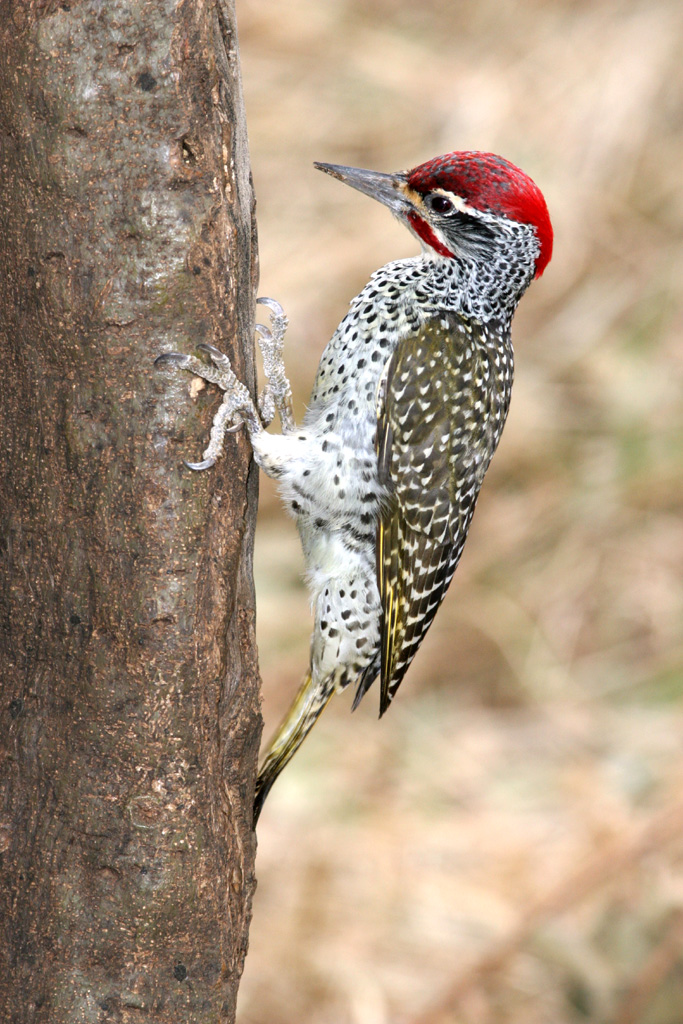
The Nubian Woodpecker is medium-sized, about 20-24 cm in length, with a wingspan of approximately 33-39 cm. Adults have a distinctive appearance, characterized by their red crown and nape in males, while females display a black crown with white spots. Both sexes exhibit a greenish back with bold white spotting, and the underparts are pale with dark spots.
Juvenile Nubian Woodpeckers resemble adults but with a duller overall coloration and less prominent spotting. The red crown of the juvenile male is less vivid, and immature females have fewer spots on the crown compared to adult females.
When comparing to similar species like the Bennett's Woodpecker, the Nubian Woodpecker can be distinguished by its more extensive spotting and the lack of a clear white throat that Bennett's Woodpecker exhibits. In flight, the Nubian Woodpecker shows a distinct undulating pattern, typical of woodpeckers, and when perched, it maintains an upright posture commonly observed in the family Picidae.
Having trouble telling birds apart? Upload a photo to our bird identification tool for an instant species match.
Nubian Woodpecker Habitat and Range
Preferred Habitat
The Nubian Woodpecker occupies a diverse array of habitats, predominantly in woodland and savanna regions. It thrives in areas with Acacia and Brachystegia trees, which provide both feeding and nesting opportunities. The species is found at elevations ranging from sea level to about 2,000 meters, although it is most common below 1,500 meters.
In terms of seasonal movements, the Nubian Woodpecker does not migrate long distances but may shift habitats locally in response to food availability and breeding needs. In urban areas, these woodpeckers are often found in parks and gardens where trees are abundant, demonstrating their adaptability to human-modified landscapes.
While generally more prevalent in rural settings with suitable vegetation, the Nubian Woodpecker's presence in urban environments underscores its versatility. The species' ability to occupy both dense forests and scattered tree savannas makes it a widespread and familiar sight throughout its range.
Geographic Range
The Nubian Woodpecker's range extends across a broad swath of sub-Saharan Africa, predominantly in the eastern and southern regions. Its breeding range includes countries such as Kenya, Tanzania, Uganda, Ethiopia, and parts of Sudan, where it inhabits both protected areas and regions with human activity.
Though not known for extensive migratory behavior, the Nubian Woodpecker exhibits some local movements largely influenced by food availability and seasonal climatic conditions. In areas where it is resident, the species tends to maintain a stable presence year-round, with minor shifts in range during different seasons.
Population density hotspots include national parks and reserves such as Serengeti in Tanzania and Amboseli in Kenya, where conservation efforts help maintain suitable habitats. Despite pressures from habitat loss and degradation in some areas, the Nubian Woodpecker remains a common resident in much of its range.
Want to know which birds visit your area? Browse our backyard birds by location guides for region-specific species lists.
What Does the Nubian Woodpecker Eat?
The Nubian Woodpecker's diet primarily consists of insects, particularly ants and termites, which it extracts from trees using its strong, chisel-like bill. Beetles, larvae, and other small invertebrates also form a significant part of its diet, especially during the breeding season when nutritional demands increase.
This woodpecker employs a variety of foraging techniques, such as probing, pecking, and gleaning, to access its prey. It often forages on tree trunks and branches, using its zygodactyl feet to cling to vertical surfaces while searching for insects hidden in the bark.
Seasonal changes influence dietary habits; during the rainy season, when insect activity is heightened, the Nubian Woodpecker's diet becomes more varied. Occasionally, it may consume fruits and seeds, particularly when insect populations are low. This opportunistic feeding strategy ensures the Nubian Woodpecker's survival in fluctuating environmental conditions.
Want to attract Nubian Woodpeckers to your yard? See our recommended feeders and seed types for the best results.
Nubian Woodpecker Behavior and Social Structure
Nubian Woodpeckers are typically solitary birds, although they may be observed in pairs during the breeding season. They exhibit strong territorial behavior, with individuals and pairs actively defending their chosen territories through vocalizations and drumming.
During courtship, the Nubian Woodpecker engages in displays that include both vocal and visual signals. Males may perform drumming sequences and display their colorful plumage to attract potential mates. Once paired, they maintain a strong bond throughout the breeding period.
In response to predators, such as birds of prey, the Nubian Woodpecker may emit alarm calls and take cover in dense foliage. Despite being primarily diurnal, its activity patterns include periods of rest during the hottest parts of the day. The Nubian Woodpecker is most active during the early morning and late afternoon when foraging for food.
Nubian Woodpecker Nesting and Reproduction
Nubian Woodpeckers construct their nests in tree cavities, which they either excavate themselves or take over from other species. Preferred nesting sites are typically found in dead trees or branches, where the wood is easier to excavate.
The clutch size for the Nubian Woodpecker usually ranges from 2 to 4 eggs. Both parents participate in incubation, which lasts approximately 12 to 14 days. After hatching, the chicks remain in the nest for another 20 to 25 days before fledging.
Throughout the nesting period, both male and female Nubian Woodpeckers share feeding duties and protect the nest from potential threats. Generally, the species raises one brood per year, although conditions such as food availability and climate can influence this.
Nubian Woodpecker Sounds and Vocalizations
The Nubian Woodpecker's vocal repertoire includes a series of sharp, piercing calls that are often heard during the breeding season. These calls serve both as territorial markers and communication between mates. The primary song consists of a rapid series of 'kik-kik-kik' notes, rising and falling in pitch.
In addition to vocalizations, the Nubian Woodpecker is known for its drumming behavior. The drumming patterns are rhythmic and can be heard over long distances, serving as both a territorial display and a communication method with other woodpeckers.
Alarm calls are shorter and more abrupt, used to warn of predators or disturbances. During the dawn chorus, the Nubian Woodpecker's calls contribute to the rich tapestry of sounds that characterize African woodlands and savannas.
Interesting Facts About the Nubian Woodpecker
- 1The Nubian Woodpecker can peck at a speed of up to 20 times per second, allowing it to efficiently excavate tree bark in search of food.
- 2Despite their small size, Nubian Woodpeckers can create cavities in trees up to 30 cm deep for nesting purposes.
- 3These woodpeckers have a unique tongue structure, with barbs that help extract insects from tree crevices.
- 4Nubian Woodpeckers have zygodactyl feet, with two toes facing forward and two backward, aiding in their climbing abilities.
- 5The red crown of the male Nubian Woodpecker becomes more vibrant during the breeding season, likely to attract mates.
- 6Drumming by Nubian Woodpeckers is not only for communication but also helps establish territory boundaries.
- 7Nubian Woodpeckers participate in mixed-species flocks during the non-breeding season, increasing foraging efficiency.
Nubian Woodpecker Conservation Status
The Nubian Woodpecker is currently classified as Least Concern by the IUCN, with stable population trends across most of its range. However, habitat loss due to deforestation and land conversion for agriculture poses a potential threat to some populations. Conservation efforts focus on habitat protection and the establishment of protected areas, which help ensure the survival of this species. In regions where conservation measures are in place, the Nubian Woodpecker benefits from a stable environment that supports its diverse habitat needs. Historically, the Nubian Woodpecker's population has remained robust, thanks in part to its adaptability and broad geographic distribution. Continued monitoring and conservation initiatives are essential to maintain this status, especially in areas where habitat degradation is a concern.
Attracting Nubian Woodpeckers to Your Feeder
The Nubian Woodpecker is a regular visitor to backyard bird feeders across its range. At the Eye On The Fly feeding station, we observe Nubian Woodpeckers regularly and capture footage with our feeder cameras.


