
Ochre-collared Piculet
Picumnus temminckii
Order: Piciformes / Family: Picidae
Wikimedia Commons
About the Ochre-collared Piculet
The Ochre-collared Piculet (Picumnus temminckii) is a small woodpecker species native to the Atlantic Forest region of southeastern Brazil. This bird is particularly notable for its diminutive size and the striking ochre coloration around its neck. These piculets play a significant role in their ecosystem as insectivorous birds that help control insect populations, thereby maintaining ecological balance in their habitat. The species occupies a range of forested environments, including primary and secondary forests, as well as edge habitats and even some urban green spaces. Their presence is a strong indicator of forest health, as they thrive in areas where insect life is abundant. Seasonal behaviors of the Ochre-collared Piculet include breeding activities that generally coincide with the rainy season, as this period provides an abundance of food resources. During this time, they are more vocal and active, participating in courtship displays and territorial defense. Despite their reliance on forested habitats, they exhibit some adaptability, occasionally venturing into degraded forests and plantations, reflecting their opportunistic nature.
The Ochre-collared Piculet belongs to the family Picidae, within the order Piciformes. These birds typically live average 5 years, with a maximum recorded of 7 years..
How to Identify a Ochre-collared Piculet
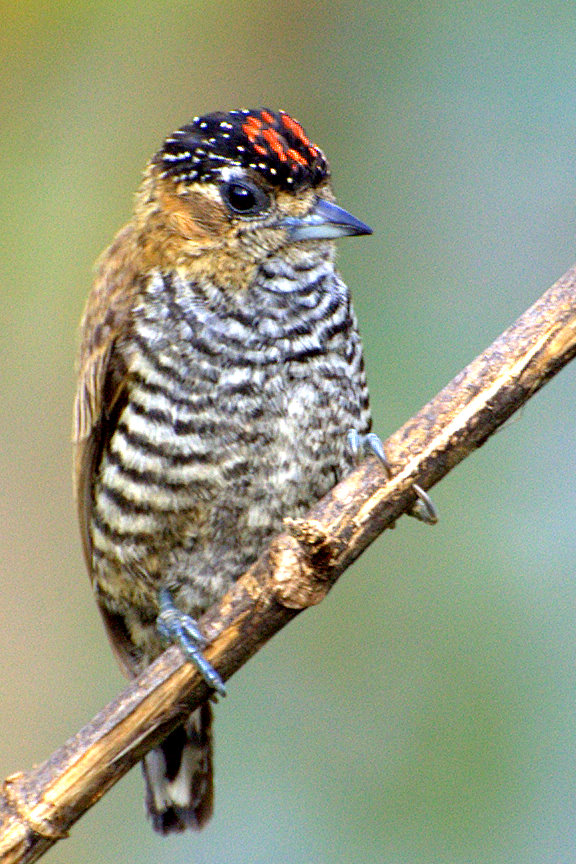
The Ochre-collared Piculet is easily identified by its small size, measuring about 10 cm in length, and its distinctive plumage pattern. Adults have an ochre band across the neck, which contrasts with their otherwise olive-green upperparts and pale underparts. The crown is often speckled with white, and males can be differentiated from females by a small patch of red feathers on their foreheads. Juvenile piculets resemble adults but lack the red forehead patch seen in males. In flight, their small size and rapid wingbeats are noticeable, and they often fly short distances from perch to perch. When perched, they exhibit a typical woodpecker posture, clinging upright to vertical branches or trunks. They may be confused with other piculets or small woodpeckers, but the ochre neckband is a distinguishing feature.
Having trouble telling birds apart? Upload a photo to our bird identification tool for an instant species match.
Ochre-collared Piculet Habitat and Range
Preferred Habitat
The Ochre-collared Piculet primarily inhabits subtropical and tropical moist lowland forests and montane forests. They are commonly found at elevations ranging from sea level up to 1,500 meters. Within these forested regions, they prefer areas with dense understory and plentiful deadwood, which are crucial for their foraging. Seasonal shifts in habitat use are minimal, although they may occupy slightly different forest strata depending on food availability. While typically forest-dwellers, these birds can sometimes be found in semi-urban areas where tree cover remains substantial.
Geographic Range
The Ochre-collared Piculet's range is primarily confined to the Atlantic Forest biome of southeastern Brazil. This includes the states of São Paulo, Rio de Janeiro, and Minas Gerais, where it is a resident species. They do not undertake long migrations, instead remaining within their range year-round. Population density is highest in well-preserved forest areas, although they can also persist in fragmented habitats where some forest cover is retained.
Want to know which birds visit your area? Browse our backyard birds by location guides for region-specific species lists.
What Does the Ochre-collared Piculet Eat?
The diet of the Ochre-collared Piculet is primarily composed of insects, which they skillfully extract from bark and small branches. Their foraging technique involves tapping and probing with their bills rather than the more forceful drilling associated with larger woodpecker species. They mainly consume ants, beetles, and larvae, but will also take small fruits and seeds when available. Seasonal variations in diet are influenced by the availability of insect prey, with a greater focus on insect consumption during the breeding season to meet the nutritional demands of raising young.
Ochre-collared Piculet Behavior and Social Structure
Ochre-collared Piculets exhibit a generally solitary or paired social structure, though they may join mixed-species flocks outside the breeding season. They are territorial, especially during the breeding season, when males engage in drumming displays and vocalizations to defend their territory. Courtship involves mutual tapping displays and synchronized movements between mates. Daily activity patterns see them most active during the morning and late afternoon, as they forage for food and engage in social interactions. In response to predators, they rely on their cryptic plumage to remain undetected, often freezing in place against bark.
Ochre-collared Piculet Nesting and Reproduction
Ochre-collared Piculets nest in cavities they excavate in dead trees or branches, often selecting sites several meters above the ground. Both the male and female participate in digging the nest hole, which provides a safe environment for rearing their young. The typical clutch consists of 2 to 4 eggs, which are incubated for about 12 to 14 days. Both parents share incubation duties and care for the hatchlings. The fledging period lasts approximately 20 to 25 days, after which the young remain dependent on the parents for a short time. Typically, this species raises one brood per year, although favorable conditions may lead to a second brood.
Ochre-collared Piculet Sounds and Vocalizations
The primary vocalization of the Ochre-collared Piculet is a series of high-pitched, rapid 'peep' or 'pik' notes that serve as both song and call. These sounds are often delivered in quick succession and are used for communication between mates and in territorial disputes. Alarm calls are sharper and more insistent, signaling distress or alerting others to the presence of predators. The piculet's vocal repertoire contributes to the dawn chorus in its habitat, adding a distinct, rhythmic element to the forest soundscape.
Interesting Facts About the Ochre-collared Piculet
- 1The Ochre-collared Piculet is one of the smallest members of the woodpecker family, measuring just 10 cm in length.
- 2Despite their small size, these birds are capable of drumming, a behavior more commonly associated with larger woodpeckers.
- 3Ochre-collared Piculets can often be found in mixed-species flocks, benefiting from the protection and foraging opportunities these groups provide.
- 4Their diet is highly specialized; they primarily consume ants and beetles, which they find by meticulously examining tree bark.
- 5This piculet's small size and cryptic coloration make it a master of camouflage, blending seamlessly with the forest environment.
Ochre-collared Piculet Conservation Status
The Ochre-collared Piculet is currently listed as Least Concern by the IUCN. Its population trend appears stable, though habitat loss due to deforestation remains a significant threat. Conservation efforts focus on preserving the Atlantic Forest, a biodiversity hotspot that supports the piculet and many other species. Historically, the population has fluctuated with changes in forest cover, emphasizing the need for continued habitat protection and restoration.
Other Picidae Species


Birds Similar to the Ochre-collared Piculet
These species are often confused with the Ochre-collared Piculet due to similar appearance or overlapping range.

