
Ou
Psittirostra psittacea
Order: Passeriformes / Family: Fringillidae
Wikimedia Commons
About the Ou
The Ou, scientifically known as Psittirostra psittacea, is a fascinating member of the Hawaiian honeycreepers, a group that has evolved into a diverse array of forms across the Hawaiian archipelago. This bird is particularly noteworthy for its parrot-like, robust beak, which sets it apart from many other honeycreepers. Historically found across the Hawaiian Islands, the Ou is now critically endangered, with its presence largely restricted to the dense native forests of Hawaii Island and Kauai. The Ou plays a crucial role in its ecosystem as a pollinator and seed disperser. By feeding on the nectar of native flowers and consuming fruits, it helps maintain the health and diversity of its forest habitat. This bird's seasonal behaviors are closely tied to the flowering and fruiting patterns of native plants. During the breeding season, which coincides with peak flowering, the Ou becomes particularly active and vocal. Outside of the breeding season, it might move to different altitudes in search of food, though its movements are not well understood due to its rarity. The Ou's significance extends beyond its ecological role; it is a symbol of Hawaii's unique biodiversity and the ongoing conservation challenges facing island ecosystems. Efforts to protect and restore its habitat are critical for the survival of this species, as it contends with threats like habitat loss, introduced predators, and disease. The bird's decline highlights the broader conservation issues in Hawaiian forests, underscoring the need for continued research and habitat protection.
The Ou belongs to the family Fringillidae, within the order Passeriformes. These birds typically live average 7 years, with a maximum recorded of 10 years.
How to Identify a Ou
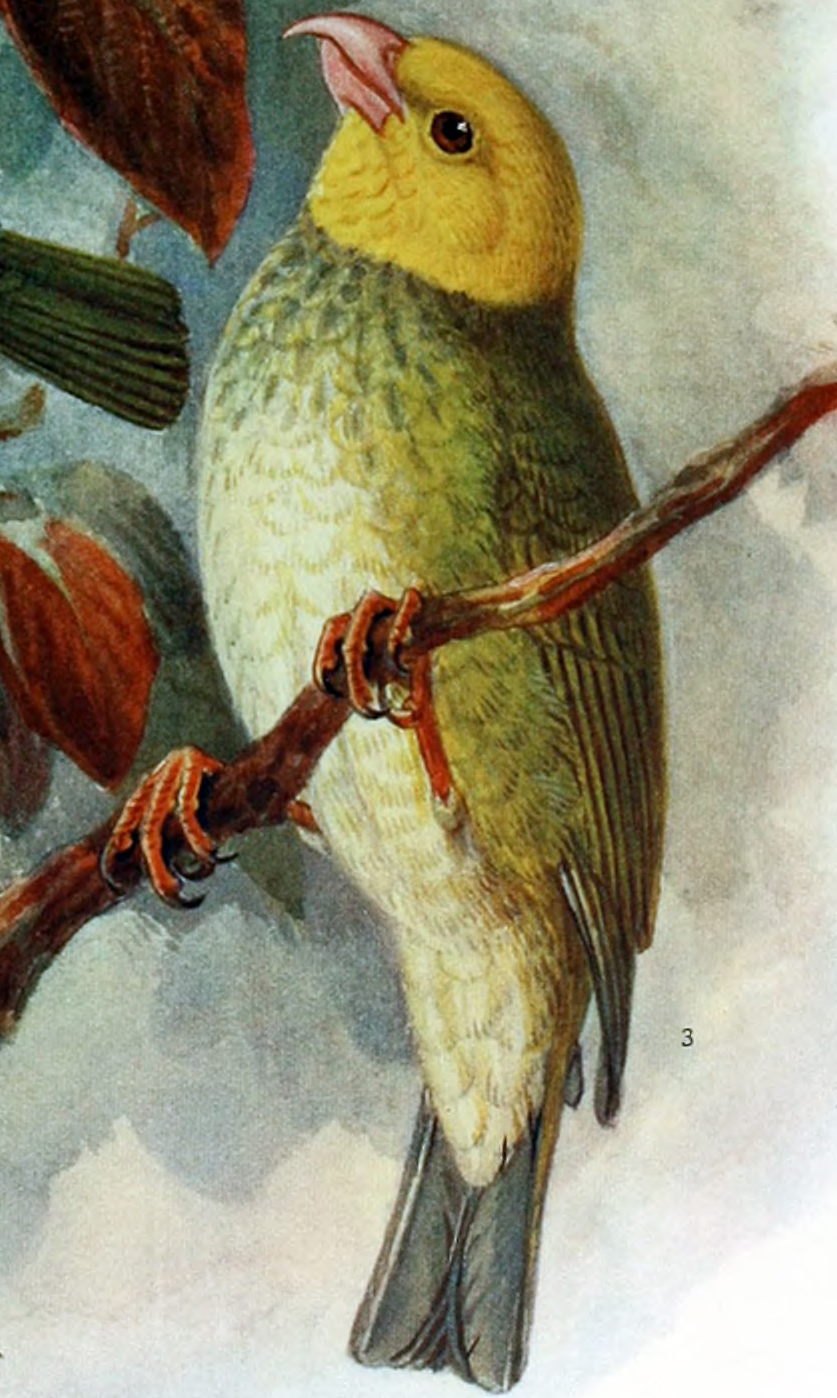
The Ou is a medium-sized honeycreeper with a striking appearance, characterized by its large, curved beak reminiscent of a parrot's. Adult Ou have a predominantly bright green plumage that provides effective camouflage among the foliage. Their underparts are slightly paler compared to their upperparts. Males and females appear similar, though males may exhibit slightly brighter colors. Juveniles resemble adults but with a duller, less vibrant green, making them less conspicuous. One of the key identification features is the bird's unique beak shape, adapted for a diet of fruits and nectar. This beak sets the Ou apart from other honeycreepers which often have more slender, curved bills. In flight, the Ou exhibits a strong and direct flight pattern, with rapid wingbeats. When perched, it often adopts a relaxed posture, sometimes clinging sideways to branches while foraging. Confusion with other species is rare due to its distinct size and beak, but observers might mistake it for other green birds if seen at a distance or in poor lighting.
Having trouble telling birds apart? Upload a photo to our bird identification tool for an instant species match.
Ou Habitat and Range
Preferred Habitat
The Ou predominantly inhabits montane rainforests on the Hawaiian Islands, particularly favoring areas with a dense canopy of native trees such as Metrosideros polymorpha (ʻōhiʻa) and Acacia koa. These forests, located at elevations ranging from 1,000 to 2,000 meters, provide a rich array of food resources. The Ou requires intact forest ecosystems with minimal disturbance, as it is highly sensitive to habitat degradation. Seasonal shifts in habitat use may occur, with the Ou moving to lower elevations during certain times of the year in search of food, although detailed patterns of such movements remain poorly documented due to the bird's rarity. Unlike some other honeycreepers, the Ou is not commonly found in urban or heavily disturbed areas.
Geographic Range
Historically, the Ou was found across multiple Hawaiian Islands, including Hawaii, Kauai, Oahu, and Molokai. However, due to significant population declines, its range has dramatically contracted. Currently, it is primarily found on Hawaii Island and to a lesser extent on Kauai. The Ou does not undertake long-distance migrations but may exhibit local altitudinal movements in response to food availability. Its historical range reductions are largely attributed to habitat loss and introduced predators. Today, the remaining populations are highly fragmented, with density hotspots in remote, inaccessible forest areas where conservation efforts are ongoing.
Want to know which birds visit your area? Browse our backyard birds by location guides for region-specific species lists.
What Does the Ou Eat?
The Ou's diet primarily consists of nectar and fruits, which it procures using its distinctive parrot-like beak. During the flowering season, it feeds extensively on the nectar of native flowers, playing an important role in pollination. Preferred nectar sources include the flowers of ʻōhiʻa and other native plants. In addition to nectar, the Ou consumes a variety of fruits, contributing to seed dispersal within its habitat. Its foraging technique often involves acrobatic maneuvers, such as hanging upside down to reach flowers and fruits. Seasonal changes in diet are evident, with a higher reliance on fruits during periods when flowers are less abundant. The Ou's feeding schedule is diurnal, with peak activity in the early morning and late afternoon when temperatures are cooler.
Ou Behavior and Social Structure
The Ou exhibits a solitary or loosely social structure, often seen foraging alone or in pairs rather than in large flocks. During the breeding season, territory establishment becomes evident, with pairs defending their chosen nesting sites from intruders. Courtship displays include vocalizations and gentle beak-touching rituals. The Ou's response to predators is cautious; it relies on dense foliage for cover and uses alarm calls to alert nearby birds. Its daily activity pattern involves early morning foraging, followed by periods of rest during the hotter parts of the day, resuming activity in the late afternoon. The Ou's behavior reflects its adaptation to a specific ecological niche, where its role as a pollinator and seed disperser is vital.
Ou Nesting and Reproduction
Ou nesting occurs in the dense canopies of native montane forests. The nest is a well-concealed cup-like structure, constructed from twigs, leaves, and moss, providing camouflage from predators. Preferred nesting locations are high branches of ʻōhiʻa and koa trees, where they lay a clutch of 2-3 eggs. The incubation period lasts approximately two weeks, primarily undertaken by the female, while the male provides food. After hatching, both parents participate in feeding the chicks, which fledge around three weeks after hatching. Typically, the Ou raises one brood per year, although this can vary with environmental conditions.
Ou Sounds and Vocalizations
The primary song of the Ou is a melodious series of fluted notes, often described as a clear and sweet whistle. These phrases vary in pitch and rhythm, providing a distinctive soundscape in its forest habitat. Calls include softer contact notes used between mates and more insistent alarm calls when threats are perceived. The dawn chorus sees increased vocal activity, with the Ou contributing to the vibrant morning soundscape typical of Hawaiian forests. Its vocalizations, while unique, can be compared to the melodious calls of other Hawaiian honeycreepers, yet with a distinct tonal quality.
Interesting Facts About the Ou
- 1The Ou's beak, similar to a parrot's, is an adaptation for its unique diet of fruits and nectar.
- 2Historically, the Ou could be found on multiple Hawaiian Islands, but now it's mostly restricted to Hawaii and Kauai.
- 3Conservation efforts for the Ou focus on habitat restoration, predator control, and disease management.
- 4The Ou's decline highlights broader issues in Hawaiian ecosystems, emphasizing the need for habitat protection.
- 5The Ou plays a crucial role in pollinating native Hawaiian plants, maintaining forest health.
- 6The Ou's melodious song is a key part of the dawn chorus in its native montane forest habitat.
- 7The Ou's nesting habits involve constructing well-camouflaged nests high in native trees, safe from many predators.
Ou Conservation Status
The Ou is listed as Critically Endangered by the IUCN, with a declining population trend. The primary threats include habitat loss, predation by introduced species such as rats and cats, and diseases like avian malaria. Conservation efforts focus on habitat protection and restoration, predator control, and disease management. Historical population changes have been drastic, with the Ou's range significantly reduced over the past century. Ongoing research aims to better understand its ecology, while captive breeding programs are being considered to bolster wild populations.
Other Fringillidae Species


Birds Similar to the Ou
These species are often confused with the Ou due to similar appearance or overlapping range.
