
Hungarian Partridge
Palaeocryptonyx hungaricus
Order: Galliformes / Family: Phasianidae
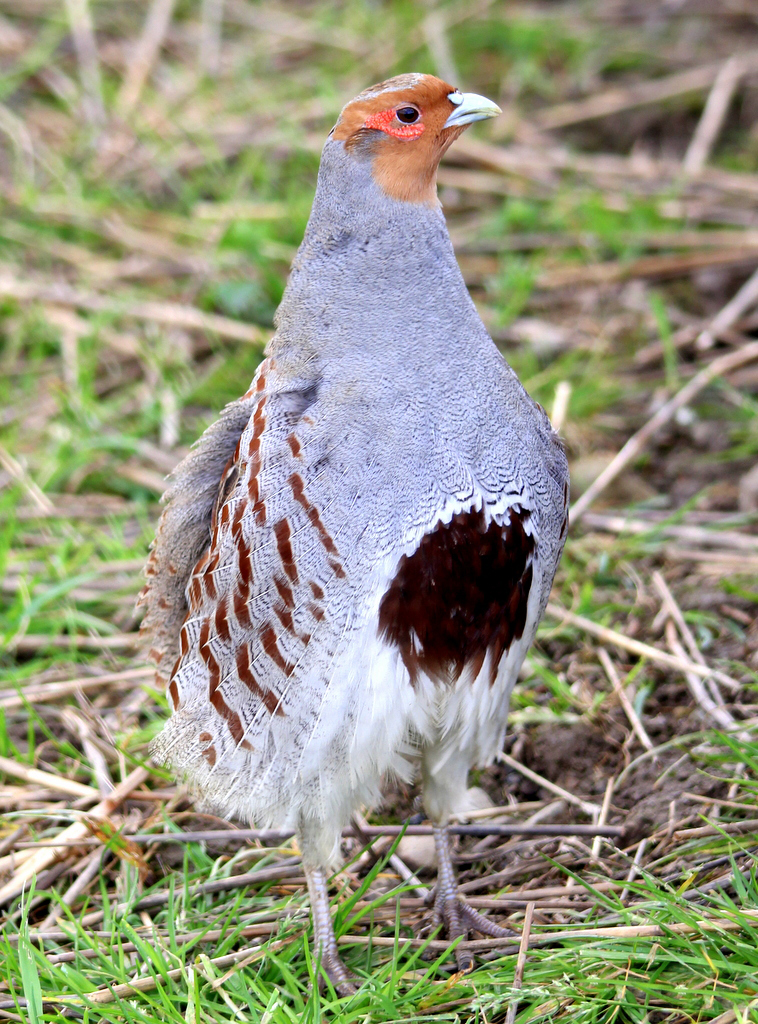
Wikimedia Commons
About the Hungarian Partridge
The Hungarian Partridge, scientifically known as Palaeocryptonyx hungaricus, is a robust game bird belonging to the family Phasianidae. This species is an emblematic figure in the grasslands and agricultural fields of Central and Eastern Europe. Its presence is particularly significant in Hungary, where its name originates, and extends to regions such as Romania, Ukraine, and parts of western Russia. In these areas, the Hungarian Partridge plays a crucial ecological role as both prey and predator. It contributes to the control of insect populations and serves as a food source for numerous raptors and mammalian predators.
This species exhibits a fascinating array of behaviors that shift with the seasons. During the breeding season, Hungarian Partridges are more territorial and less gregarious, with pairs often establishing nesting territories in dense grass or crop cover. As autumn approaches, these birds become more social, often forming coveys that can comprise as many as 15 individuals. These groups enhance their survival chances by providing increased vigilance against predators and more efficient foraging.
The Hungarian Partridge has adapted well to human-altered landscapes, thriving in areas of mixed farming. Its presence is indicative of healthy agro-ecosystems, as it requires a mosaic of vegetation types for nesting, cover, and feeding. Unfortunately, the intensification of agriculture, coupled with habitat fragmentation, poses a threat to its populations. Nonetheless, some conservation programs aim to mitigate these impacts by promoting sustainable farming practices and maintaining field margins, which provide vital habitats.
Throughout the year, the diet of the Hungarian Partridge shifts according to food availability. In spring and summer, insects like beetles and ants dominate their diet. During the colder months, they rely heavily on seeds and grains. These dietary shifts reflect their adaptability and resilience in the face of changing environmental conditions. The species' ability to thrive in a range of habitats, from temperate grasslands to semi-arid regions, underscores its ecological versatility.
The Hungarian Partridge belongs to the family Phasianidae, within the order Galliformes. These birds typically live Unknown; extinct species..
How to Identify a Hungarian Partridge
Most notably, the Hungarian Partridge is distinguishable by its intricate plumage. Adults display a mottled brown and gray pattern, which provides effective camouflage in their natural habitat. The bird's underparts are a lighter buff color, contrasted by a chestnut-colored horseshoe marking on the belly, which is more pronounced in males. Females tend to have less distinct markings, aiding them in nesting concealment.
Juveniles resemble adults but have a more subdued color palette, lacking the distinct belly marking. As they mature, their plumage develops into the adult pattern, a process that occurs over several months. The partridge's stout body, rounded wings, and short tail are characteristic features, with a length of approximately 30-32 centimeters and a wingspan reaching 45-48 centimeters.
In flight, the Hungarian Partridge presents a rapid, whirring wingbeat, interspersed with short glides. This flight pattern is a key identifying trait, distinguishing it from similar species such as the Chukar Partridge and the Gray Partridge. When perched, they exhibit a slightly hunched posture, a behavior often observed when they are wary of predators.
Having trouble telling birds apart? Upload a photo to our bird identification tool for an instant species match.
Hungarian Partridge Habitat and Range
Preferred Habitat
The Hungarian Partridge thrives in open grasslands and agricultural fields, favoring habitats that provide ample ground cover. These birds are often found at elevations ranging from lowland plains to foothills, rarely venturing into densely forested or mountainous areas. They are particularly prevalent in regions with a mosaic of crops and natural vegetation, such as those found in Hungary, Ukraine, and Romania.
During the breeding season, Hungarian Partridges prefer areas with dense grasses or crops that offer protection from predators and harsh weather. In winter, they may shift to areas with stubble fields and hedgerows, which provide essential cover and foraging opportunities. While predominantly rural, they occasionally edge into peri-urban areas where suitable habitats persist.
Their adaptability to a variety of grassland habitats, whether natural or man-made, underscores their resilience. However, they remain absent from densely urbanized environments, relying instead on agricultural landscapes where traditional farming practices are maintained.
Geographic Range
The breeding range of the Hungarian Partridge extends across Central and Eastern Europe, encompassing countries such as Hungary, Romania, Ukraine, and parts of western Russia. This area represents the core of their distribution, where population densities are typically highest.
In some regions, their range overlaps with that of the Gray Partridge, although the Hungarian Partridge tends to occupy slightly warmer and drier environments. There is no significant migratory movement in this species, as they are largely sedentary, residing year-round within their breeding territories. However, some seasonal movement to different habitats occurs in response to food availability and weather conditions.
Population density hotspots are often found in areas where traditional farming is practiced, with significant populations observed in the Great Hungarian Plain and the steppes of Ukraine. These regions offer the ideal combination of food resources and habitat structure, crucial for supporting healthy partridge populations.
Want to know which birds visit your area? Browse our backyard birds by location guides for region-specific species lists.
What Does the Hungarian Partridge Eat?
The diet of the Hungarian Partridge is highly versatile, reflecting its adaptability to seasonal variations in food availability. During the spring and summer months, these birds predominantly consume insects, including beetles, ants, and caterpillars, which provide essential protein for growth and reproduction.
As the seasons change and insect availability diminishes, their diet shifts to include more plant-based foods. Seeds and grains become the primary food sources in autumn and winter, with partridges foraging in fields and along hedgerows for wheat, barley, and other grains. They may also consume small amounts of clover and other leafy vegetation.
Foraging typically occurs in the early morning and late afternoon, when they venture into open areas to feed. Their foraging technique involves walking slowly and pecking at the ground, often in small groups to maximize efficiency and minimize the risk of predation. They are adept at exploiting available resources, ensuring their survival across varied landscapes.
Hungarian Partridge Behavior and Social Structure
The Hungarian Partridge exhibits complex social structures, with behaviors that vary seasonally. During the breeding season, pairs form and become territorial, often defending their chosen nesting sites vigorously. The male plays a crucial role in territorial defense, using vocalizations and displays to deter rivals.
Outside the breeding season, these birds become more gregarious, forming coveys of up to 15 individuals. These social groups provide several advantages, including enhanced predator detection and increased foraging efficiency. The birds maintain a hierarchical social structure within the covey, with dominant individuals often leading foraging and roosting activities.
Their response to predators is swift and coordinated, often involving rapid flight to dense cover. When disturbed, they may emit alarm calls to alert others in the group. Daily activity patterns are bimodal, with peak activity occurring in the early morning and late afternoon, allowing them to avoid the heat of midday.
Hungarian Partridge Nesting and Reproduction
Nest construction for the Hungarian Partridge typically involves a scrape in the ground, lined with grasses and leaves. Nests are often hidden in dense vegetation or crop fields, providing camouflage from predators. The female usually selects the nesting site and undertakes the majority of nest building.
Clutch sizes range from 10 to 18 eggs, with incubation lasting approximately 23 to 25 days. The female incubates the eggs alone, while the male guards the territory. Upon hatching, chicks are precocial, leaving the nest within hours to follow their parents, who guide them to food sources.
Fledging occurs at around 10 to 14 days, though the young remain with their parents for several weeks, learning essential survival skills. Typically, Hungarian Partridges raise one brood per year, although in optimal conditions, they may attempt a second. Parental roles are well-defined, with both sexes participating in chick rearing, ensuring high survival rates.
Hungarian Partridge Sounds and Vocalizations
The Hungarian Partridge is known for its distinctive calls, which include a sharp, repetitive 'kerr-ik' sound often heard during territorial disputes or when alarmed. This call is loud and carries over long distances, serving as an effective communication tool within coveys.
During the breeding season, males may produce a series of whistling notes, used in courtship displays to attract females. These whistling notes are softer and less frequent than their alarm calls.
While not as vocal as some other game birds, the Hungarian Partridge's calls play a crucial role in maintaining social bonds and coordinating group movements. They participate in dawn choruses, where their calls contribute to the acoustic landscape of grassland habitats.
Interesting Facts About the Hungarian Partridge
- 1The Hungarian Partridge can lay up to 18 eggs per clutch, one of the largest clutch sizes among game birds.
- 2Despite their name, Hungarian Partridges are not exclusive to Hungary and have a wide range across Europe.
- 3They have a unique flight pattern with rapid wingbeats followed by short glides, making them recognizable in the field.
- 4The Hungarian Partridge's call can be heard over distances of up to 1.5 kilometers in open landscapes.
- 5These birds are known to form large coveys outside the breeding season, enhancing their survival against predators.
- 6The Hungarian Partridge has adapted well to agricultural landscapes, often thriving where other species struggle.
- 7Females play a crucial role in nest selection and building, ensuring the safety of their clutch with strategic site choice.
Hungarian Partridge Conservation Status
The Hungarian Partridge currently holds a status of Least Concern on the IUCN Red List. However, its populations face pressures from habitat loss due to agricultural intensification and land use changes. Pesticide use also poses a threat by reducing insect prey availability. Conservation efforts focus on maintaining traditional farming practices and preserving field margins that provide essential habitat. Some countries have implemented agri-environment schemes to support biodiversity, benefiting partridge populations. Historically, population numbers have fluctuated due to changes in land management and climatic conditions. Continued monitoring and adaptive management strategies are essential to ensure the species' long-term viability.


