
Pale-billed Hornbill
Lophoceros pallidirostris
Order: Bucerotiformes / Family: Bucerotidae
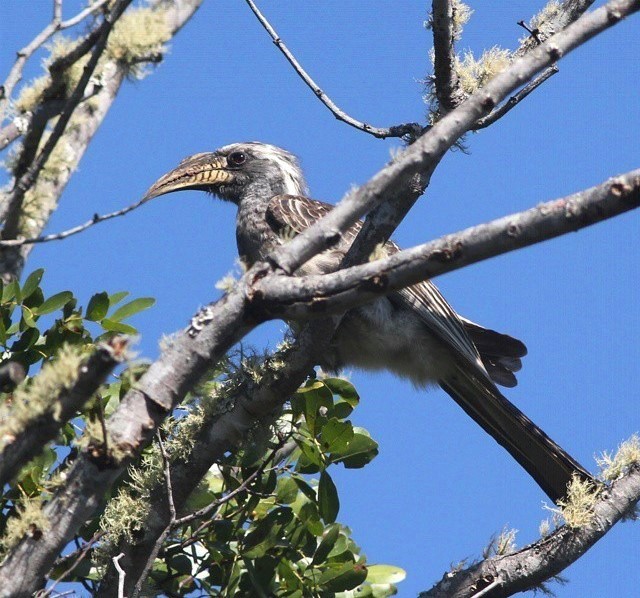
Wikimedia Commons
About the Pale-billed Hornbill
The Pale-billed Hornbill, Lophoceros pallidirostris, is a charismatic bird of the Bucerotidae family. Found predominantly in the dry savannas and woodlands of sub-Saharan Africa, this hornbill displays adaptability to a variety of environments, from open woodlands to dense miombo forests. It is especially prevalent in countries such as Zambia, Angola, and the Democratic Republic of the Congo, where it plays a significant ecological role as both predator and prey. Its presence in these ecosystems contributes to seed dispersal and pest control, ensuring the health and balance of its habitat.
The significance of the Pale-billed Hornbill extends beyond its ecological role. It is also an important species for ornithologists and birdwatchers, offering insights into avian behavior and adaptation to changing environments. As a member of the Bucerotiformes order, the hornbill is part of a unique group known for their distinctive casques and vibrant personalities. Its characteristic pale bill sets it apart from other hornbills, serving as a key identifying trait during field observations.
Seasonal behaviors of the Pale-billed Hornbill include notable changes in foraging patterns and habitat use. During the breeding season, these hornbills become more territorial, often seen defending their chosen areas from intruders. In contrast, the non-breeding season witnesses more social behavior, with hornbills forming small flocks as they roam their territories. Their adaptability to both solitary and flocking lifestyles underscores their versatility as a species, allowing them to thrive in diverse environments throughout the year.
The Pale-billed Hornbill belongs to the family Bucerotidae, within the order Bucerotiformes. These birds typically live average 10-12 years with a max recorded of 15 years.
How to Identify a Pale-billed Hornbill
The Pale-billed Hornbill is easily identified by its prominent pale-colored bill, which contrasts sharply with its darker plumage. Adult birds exhibit a primarily gray-brown body with lighter underparts, while their wings are marked with a pattern of white and black feathering. This coloration provides excellent camouflage among the tree branches and dry landscapes of their habitat.
Juvenile hornbills bear a resemblance to adults but tend to have a duller and more uniform coloration, lacking the pronounced contrast seen in mature birds. Sexual dimorphism is subtle in this species, with males generally being slightly larger and possessing a more pronounced casque on their bill.
When observing the Pale-billed Hornbill in flight, birders should note its unique silhouette, characterized by broad wings and a long tail. This distinctive shape aids in distinguishing it from other hornbills, such as the African Gray Hornbill, which can appear similar at a distance. Perching Pale-billed Hornbills often adopt an upright posture, using their tails for balance and frequently venturing out onto exposed branches.
Having trouble telling birds apart? Upload a photo to our bird identification tool for an instant species match.
Pale-billed Hornbill Habitat and Range
Preferred Habitat
Pale-billed Hornbills are typically found in dry savannas and woodlands, thriving in regions where Acacia and miombo trees dominate the landscape. They prefer habitats that provide a mixture of open spaces and dense foliage, allowing for both foraging and nesting opportunities. These hornbills are commonly observed at elevations ranging from sea level up to 1500 meters, although they are more prevalent at lower elevations.
Throughout the year, the Pale-billed Hornbill may shift its habitat preferences slightly in response to seasonal changes. During the wet season, they may venture into denser forests in search of food, while in the dry season, they often remain in more open areas where food sources are more predictable. Despite their adaptability, these hornbills are not typically found in urban environments, preferring rural and semi-rural areas where human disturbance is minimal.
Geographic Range
The Pale-billed Hornbill is native to sub-Saharan Africa, with a range extending from Angola and Zambia in the west to Tanzania in the east. This species is non-migratory, with established territories that are maintained throughout the year. Within its range, the hornbill is most commonly found in regions characterized by dry savannas and woodlands, although it may occasionally inhabit wetter forested areas during certain seasons.
Population density hotspots for the Pale-billed Hornbill include the miombo woodlands of central Zambia and the savannas of southern Angola. Within these areas, they are a common sight, often observed in pairs or small family groups. Despite their wide distribution, local populations may vary in density, influenced by factors such as habitat availability and food resources.
Want to know which birds visit your area? Browse our backyard birds by location guides for region-specific species lists.
What Does the Pale-billed Hornbill Eat?
The diet of the Pale-billed Hornbill is diverse, consisting primarily of insects, small vertebrates, and various fruits. During the wet season, these hornbills exploit the abundance of insects, such as beetles and grasshoppers, which form a significant portion of their diet. They employ a foraging technique that involves probing into leaf litter and bark crevices to uncover hidden prey.
In the dry season, when insect availability decreases, the Pale-billed Hornbill shifts its focus to fruits and seeds. Fig trees, in particular, provide a vital food source during this time. The hornbill's strong bill and agile movements enable it to pluck fruits efficiently, even from the most challenging perches. Their feeding schedule is largely diurnal, with peak activity occurring during the early morning and late afternoon when temperatures are more moderate.
Pale-billed Hornbill Behavior and Social Structure
Socially, the Pale-billed Hornbill exhibits a mix of solitary and gregarious behavior. During the breeding season, these birds become fiercely territorial, with pairs defending their chosen nesting sites against rivals. Courtship displays are elaborate, involving a series of vocalizations and mutual preening, which strengthen pair bonds.
Outside of the breeding season, the Pale-billed Hornbill may form small flocks, particularly when foraging for food. These groups often consist of family members or neighboring pairs, collaborating to locate and exploit food resources. The hornbill's response to predators is vigilant, with loud alarm calls and evasive flights to thicker cover when threatened.
Daily activities of the Pale-billed Hornbill follow a predictable pattern, with peak activity during the cooler hours of the day. Midday often finds them resting in shaded areas to avoid the harsh sun, resuming foraging activities as temperatures decline.
Pale-billed Hornbill Nesting and Reproduction
Pale-billed Hornbills nest in natural tree cavities, often selecting sites in mature trees with suitable entrance sizes. The female hornbill takes on the primary role of preparing the nest, using mud and excrement to seal the entrance after entering, leaving only a small opening for the male to pass food through.
The typical clutch size ranges from two to four eggs, which the female incubates for around 25 to 30 days. During this period, the male is responsible for providing food to the female and later to the chicks. Once hatched, the chicks remain in the nest for another 40 to 50 days, during which both parents share the responsibility of feeding and protecting them.
Pale-billed Hornbills usually have one brood per year, although in areas with abundant food, a second brood may occur. The fledging process is critical, as young hornbills must quickly learn to forage and avoid predators once they leave the nest.
Pale-billed Hornbill Sounds and Vocalizations
The vocal repertoire of the Pale-billed Hornbill includes a variety of calls and songs. The primary song is a series of resonant, rhythmic hoots, often repeated several times in a row. These calls serve as both territorial markers and communication signals between mates.
The hornbill's call notes are shorter and more abrupt, used for quick communication or alerting others to potential threats. Alarm calls are sharp and piercing, designed to warn other birds of nearby danger. During the dawn chorus, the Pale-billed Hornbill is particularly vocal, contributing to the symphony of bird calls that greet the morning.
Interesting Facts About the Pale-billed Hornbill
- 1The Pale-billed Hornbill's casque serves not only as a resonating chamber for calls but also as a tool for digging into tree bark.
- 2Unlike many bird species, Pale-billed Hornbills exhibit cooperative breeding, with older offspring sometimes helping to rear new chicks.
- 3Pale-billed Hornbills can consume up to 60% of their body weight in food each day during peak foraging seasons.
- 4These hornbills have a mutualistic relationship with certain tree species, helping disperse seeds through their droppings.
- 5The Pale-billed Hornbill's pale bill is an adaptation that helps reflect sunlight, reducing heat absorption in its arid habitat.
Pale-billed Hornbill Conservation Status
The Pale-billed Hornbill is currently listed as Least Concern by the IUCN, with population trends considered stable. However, the species faces threats from habitat loss due to deforestation and agricultural expansion. Conservation efforts focus on preserving its natural habitat and promoting sustainable land use practices. Historically, the hornbill's population has remained relatively stable, benefiting from its adaptability to various environments. Continued monitoring and habitat protection are essential to ensure the long-term conservation of the species.


