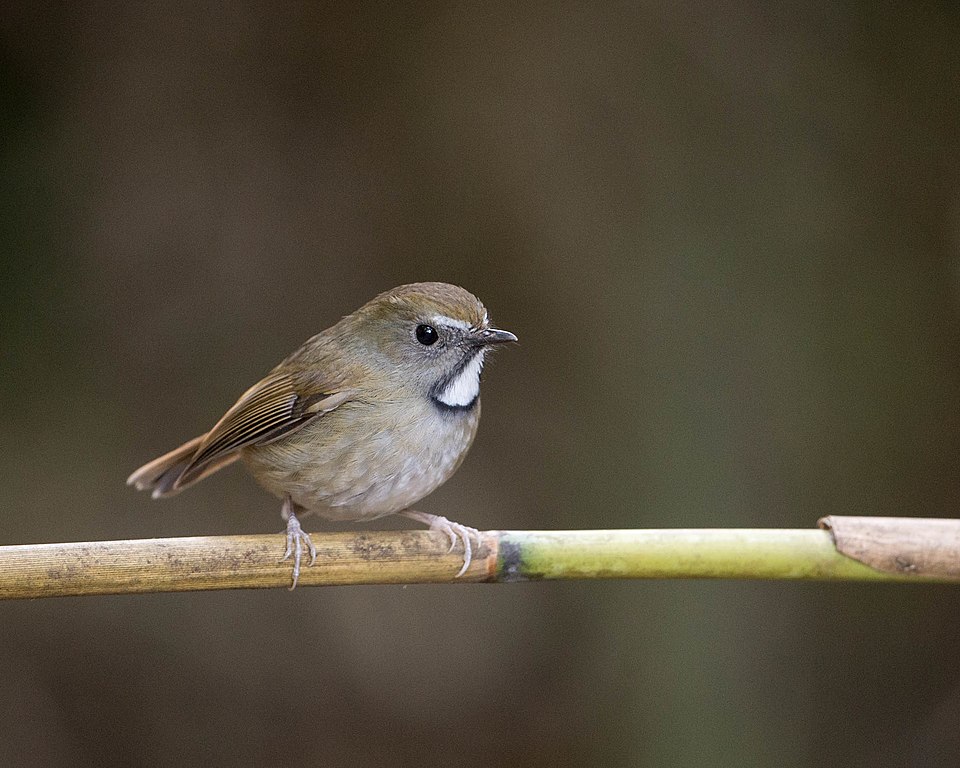
Pale-chinned Blue Flycatcher
Cyornis poliogenys
Order: Passeriformes / Family: Muscicapidae

Wikimedia Commons
About the Pale-chinned Blue Flycatcher
The Pale-chinned Blue Flycatcher, scientifically known as Cyornis poliogenys, is a small passerine bird belonging to the family Muscicapidae. This species is particularly notable for the males' vibrant azure blue upperparts contrasted with a distinctive pale chin, which provides the bird its common name. Females, on the other hand, are more subdued in coloration, featuring olive-brown upperparts and pale underparts with a subtle hint of blue on the wings and tail. These birds are known for their agile and acrobatic flight, often darting through the forest understory in pursuit of insects.
The ecological role of the Pale-chinned Blue Flycatcher is significant, as it helps control insect populations in its habitat. It is primarily found in the subtropical and tropical moist lowland forests across Southeast Asia. This bird is commonly seen in regions like northeastern India, Myanmar, Thailand, and parts of southern China, where it occupies dense foliage of forest edges and clearings. During the breeding season, which typically spans from March to July, these flycatchers become particularly active, engaging in elaborate courtship displays.
Seasonal behaviors of the Pale-chinned Blue Flycatcher are marked by their breeding activities and subsequent seasonal movements. Post-breeding, they may disperse across their range, though they do not undertake long migratory journeys. Instead, they tend to move locally within their range, following food availability and suitable habitat conditions. The bird's preference for dense forest cover makes it a vital component of its ecosystem, contributing to seed dispersal and forest regeneration through its feeding habits.
Overall, the Pale-chinned Blue Flycatcher is a species of interest not only for its striking appearance but also for its role in maintaining the ecological balance in the regions it inhabits. Its presence is an indicator of healthy forest ecosystems, and it plays a crucial role in the intricate web of life within its tropical domain.
The Pale-chinned Blue Flycatcher belongs to the family Muscicapidae, within the order Passeriformes. These birds typically live typically around 4-5 years, with some individuals reaching up to 6 years..
How to Identify a Pale-chinned Blue Flycatcher
Identifying the Pale-chinned Blue Flycatcher involves noting several key field marks. Adult males exhibit a bright azure blue plumage on the upperparts, with a more intense blue on the wings and tail. The chin and throat area is noticeably pale, almost white, which contrasts sharply with the rest of the plumage. In comparison, females are more cryptic in coloration, with olive-brown upperparts and a subtle wash of blue on the wings and tail. The underparts of females are lighter, often with a slight buff tinge. Juveniles resemble females in coloration but may show faint streaking on the throat and breast.
Differences between males and females are quite pronounced, making gender identification straightforward. Males' vivid blue coloration is not only a visual delight but also serves as a distinguishing feature from similar species. Potential confusion may arise with the Blue-throated Flycatcher, but the Pale-chinned Blue Flycatcher's pale chin provides a clear differentiator.
In flight, the Pale-chinned Blue Flycatcher presents a sleek silhouette with rapid, agile movements that are typical of flycatchers. When perched, they tend to hold themselves upright, often flicking their tails sideways, a behavior that is characteristic of many in the flycatcher family. Observing these traits can assist birders in confidently identifying this species in the field.
Having trouble telling birds apart? Upload a photo to our bird identification tool for an instant species match.
Pale-chinned Blue Flycatcher Habitat and Range
Preferred Habitat
The Pale-chinned Blue Flycatcher favors subtropical and tropical moist lowland forests, where it thrives under the dense canopy. It is frequently found in areas with a mix of mature trees and secondary growth, often near streams or other bodies of water. This preference for forest habitats means they are typically encountered at elevations ranging from sea level up to around 1,500 meters, although they are predominantly more common in lowland areas.
Seasonal habitat shifts are not prominent in this species, as they tend to remain within forested environments year-round. However, they may move slightly in elevation or within their range in response to food availability and climatic conditions. In urban settings, the Pale-chinned Blue Flycatcher is less common, although it may occasionally be spotted in well-wooded parks and gardens, particularly during dispersal after the breeding season.
Rural and forested environments provide the ideal conditions for this species, with its reliance on insect prey and preference for dense foliage making less disturbed areas more suitable. As such, conservation of their natural habitats is crucial for the continued survival of these flycatchers.
Geographic Range
The breeding range of the Pale-chinned Blue Flycatcher spans across Southeast Asia, with significant populations in northeastern India, Myanmar, Thailand, and southern China. Within these regions, the bird occupies suitable forested habitats, showing a preference for areas with dense foliage and abundant insect life.
During the non-breeding season, these birds do not undertake extensive migrations but may exhibit local movements within their range. This local dispersal is often driven by the availability of food resources and suitable habitats. While not migratory in the traditional sense, their movements reflect a degree of adaptability in response to environmental conditions.
Population density hotspots for the Pale-chinned Blue Flycatcher can be found in the forested areas of Assam, Arunachal Pradesh, and the foothills of the Himalayas in India. These regions offer optimal conditions for breeding and feeding, making them important areas for the study and conservation of this species. The bird's presence in these locations highlights the importance of preserving forested habitats that support a rich diversity of avian life.
Want to know which birds visit your area? Browse our backyard birds by location guides for region-specific species lists.
What Does the Pale-chinned Blue Flycatcher Eat?
The diet of the Pale-chinned Blue Flycatcher primarily consists of insects, which they catch using their adept flycatching abilities. Their foraging technique involves sallying from a perch to capture prey mid-air, a behavior typical of flycatchers. They have also been observed gleaning insects from foliage, making use of their agility and keen eyesight.
Common prey items include small flies, beetles, and other arthropods, with the birds demonstrating a preference for soft-bodied insects. During the breeding season, their dietary needs increase, and they may consume larger quantities of insects to meet the demands of feeding their young.
Seasonally, there may be slight shifts in diet composition depending on insect availability. However, their reliance on insect prey remains consistent throughout the year. Feeding primarily occurs during the day, with peak activity in the early morning and late afternoon when insect activity is highest.
The Pale-chinned Blue Flycatcher's diet plays a critical role in controlling insect populations within their habitat, contributing to the ecological balance of the forest ecosystems they inhabit.
Pale-chinned Blue Flycatcher Behavior and Social Structure
The behavior of the Pale-chinned Blue Flycatcher is characterized by its solitary and territorial nature, particularly during the breeding season. Males establish and defend territories through song and visual displays, often choosing prominent perches to announce their presence. Courtship displays involve a series of aerial maneuvers and vocalizations designed to attract a mate.
Outside the breeding season, these flycatchers may be observed in loose associations, though they remain largely solitary. Flocking behavior is uncommon, and individuals tend to maintain their own feeding territories. In response to predators, the Pale-chinned Blue Flycatcher exhibits alertness and may issue sharp alarm calls to warn nearby conspecifics.
Daily activity patterns include periods of active foraging interspersed with rest periods where the bird engages in preening and sunning. These flycatchers are most active during the cooler parts of the day, with a noticeable decline in activity during the heat of midday.
Overall, the Pale-chinned Blue Flycatcher's behavior reflects its adaptation to a life of insect hunting in dense forest environments, where stealth, agility, and keen senses are essential for survival.
Pale-chinned Blue Flycatcher Nesting and Reproduction
The nesting habits of the Pale-chinned Blue Flycatcher are indicative of their adaptation to forest environments. They build their nests in natural cavities, often in trees or among roots and rocks, using materials such as moss, leaves, and fine twigs. The nest is a cup-shaped structure, carefully constructed to provide stability and camouflage from predators.
Typically, the clutch size ranges from two to four eggs, with incubation carried out primarily by the female. The incubation period lasts approximately 14 to 16 days, during which the male may assist by bringing food to the nesting female. Once hatched, the chicks are altricial and require constant care and feeding by both parents.
Fledging occurs about 14 to 18 days after hatching, with the young birds remaining dependent on the parents for some time before becoming fully independent. The number of broods per year is generally one, although in optimal conditions, a second brood may be attempted.
The nesting strategy of the Pale-chinned Blue Flycatcher reflects the need for concealment and protection in their forested habitats, ensuring the successful rearing of their young.
Pale-chinned Blue Flycatcher Sounds and Vocalizations
The primary song of the Pale-chinned Blue Flycatcher is a series of melodious and fluty notes, delivered in a rhythmic pattern. The song is typically soft yet carries well through the forest, serving as both a territorial marker and a mate attractant. The typical song sequence consists of three to five notes, with slight variations in pitch and tempo.
Call notes are sharper and more abrupt, often used as contact calls between mates or family members. Alarm calls are distinct, consisting of a series of rapid, high-pitched notes that serve to alert other birds to potential threats.
During the dawn chorus, the Pale-chinned Blue Flycatcher plays a prominent role, its song blending harmoniously with those of other forest species. The bird's vocalizations are an integral part of its behavior, aiding in communication and social interaction within its species.
Compared to other flycatchers, the Pale-chinned Blue Flycatcher's song is more musical and less harsh, making it a pleasure for birdwatchers to hear in its natural habitat.
Interesting Facts About the Pale-chinned Blue Flycatcher
- 1The Pale-chinned Blue Flycatcher is known for its striking sexual dimorphism, with males displaying vivid blue plumage and females having more subdued colors.
- 2Despite its name, the Pale-chinned Blue Flycatcher is known to lack a significant chin patch in some individuals, leading to fascinating variations among populations.
- 3This species exhibits a unique foraging behavior known as 'sallying,' where it catches insects mid-flight with remarkable agility and precision.
- 4The Pale-chinned Blue Flycatcher is often found at elevations up to 1,500 meters, making it a common sight in lower montane forests.
- 5Its song, a series of melodious fluty notes, is often heard during the dawn chorus, adding to the rich soundscape of Southeast Asian forests.
- 6While primarily insectivorous, the Pale-chinned Blue Flycatcher may occasionally consume small fruits, showcasing its dietary adaptability.
- 7The nesting cup of the Pale-chinned Blue Flycatcher is intricately woven from moss and leaves, reflecting its mastery in using natural materials.
Pale-chinned Blue Flycatcher Conservation Status
The Pale-chinned Blue Flycatcher is currently listed as Least Concern on the IUCN Red List, with populations considered stable across its range. However, like many forest-dependent species, it faces threats from habitat loss due to deforestation and land-use changes. These activities reduce the availability of suitable breeding and foraging habitats, placing pressure on local populations. Conservation efforts focus on safeguarding forest habitats and promoting sustainable land-use practices to ensure the preservation of biodiversity. Protected areas and national parks within the flycatcher's range play a crucial role in maintaining population stability. Historically, the Pale-chinned Blue Flycatcher has shown resilience in adapting to environmental changes, but continued habitat degradation could pose significant challenges. Monitoring population trends and implementing conservation measures are essential to prevent potential declines. Engagement with local communities and awareness programs can enhance conservation outcomes by promoting practices that support habitat conservation and biodiversity protection.