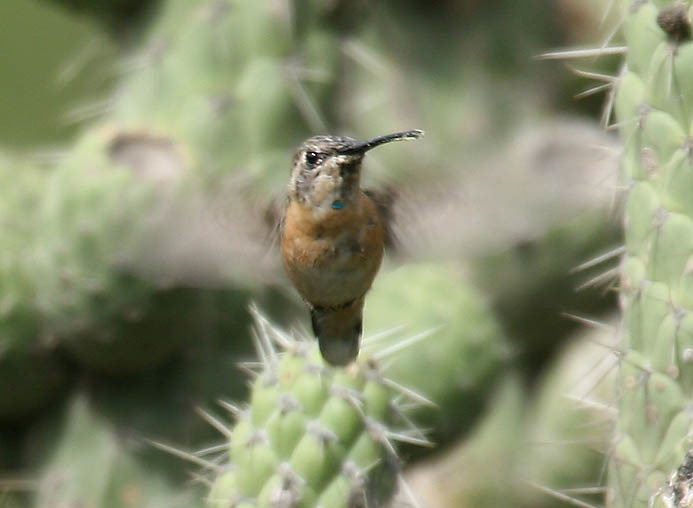
Peruvian Sheartail
Thaumastura cora
Order: Apodiformes / Family: Trochilidae

Wikimedia Commons
About the Peruvian Sheartail
The Peruvian Sheartail, Thaumastura cora, is a captivating hummingbird species known for its vibrant appearance and dynamic behaviors. This small yet striking bird inhabits the arid and semi-arid regions along the western coast of South America, particularly in Peru and into southern Ecuador and northern Chile. The species is well-adapted to the diverse ecological niches it occupies, from coastal scrubs to inland valleys, where it plays a crucial role as a pollinator. As a member of the family Trochilidae, the Peruvian Sheartail contributes significantly to the ecosystems it inhabits by facilitating the reproduction of various flowering plants. During breeding season, this hummingbird is particularly active, with males showcasing their impressive tails in elaborate aerial displays to attract females. The Peruvian Sheartail demonstrates remarkable adaptability, thriving in both natural and modified landscapes, including urban gardens where it often visits feeders. This bird's presence is an indicator of healthy ecosystems, as it relies on abundant floral resources and insects for sustenance. Despite facing habitat fragmentation and other environmental pressures, the Peruvian Sheartail remains a vibrant and resilient species, symbolizing the rich biodiversity of its native regions. Conservation efforts focus on preserving its natural habitat and mitigating human-induced threats, ensuring that this striking hummingbird continues to enchant observers and fulfill its ecological role.
The Peruvian Sheartail belongs to the family Trochilidae, within the order Apodiformes. These birds typically live usually 3-5 years, with some individuals reaching up to 7 years..
How to Identify a Peruvian Sheartail
The Peruvian Sheartail is distinguished by its small size, measuring about 10 to 12 cm in length, and its notably long, forked tail, which is most pronounced in males. Males exhibit a striking iridescent green plumage on the upperparts and a white underbelly, with a vibrant purple gorget that can appear almost black in poor lighting. Females, while similar in size, have less pronounced tail forks and lack the vivid gorget, instead displaying a subtler gray throat. Juveniles resemble females but may have more muted colors overall. In flight, the Peruvian Sheartail presents a distinctive silhouette due to its long tail and rapid wingbeats typical of hummingbirds. When perched, it often holds its tail slightly fanned, accentuating its forked shape. This species can be confused with other small hummingbirds like the Oasis Hummingbird, but the tail length and male gorget coloration are key distinguishing features.
Having trouble telling birds apart? Upload a photo to our bird identification tool for an instant species match.
Peruvian Sheartail Habitat and Range
Preferred Habitat
The Peruvian Sheartail inhabits a variety of environments, primarily favoring arid and semi-arid regions. It is commonly found in coastal scrubs, dry valleys, and open areas with scattered vegetation. This adaptable bird can also thrive in urban settings, where it frequents gardens and parks, especially those with abundant flowering plants. Elevation-wise, it occupies areas from sea level up to around 2,500 meters. Seasonal habitat shifts are minimal, but it may move locally in search of optimal feeding grounds, particularly during periods of floral scarcity. The presence of the Peruvian Sheartail in both rural and urban landscapes underscores its versatility and adaptability to human-altered environments.
Geographic Range
The Peruvian Sheartail is primarily distributed along the western coast of South America. Its breeding range extends from northern Chile through coastal Peru and into southern Ecuador. While it is largely a resident species, some local movements occur in response to food availability and climatic conditions. Population density is highest in regions with abundant floral resources, such as the coastal valleys of Peru. Although not typically migratory, the species may exhibit altitudinal movements, descending to lower elevations during colder months and returning to higher altitudes as conditions warm.
Want to know which birds visit your area? Browse our backyard birds by location guides for region-specific species lists.
What Does the Peruvian Sheartail Eat?
The diet of the Peruvian Sheartail predominantly consists of nectar from a variety of flowering plants. It favors species that produce tubular flowers, which align with its long bill, allowing efficient nectar extraction. In addition to nectar, the sheartail supplements its diet with small insects and spiders, providing essential proteins. Seasonal variations in flowering patterns influence its diet, with the bird adjusting its foraging range to locate blooming plants. Peruvian Sheartails exhibit a unique hovering technique, allowing them to feed while suspended in front of flowers. They are most active during early morning and late afternoon, aligning their feeding schedule with peak nectar availability.
Want to attract Peruvian Sheartails to your yard? See our recommended feeders and seed types for the best results.
Peruvian Sheartail Behavior and Social Structure
The Peruvian Sheartail displays a range of intriguing behaviors, particularly during the breeding season. Males engage in elaborate courtship displays, showcasing their long, forked tails in aerial maneuvers designed to attract females. These displays often involve rapid, swooping flights and hovering, accompanied by vocalizations that enhance the spectacle. Territoriality is a prominent behavior, with males aggressively defending feeding territories from intruders, including other hummingbirds and even larger birds. Despite their small size, Peruvian Sheartails exhibit boldness and tenacity. Outside of breeding, they can be seen visiting a series of flowers along a set route, a behavior known as trap-lining. They are generally solitary but may be seen in loose associations where food sources are abundant. The species demonstrates a keen awareness of predators, often retreating to dense cover when threatened.
Peruvian Sheartail Nesting and Reproduction
Peruvian Sheartails construct their nests with remarkable precision, utilizing plant fibers, spider silk, and lichen to create a sturdy yet flexible structure. These nests are typically located on branches of shrubs or small trees, often concealed among leaves for protection. The female alone is responsible for nest construction and incubation. She lays two small, white eggs, which she incubates for approximately 15 to 18 days. After hatching, the young remain in the nest for about 20 to 25 days before fledging. The female continues to care for the fledglings, providing food and protection. Peruvian Sheartails may produce two broods per year, depending on environmental conditions and food availability.
Peruvian Sheartail Sounds and Vocalizations
The vocalizations of the Peruvian Sheartail are characterized by a series of high-pitched, metallic chips and trills. These sounds serve various functions, from courtship displays to territorial defense. The primary song is a rapid series of notes, often delivered during flight displays. Alarm calls differ, sounding sharper and more insistent, alerting other birds to potential threats. During the dawn chorus, Peruvian Sheartails contribute their distinctive calls to the ambient soundscape, a testament to their active and vocal nature.
Interesting Facts About the Peruvian Sheartail
- 1The Peruvian Sheartail's tail length can exceed its body length, making it one of the longest-tailed hummingbirds relative to size.
- 2Males use their long tails in courtship displays, creating a mesmerizing spectacle to attract mates.
- 3This hummingbird can beat its wings up to 70 times per second, allowing it to hover effortlessly while feeding.
- 4Despite their small size, Peruvian Sheartails are fiercely territorial, often chasing away larger birds from their feeding areas.
- 5The species' adaptability to urban environments has allowed it to thrive in gardens where native flora is preserved.
Peruvian Sheartail Conservation Status
The Peruvian Sheartail is currently classified as Least Concern by the IUCN, with a stable population trend. However, it faces threats from habitat degradation due to agricultural expansion and urban development. Conservation efforts focus on habitat preservation and the establishment of protected areas to safeguard critical feeding and breeding sites. Historically, the population has remained relatively stable, but ongoing monitoring is essential to detect any changes due to environmental pressures.
Attracting Peruvian Sheartails to Your Feeder
The Peruvian Sheartail is a regular visitor to backyard bird feeders across its range. At the Eye On The Fly feeding station, we observe Peruvian Sheartails regularly and capture footage with our feeder cameras.
Other Trochilidae Species


Birds Similar to the Peruvian Sheartail
These species are often confused with the Peruvian Sheartail due to similar appearance or overlapping range.