
Philippine Hawk-Eagle
Nisaetus philippensis
Order: Accipitriformes / Family: Accipitridae
Wikimedia Commons
About the Philippine Hawk-Eagle
The Philippine Hawk-Eagle (Nisaetus philippensis) is a powerful raptor endemic to the Philippines, found primarily in the islands of Luzon, Leyte, Samar, Mindanao, and smaller surrounding islands. As a member of the Accipitridae family, this eagle exhibits the classic traits of its kin: keen eyesight, formidable talons, and a robust build. With a wingspan ranging from 105 to 120 cm, this medium-sized raptor commands respect both in the air and on land.
The significance of the Philippine Hawk-Eagle cannot be understated, as it plays a crucial role in maintaining the ecological balance within its habitat. As an apex predator, it helps control populations of small to medium-sized mammals and birds, thus ensuring a healthy ecosystem. This eagle is also culturally significant to local communities, often featured in folklore and revered as a symbol of power and freedom.
Primarily inhabiting the dipterocarp and montane forests, the Philippine Hawk-Eagle prefers elevations ranging from lowland areas up to 1,800 meters. These dense forested regions offer ample cover and hunting opportunities. However, deforestation and habitat fragmentation pose significant threats to this species, leading to a decline in population. Despite these challenges, the Philippine Hawk-Eagle has shown some adaptability by occasionally venturing into secondary forests and mixed plantations.
Seasonally, the Philippine Hawk-Eagle exhibits slight altitudinal movements, likely in response to prey availability and breeding requirements. While some individuals may inhabit territories year-round, others might shift to different elevations during the non-breeding season. This adaptability, however, may not be enough to counter the ongoing loss of its natural habitat, emphasizing the need for focused conservation efforts.
The Philippine Hawk-Eagle belongs to the family Accipitridae, within the order Accipitriformes. These birds typically live average 10-15 years, max recorded 18 years.
How to Identify a Philippine Hawk-Eagle
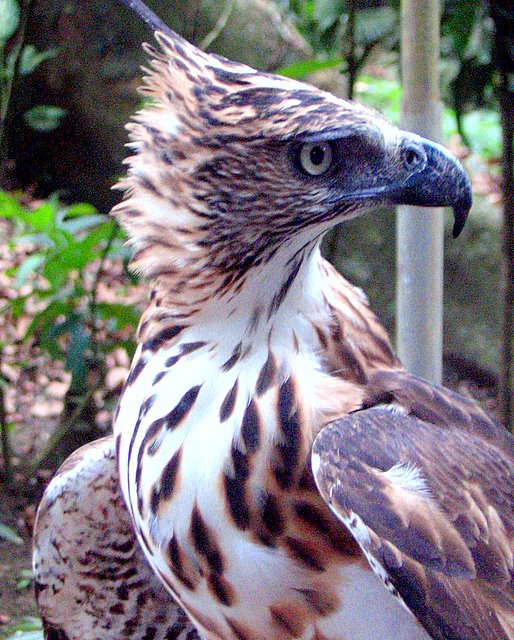
Adult Philippine Hawk-Eagles are distinguishable by their striking appearance, sporting a prominent crest of elongated feathers that can vary in color from dark brown to almost black. The upperparts are generally brown with a complex pattern of bars and streaks, while the underparts are paler, often with rufous or white barring. The eyes of this raptor are a piercing yellow, set in a fierce countenance that reflects its predatory nature.
Juvenile Philippine Hawk-Eagles differ in appearance, usually having lighter plumage and a less developed crest compared to their adult counterparts. As they mature, their plumage darkens and the crest becomes more pronounced, helping them blend into their forested surroundings more effectively.
Sexual dimorphism in this species is subtle, with females typically larger than males, a common trait among raptors. The flight silhouette of the Philippine Hawk-Eagle is characteristic, with broad, rounded wings and a relatively short tail, providing agility in forested environments. When perched, they maintain an upright stance, often observed scanning their surroundings for potential prey.
While the Philippine Hawk-Eagle may be confused with other large raptors within its range, such as the Philippine Serpent Eagle, its distinctive crest and bold barring, as well as its larger size, provide reliable identification markers.
Having trouble telling birds apart? Upload a photo to our bird identification tool for an instant species match.
Philippine Hawk-Eagle Habitat and Range
Preferred Habitat
The Philippine Hawk-Eagle primarily inhabits primary dipterocarp forests, which are characterized by tall, broad-leaved evergreen trees that form a dense canopy. These forests provide the cover and hunting grounds necessary for the hawk-eagle's survival. The species thrives in areas ranging from sea level up to 1,800 meters in elevation, often preferring the mid-mountain slopes where human disturbance is less pronounced.
In recent years, due to habitat loss, the Philippine Hawk-Eagle has been observed in secondary forests and mixed plantations. These areas, although not ideal, still offer some of the structural complexity required for hunting and nesting. However, the eagle's adaptability to degraded habitats has its limits, underscoring the importance of conserving its native forest environment.
The eagle's presence in urbanized areas remains rare. It is occasionally sighted in rural landscapes that maintain patches of forest cover, but urban expansion continues to encroach on its natural habitat. Seasonal habitat shifts are minimal, though some altitudinal movement occurs based on breeding and food availability.
Geographic Range
Endemic to the Philippines, the Philippine Hawk-Eagle's range encompasses several major islands, including Luzon, Leyte, Samar, and Mindanao. Within these islands, it is predominantly found in forested regions, both lowland and montane. Despite being relatively widespread across its range, the species is not evenly distributed, with certain areas hosting higher population densities due to favorable habitat conditions.
Breeding territories are established in regions with dense forest cover, offering the necessary resources for nesting and raising young. During non-breeding seasons, some individuals may move to different elevations, but these shifts are generally limited and localized.
The Philippine Hawk-Eagle does not undertake long-distance migrations, instead remaining within its established territories year-round. This sedentary nature highlights the importance of preserving the forests it inhabits, as these areas are crucial for the species' survival and reproductive success. Population hotspots are often found in protected areas where conservation efforts have helped mitigate habitat loss and hunting pressures.
Want to know which birds visit your area? Browse our backyard birds by location guides for region-specific species lists.
What Does the Philippine Hawk-Eagle Eat?
The Philippine Hawk-Eagle is a formidable predator, primarily preying on small to medium-sized mammals such as rodents and bats, birds, and occasionally reptiles. Its diet reflects its role as an apex predator within its forested ecosystem. The eagle's hunting techniques are highly adapted to its environment, often employing a stealthy approach from a concealed perch before launching a rapid attack on unsuspecting prey.
Seasonal variations in diet are influenced by prey availability. During certain times of the year, when specific prey becomes scarce, the hawk-eagle may diversify its diet to include a wider range of species. This adaptability is crucial for survival, especially in fragmented habitats where preferred prey might be less abundant.
Prey size can vary, but typically, the eagle targets animals that can be subdued and carried away in flight. The hawk-eagle hunts primarily at dawn and dusk, capitalizing on the lower light conditions to enhance its stealth. This crepuscular activity pattern reduces competition with other diurnal raptors while taking advantage of the periods when many prey species are most active.
Philippine Hawk-Eagle Behavior and Social Structure
The Philippine Hawk-Eagle exhibits a solitary lifestyle, except during the breeding season when pairs form strong bonds. Territorial behavior is pronounced, with individuals defending their domains vigorously against intruders. The boundaries of these territories are often marked by vocal displays and aerial acrobatics, as the hawk-eagles assert their dominance over their chosen area.
Courtship displays involve impressive aerial maneuvers and mutual calling between pairs, strengthening the pair bond. During these displays, partners may engage in synchronized flights, diving and climbing in unison as a demonstration of their compatibility and fitness.
The species is predominantly sedentary, remaining within its established territory throughout the year. Daily activities are centered around hunting and territory patrols, with peak activity periods occurring during the early morning and late afternoon. The hawk-eagle remains alert and vigilant, employing its excellent vision to monitor for potential threats and prey.
In response to predators, the Philippine Hawk-Eagle exhibits defensive behaviors, often using its powerful talons and beak to fend off attackers. Despite being near the top of the food chain, young eagles and nests are vulnerable to predation by larger birds of prey and occasionally humans, emphasizing the eagle's cautious and protective nature.
Philippine Hawk-Eagle Nesting and Reproduction
The Philippine Hawk-Eagle constructs large, sturdy nests made from sticks and lined with green leaves, often placed high in the fork of a tall tree. These nests are typically located in dense forested areas, providing cover and security from potential predators. The choice of nesting site is critical, with preference given to areas that offer a wide view of the surrounding territory.
A typical clutch consists of one to two eggs, although it is common for only one chick to survive to fledging due to sibling competition and limited resources. The incubation period lasts approximately 45 days, with both parents sharing duties, though the female primarily undertakes incubation while the male provides food.
After hatching, the young hawk-eagles remain in the nest for about 70 to 80 days before fledging. During this time, the parents are highly attentive, ensuring the chicks receive ample food and protection. Post-fledging, juveniles continue to depend on their parents for several months, learning essential hunting skills and gaining independence gradually.
The species typically raises one brood per year, with breeding timing often synchronized with periods of prey abundance, ensuring that the young have the best chance of survival.
Philippine Hawk-Eagle Sounds and Vocalizations
The Philippine Hawk-Eagle's calls are distinctive and varied, serving multiple purposes from territorial defense to communication between mates. Its primary call is a sharp, high-pitched whistle, often repeated in a series, resembling the sound of a referee's whistle but with a more melodic tone. This call is frequently used to declare territory boundaries and can be heard echoing through the forest.
Alarm calls differ slightly, often more urgent and rapid, alerting nearby hawk-eagles to potential dangers. These vocalizations play a crucial role in maintaining territory and warning of intruders, whether they are other raptors or human threats.
During the dawn chorus, the hawk-eagle's calls are more frequent, coinciding with increased activity as the forest awakens. This period is marked by a symphony of sounds from various bird species, among which the hawk-eagle's piercing calls stand out. Comparatively, its vocalizations are sharper and more penetrating than those of other forest raptors, making it a distinctive voice in its habitat.
Interesting Facts About the Philippine Hawk-Eagle
- 1The Philippine Hawk-Eagle's eyesight is so sharp it can spot prey from over a kilometer away, making it a formidable hunter.
- 2Unlike many other raptors, the Philippine Hawk-Eagle often hunts alone, preferring solitude to maintain a stealthy approach.
- 3Despite its size, the Philippine Hawk-Eagle is incredibly agile, able to maneuver through dense forest canopies while chasing prey.
- 4The species' vocalizations are not only used for communication but also serve as a deterrent to potential competitors and intruders.
- 5Cultural beliefs in some Filipino communities regard the Philippine Hawk-Eagle as a symbol of courage and strength, often featuring in local folklore.
- 6The Philippine Hawk-Eagle's nesting period coincides with the breeding season of many of its prey species, ensuring ample food supply for its young.
- 7Conservation areas have been instrumental in stabilizing some populations of the Philippine Hawk-Eagle, highlighting the importance of protected habitats.
Philippine Hawk-Eagle Conservation Status
The Philippine Hawk-Eagle is currently listed as Vulnerable by the IUCN, with a declining population trend attributed mainly to habitat loss and degradation. Deforestation for agriculture, logging, and urban development has significantly reduced the available habitat, posing the greatest threat to its survival. Conservation efforts focus on habitat protection, with several key areas designated as protected zones to safeguard remaining populations. These efforts also include education and awareness programs to reduce hunting pressures, as local communities sometimes target the eagle due to cultural beliefs or perceived threats to livestock. Historically, the hawk-eagle’s population experienced a decline with increased human activity on the islands it inhabits. However, recent conservation initiatives have shown promise. Continued efforts are necessary to ensure the species does not slip further toward endangerment, emphasizing the need for sustainable land-use practices and expanded protected areas.


