
Pileated Parrot
Pionopsitta pileata
Order: Psittaciformes / Family: Psittacidae
Wikimedia Commons
About the Pileated Parrot
The Pileated Parrot, scientifically known as Pionopsitta pileata, is a striking member of the Psittacidae family. This medium-sized parrot is native to the Atlantic Forest of southeastern Brazil, Paraguay, and northeast Argentina, where it plays a crucial role in seed dispersal and forest regeneration. Typically found in lowland and foothill forests, the Pileated Parrot thrives in humid, subtropical environments, favoring areas with dense foliage and abundant fruit trees.
The ecological significance of the Pileated Parrot is substantial. As frugivores, these parrots help maintain the health of their forest habitats by dispersing seeds over wide areas, thus aiding in the propagation of various plant species. Their presence is indicative of healthy forest ecosystems, as they require large tracts of undisturbed habitat to thrive. They are often seen in mixed-species flocks, which enhances their foraging efficiency and offers protection against predators.
Seasonal behaviors of the Pileated Parrot include slight altitudinal migrations, often moving to lower elevations during the non-breeding season in search of food resources. These movements are typically within the same general geographic area, as the parrot does not engage in long-distance migrations. During the breeding season, which coincides with the rainy season, they become more territorial and are frequently observed in pairs or small family groups. Their role in the ecosystem cannot be overstated, as they contribute significantly to the diversity and health of their native forests.
The Pileated Parrot belongs to the family Psittacidae, within the order Psittaciformes. These birds typically live average 18 years with a maximum recorded of 30 years..
How to Identify a Pileated Parrot
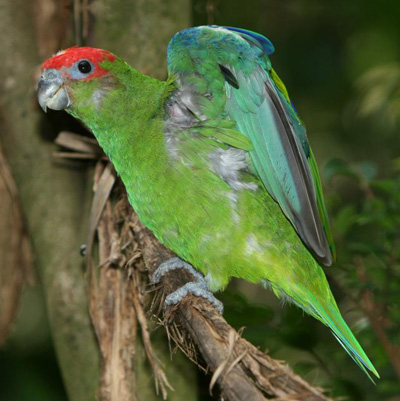
The Pileated Parrot is easily recognized by its vibrant red cap or pileus, from which it derives its common name. The rest of its plumage is predominantly green, providing excellent camouflage against the foliage of its forested habitat. Adults exhibit a striking contrast between the red cap and the deep green of their bodies, while juveniles have a slightly duller appearance, with a less pronounced red on the head.
Both males and females sport similar plumage, making it difficult to distinguish between the sexes in the field. However, close observation may reveal slightly more vibrant coloration in males, especially during the breeding season. In flight, the Pileated Parrot displays a rapid and direct flight pattern, with quick wingbeats and occasional glides, typical of many forest-dwelling parrots.
Confusion with other parrot species can occur, particularly with the Red-capped Parrot, but the Pileated Parrot's more compact size and distinct red cap help differentiate it. When perched, it adopts an upright posture, often tilting its head to better scrutinize its surroundings. This behavior enhances its ability to detect predators and locate food sources within the dense canopy.
Having trouble telling birds apart? Upload a photo to our bird identification tool for an instant species match.
Pileated Parrot Habitat and Range
Preferred Habitat
The Pileated Parrot primarily inhabits the Atlantic Forest biome, a region rich in biodiversity but highly fragmented. It prefers subtropical lowland rainforests, montane forests, and secondary growth forests. These habitats provide ample food resources and nesting opportunities. Typically found at elevations ranging from sea level up to 1,000 meters, the parrot is adaptable but still requires forested environments to thrive.
Seasonal habitat shifts may occur, with the parrot moving to lower elevations during periods of food scarcity. While the Pileated Parrot can occasionally be found in forest edges and clearings, its presence in urban areas is rare, as it relies heavily on primary and secondary forests for survival. Conservation efforts focus on protecting and restoring these critical habitats, ensuring the parrot's long-term survival.
Geographic Range
The geographical range of the Pileated Parrot spans southeastern Brazil, particularly in the states of São Paulo, Rio de Janeiro, and Minas Gerais. Its range extends into eastern Paraguay and the Misiones province of northeast Argentina. These areas represent the core of its distribution, where it is relatively more common.
The Pileated Parrot does not undertake long-distance migrations, instead exhibiting local movements in response to food availability. During the breeding season, it remains within its established territories in the lowland forests. Population density hotspots include Brazil's Atlantic Forest, which still harbors large, though fragmented, forested areas vital for the species' survival.
Want to know which birds visit your area? Browse our backyard birds by location guides for region-specific species lists.
What Does the Pileated Parrot Eat?
The diet of the Pileated Parrot primarily consists of fruits, seeds, and nuts, making it an essential frugivore within its ecosystem. Seasonal changes in fruit availability lead to variations in its diet, as it shifts to whatever is most abundant at the time. This adaptability allows the parrot to exploit a variety of food sources throughout the year.
The parrot employs a foraging technique that involves deftly climbing through the forest canopy, using its strong beak to crack open hard seeds and nuts. Its feeding schedule is typically diurnal, with peak foraging activity occurring in the early morning and late afternoon. Despite its preference for fruit, the Pileated Parrot may occasionally consume flowers and nectar, further aiding in the pollination of certain plant species.
Pileated Parrot Behavior and Social Structure
The Pileated Parrot exhibits a social and gregarious nature, often found in small flocks outside the breeding season. These flocks provide increased protection against predators and enhance foraging efficiency. During the breeding season, the parrot becomes more territorial, with pairs defending their nesting sites vigorously.
Courtship displays are subtle, involving mutual preening and synchronized movements between mates. Vocalizations play a crucial role in maintaining pair bonds and communicating with flock members. Daily activity patterns include periods of intense foraging interspersed with rest and social interaction.
When faced with potential threats, the Pileated Parrot relies on its agility and strong flight capabilities to evade predators. Alarm calls are sharp and piercing, alerting nearby flock members to danger. The parrot's ability to navigate dense forests with ease is a testament to its evolutionary adaptations for survival in its native habitat.
Pileated Parrot Nesting and Reproduction
Nesting habits of the Pileated Parrot involve utilizing natural tree cavities or abandoned nest holes created by other birds. These cavities provide protection from predators and the elements. The parrot exhibits a preference for large, mature trees that can support its nesting requirements.
A typical clutch consists of 2 to 4 eggs, with the female responsible for the majority of the incubation, which lasts approximately 24 to 26 days. Both parents participate in feeding and caring for the chicks, which fledge around 6 to 8 weeks after hatching. The Pileated Parrot usually raises one brood per year, although favorable conditions may lead to a second.
Parental roles are well-defined, with the male primarily responsible for defending the territory and foraging, while the female tends to the nest. This division of labor ensures the successful rearing of their young, contributing to the stability of local populations.
Pileated Parrot Sounds and Vocalizations
The Pileated Parrot's vocal repertoire includes a series of harsh, metallic calls that serve as contact calls within flocks. These calls consist of repeated 'klee-klee-klee' notes, often heard echoing through the forest canopy. The parrot's alarm calls are more piercing and rapid, designed to alert fellow flock members of imminent danger.
During the dawn chorus, the Pileated Parrot becomes particularly vocal, engaging in a cacophony of sounds that establish territorial boundaries and facilitate social interactions. Comparatively, the parrot's calls are less melodious than those of many songbirds, but their distinctiveness makes them a reliable identifier in their natural habitat.
Interesting Facts About the Pileated Parrot
- 1The Pileated Parrot's red cap, known as a pileus, inspired its common name and distinguishes it from many other parrot species.
- 2Despite its striking appearance, the Pileated Parrot's green plumage provides excellent camouflage among the dense foliage of the Atlantic Forest.
- 3The Pileated Parrot is a key seed disperser in its habitat, playing a critical role in the regeneration of the Atlantic Forest ecosystem.
- 4Unlike many parrot species, the Pileated Parrot does not migrate long distances, instead making localized movements in search of food.
- 5The vocalizations of the Pileated Parrot are less melodious than those of songbirds, consisting of harsh, metallic calls that echo through the forest.
- 6The Pileated Parrot is a social bird, often forming small flocks that provide increased protection against predators in its native habitat.
- 7Conservation efforts for the Pileated Parrot focus on habitat protection, as deforestation poses a significant threat to its continued survival.
Pileated Parrot Conservation Status
The Pileated Parrot is currently listed as Near Threatened by the IUCN, with its population trend showing a gradual decline. The primary threats to its survival include habitat loss due to deforestation and fragmentation of the Atlantic Forest. These pressures have led to decreased breeding and foraging habitats, impacting population numbers. Conservation efforts focus on habitat restoration and protection, with initiatives aimed at reforestation and the establishment of protected areas. Historical population studies indicate that the parrot's numbers have been more robust in the past, emphasizing the urgency of these efforts to prevent further decline. Public awareness campaigns and legal protections are vital components of ongoing conservation strategies.
Other Psittacidae Species


Birds Similar to the Pileated Parrot
These species are often confused with the Pileated Parrot due to similar appearance or overlapping range.

