
Plain-brown Woodcreeper
Dendrocincla fuliginosa
Order: Passeriformes / Family: Furnariidae
Wikimedia Commons
About the Plain-brown Woodcreeper
The Plain-brown Woodcreeper, or Dendrocincla fuliginosa, is a bird whose unassuming appearance belies its ecological significance. As a member of the Furnariidae family, this bird thrives in the tropical and subtropical forests of Central and South America. It is primarily found in lowland rainforests, including the Amazon Basin, where its presence is crucial for the health of its ecosystem. Its ability to blend into the forest understory allows it to play a role in controlling insect populations, contributing to the balance of the forest ecosystem. As a non-migratory species, the Plain-brown Woodcreeper is a year-round resident in its range, which includes countries such as Brazil, Colombia, Venezuela, and parts of Central America up to Belize. Its distribution is primarily tied to the availability of dense forest habitats, where it can be found from sea level up to elevations of around 1,500 meters. The bird's ecological role extends beyond its insectivorous diet. By foraging along tree trunks and branches, it helps control populations of insects that could otherwise harm the forest. During the breeding season, which typically occurs during the rainy months, it becomes particularly vocal as it defends its territory and engages in courtship behaviors. The Plain-brown Woodcreeper's preference for undisturbed forests makes it a good indicator species for the health of these ecosystems. Its presence often signals a rich, biodiverse environment. However, this preference also makes it vulnerable to deforestation and habitat fragmentation, which are significant threats throughout its range. Conservation efforts focused on preserving large tracts of continuous forest are critical for the long-term survival of this species. By maintaining these habitats, we not only protect the Plain-brown Woodcreeper but also the myriad other species that share its home.
The Plain-brown Woodcreeper belongs to the family Furnariidae, within the order Passeriformes. These birds typically live typically 5-7 years, with some individuals living up to 9 years..
How to Identify a Plain-brown Woodcreeper
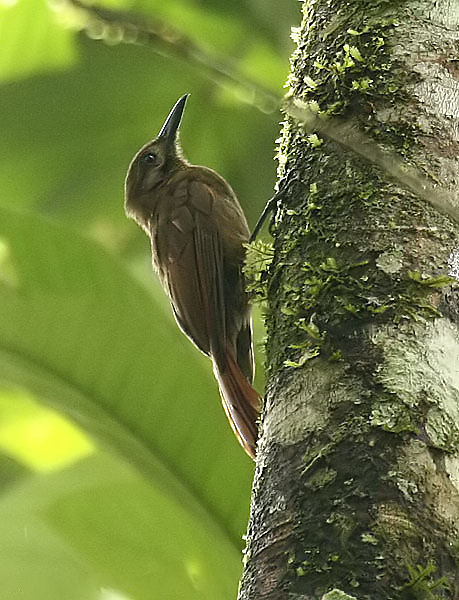
Identifying the Plain-brown Woodcreeper requires attention to its subtle characteristics. Adult birds exhibit a uniform brown coloration that blends seamlessly with the bark of trees, providing excellent camouflage. Their plumage lacks the streaks or spots found in many other woodcreepers, which can help distinguish them in the field. The bird's underparts are slightly paler than its back, and its long, slightly curved bill is well-adapted for probing into bark for insects. Juveniles may appear slightly duller than adults, but otherwise share similar markings. There is little sexual dimorphism in this species, so male and female Plain-brown Woodcreepers look alike, which can make field identification challenging. The bird's flight is characterized by short, direct bursts, typically moving from one tree trunk to another. Its perching posture is distinctive, as it often clings to vertical surfaces like tree trunks, relying on its strong feet and tail for support. Among woodcreepers, it is one of the less conspicuous species, with other similar species like the Cocoa Woodcreeper showing more pronounced patterns and larger size, which helps differentiate them.
Having trouble telling birds apart? Upload a photo to our bird identification tool for an instant species match.
Plain-brown Woodcreeper Habitat and Range
Preferred Habitat
The Plain-brown Woodcreeper is typically found in lowland tropical and subtropical forests. These habitats include primary rainforests, secondary forests, and occasionally, forest edges. The bird prefers dense understory vegetation, where it can forage along tree trunks and branches. In the Amazon Basin, it thrives in humid, evergreen forests. Elevations range from sea level to about 1,500 meters, with the bird being more common in lower elevations. While it is primarily associated with rural and remote forested areas, it can occasionally be found in mature secondary growth near urban areas, provided that sufficient tree cover is available. There are no significant seasonal habitat shifts for this species, as it is a resident bird that does not migrate long distances. Its presence in specific locations is strongly tied to the availability of intact forest habitats.
Geographic Range
The breeding range of the Plain-brown Woodcreeper includes a wide expanse of Central and South America. It is found in countries such as Belize, Costa Rica, Panama, Colombia, Venezuela, Ecuador, Peru, and throughout the Amazon Basin in Brazil. This range highlights its preference for tropical and subtropical regions. Unlike many bird species, the Plain-brown Woodcreeper does not undertake significant migrations, remaining within its established range year-round. The bird is most abundant in areas with extensive, undisturbed forest cover, such as the Amazon rainforest and regions of the Guyana Shield. Population density is typically higher in these pristine habitats, where the ecological conditions support a diverse array of insect prey. Despite its broad geographical range, habitat fragmentation and deforestation remain key threats, leading to localized declines in certain areas.
Want to know which birds visit your area? Browse our backyard birds by location guides for region-specific species lists.
What Does the Plain-brown Woodcreeper Eat?
The diet of the Plain-brown Woodcreeper primarily consists of insects and other arthropods. It employs a foraging technique known as 'bark-gleaning', where it systematically searches the bark of trees for hidden prey. This diet includes ants, beetles, and spiders, with a preference for larger insects that provide more nutritional value. Occasionally, it may consume small lizards or amphibians if they are available. The bird's feeding schedule is diurnal, with most activity occurring during the early morning and late afternoon. Seasonal changes in food availability can affect its diet composition, although it remains largely insectivorous year-round. During the wet season, the abundance of insects provides ample feeding opportunities, while in drier months, the bird may need to range more widely to locate sufficient prey.
Plain-brown Woodcreeper Behavior and Social Structure
The Plain-brown Woodcreeper exhibits solitary behavior for much of the year, although it may occasionally join mixed-species flocks when foraging. This behavior allows it to capitalize on the vigilance of other species while searching for food. During the breeding season, it becomes more territorial, with males often singing to establish and defend their territory. Courtship displays involve mutual preening and vocalizations, which strengthen pair bonds. The bird's response to predators is to rely on its camouflage, remaining motionless against tree bark to avoid detection. It typically avoids open areas, preferring the safety of the dense forest understory. Daily activity patterns include periods of active foraging interspersed with rest and preening. Although not migratory, the Plain-brown Woodcreeper may adjust its territory boundaries in response to changes in food availability or habitat conditions.
Plain-brown Woodcreeper Nesting and Reproduction
The nesting habits of the Plain-brown Woodcreeper involve the use of cavities, either natural or those abandoned by other species. These nests are often located in the trunks of trees or large branches, providing protection from predators and environmental conditions. The bird may line the cavity with soft materials such as leaves, feathers, and moss to create a suitable environment for egg incubation. Clutch sizes typically range from two to three eggs. Both parents share the responsibilities of incubation, which lasts about 15 to 17 days. After hatching, the young remain in the nest for approximately 18 to 20 days, during which both parents provide food and protection. The number of broods per year is usually limited to one, although in optimal conditions, a second brood may be attempted.
Plain-brown Woodcreeper Sounds and Vocalizations
The primary song of the Plain-brown Woodcreeper is a series of clear, ascending whistles, often described as 'whee-whee-whee'. This song serves to establish territory and attract mates during the breeding season. Its call notes vary from soft 'churrs' to sharp 'tchik' sounds, used for communication between mates and to signal alarm. In the presence of threats, the bird may emit a rapid series of alarm calls to warn nearby individuals. During the dawn chorus, its song can be heard echoing through the forest, adding to the symphony of early morning bird activity. The Plain-brown Woodcreeper's vocalizations, while not as complex as some songbirds, are distinct enough to aid in identification.
Interesting Facts About the Plain-brown Woodcreeper
- 1The Plain-brown Woodcreeper is an expert insectivore, capable of consuming thousands of insects annually.
- 2Despite its plain appearance, the Plain-brown Woodcreeper plays a vital role in controlling forest insect populations.
- 3The bird's long, curved bill is perfectly adapted for extracting insects from tree bark crevices.
- 4It is often heard before seen, with its distinctive ascending whistles echoing through the forest.
- 5The Plain-brown Woodcreeper is a master of camouflage, blending in seamlessly with the forest understory.
- 6This bird species does not migrate, making it a year-round resident of its tropical forest habitats.
- 7Observing the Plain-brown Woodcreeper can provide insight into the health and diversity of forest ecosystems.
Plain-brown Woodcreeper Conservation Status
The Plain-brown Woodcreeper is currently listed as Least Concern by the IUCN, with stable population trends in many parts of its range. However, deforestation and habitat destruction pose significant threats, leading to localized population declines. Conservation efforts focus on preserving large tracts of continuous forest, which are essential for the survival of this species. Protected areas such as national parks and reserves play a crucial role in safeguarding its habitat. Historical data indicate that while the species has experienced some habitat loss, its wide distribution and adaptability to various forest types have helped buffer against severe population declines.


