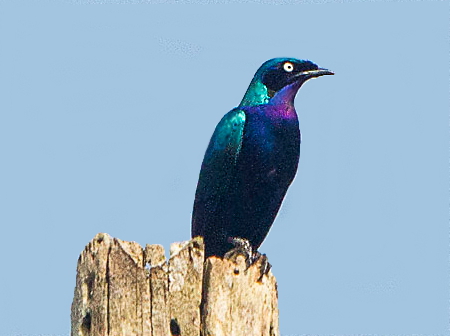
Principe Starling
Lamprotornis ornatus
Order: Passeriformes / Family: Sturnidae

Wikimedia Commons
About the Principe Starling
The Principe Starling, Lamprotornis ornatus, is a striking member of the starling family, known for its captivating iridescent plumage. Endemic to the island of Príncipe, part of São Tomé and Príncipe off the western coast of Central Africa, this species thrives in the lush, humid conditions of tropical lowland forests and occasionally ventures into degraded forest areas. As a medium-sized starling, it plays a significant role in the forest ecosystems by contributing to seed dispersal and insect population control through its varied diet.
While the Principe Starling is not migratory, it demonstrates seasonal shifts in behavior, particularly during breeding periods when it becomes more territorial. Its ecological role is emphasized by its feeding habits, which include consuming a range of insects, fruits, and small invertebrates, thus maintaining the ecological balance within its habitat. The bird's presence is vital for the regeneration of the forest as it aids in the propagation of several plant species.
The conservation of the Principe Starling is of particular importance due to its limited range. Its population is largely influenced by habitat destruction, primarily due to deforestation for agriculture and development. Despite these threats, the bird currently maintains a stable population, thanks in part to the protected status of much of its habitat within Príncipe's natural reserves. The starling's reliance on the dense forest canopy highlights the need for ongoing conservation efforts to preserve these environments in the face of growing anthropogenic pressures.
The Principe Starling belongs to the family Sturnidae, within the order Passeriformes. These birds typically live 5-10 years with the potential for longer in protected environments.
How to Identify a Principe Starling
The Principe Starling boasts a plumage that catches the eye with its dazzling iridescence, predominantly green with a sheen that can appear bluish or purplish in different lights. Adults display a uniform color across the body, with a slightly paler vent area. The feathers are tight and glossy, reflecting light in a manner that enhances their vivid appearance. Juveniles sport a duller, more muted coloration, lacking the full iridescence of the adults, which they attain after their first molt.
There is little sexual dimorphism in this species, making it challenging to distinguish males from females based solely on plumage. However, subtle size differences can sometimes be noted, with males generally being slightly larger. In flight, the Principe Starling presents a sleek silhouette with pointed wings and a short, squared tail, which aids in maneuvering through dense forest canopies.
Despite its unique coloration, the Principe Starling can occasionally be confused with other glossy starlings in the region. However, its distinct island range and specific plumage characteristics, such as its consistent green sheen, help differentiate it from others like the Splendid Starling, which displays more varied coloration.
Having trouble telling birds apart? Upload a photo to our bird identification tool for an instant species match.
Principe Starling Habitat and Range
Preferred Habitat
The Principe Starling predominantly inhabits tropical lowland forests, thriving in the dense, humid canopy where it finds abundant food and suitable nesting sites. It prefers areas with thick foliage that provide ample cover and resources. The bird can also adapt to secondary forests and occasionally enters plantations or degraded areas where forest has been cleared, though it primarily remains within the natural forest boundaries.
Typically found at elevations ranging from sea level to around 800 meters, the Principe Starling does not exhibit significant altitudinal migration but may adjust its habitat use slightly in response to seasonal changes in food availability. While it rarely ventures into urban areas, it can occasionally be spotted at the forest edges near human settlements where natural vegetation persists.
Geographic Range
The Principe Starling is endemic to Príncipe, an island in the Gulf of Guinea off the coast of Central Africa. Its range is thus highly restricted, confined to this small island where it occupies the available forested habitats. The bird does not engage in long-distance migration, remaining resident on the island throughout the year.
Within Príncipe, the starling is most densely populated in the island's extensive forests, particularly in areas with minimal human disturbance. This limited range, while offering protection from broader threats faced by migratory species, also makes the starling vulnerable to localized environmental changes. Its population density is highest in the central and northern parts of the island, where primary forest is more prevalent.
Want to know which birds visit your area? Browse our backyard birds by location guides for region-specific species lists.
What Does the Principe Starling Eat?
The Principe Starling has a diverse diet that shifts with seasonal availability, primarily consisting of insects, fruits, and small invertebrates. During the wet season, when insect populations peak, the starling consumes a large number of beetles, caterpillars, and other arthropods, which it skillfully captures using its sharp, pointed bill.
In the dry season, when insects are less abundant, it relies more heavily on fruit, playing a crucial role in seed dispersal for various forest plants. The starling often forages high in the canopy, but it will descend to mid-levels or even ground level when fruiting trees are accessible. Its feeding schedule is diurnal, with peak activity in the early morning and late afternoon, taking advantage of cooler temperatures and reduced competition.
Principe Starling Behavior and Social Structure
The Principe Starling exhibits a fascinating array of behaviors, many of which are linked to its social structure. It is a highly social bird, often found in small flocks that communicate through a series of complex vocalizations. This flocking behavior provides safety in numbers, crucial for detecting and responding to predators such as raptors.
Territorial during the breeding season, Principe Starlings engage in displays and vocal duels to establish dominance and secure nesting sites. Courtship involves intricate dances and vocalizations, with males showcasing their plumage to attract mates.
Throughout the day, the starling demonstrates a predictable pattern of activity, foraging actively during the cooler parts of the day and seeking shaded rest during the midday heat. This pattern changes little across seasons, reflecting the stable climatic conditions within its habitat.
Principe Starling Nesting and Reproduction
The Principe Starling nests in tree cavities, often utilizing natural hollows or those created by other species like woodpeckers. The nesting site is typically located high in the canopy, offering protection from ground predators. Nests are constructed from a variety of materials including twigs, leaves, and grasses, lined with softer materials for insulation and comfort.
The breeding season coincides with the onset of the wet season, ensuring abundant food for the young. A typical clutch comprises 2-4 eggs, which are incubated by both parents over a period of about 14 days. After hatching, the fledglings remain in the nest for approximately three weeks, during which they are fed and cared for by both parents. The species usually raises one brood per year, although favorable conditions may occasionally permit a second.
Principe Starling Sounds and Vocalizations
The vocal repertoire of the Principe Starling is both complex and melodious, characterized by a series of whistles, clicks, and chatters. Its primary song is a series of high-pitched whistles interspersed with softer, melodious notes, often delivered from high perches within the canopy. The bird's call notes are typically sharp and metallic, used to maintain contact within flocks or signal alarm.
Alarm calls are more urgent, consisting of rapid, repeated notes that alert others to potential danger. During the early morning hours, the Principe Starling participates in a dawn chorus, contributing its varied calls to the rich tapestry of forest sounds. Its vocalizations are distinctive and can be differentiated from other sympatric starling species by their unique rhythm and tonal quality.
Interesting Facts About the Principe Starling
- 1The Principe Starling is exclusive to Príncipe Island, showcasing remarkable adaptation to its unique environment.
- 2Its iridescent plumage results from microscopic feather structures that refract light, rather than pigments.
- 3Despite being a forest bird, the Principe Starling shows flexibility by sometimes foraging in human-altered landscapes.
- 4This starling species contributes significantly to seed dispersal, aiding forest regeneration on Príncipe.
- 5During courtship, Principe Starlings perform elaborate displays involving synchronized movements and vocalizations.
- 6The starling's diet adjusts with seasonal changes, showcasing its adaptability in resource utilization.
- 7The Principe Starling's vocalizations are complex, with some calls resembling the musicality of a flute.
Principe Starling Conservation Status
The Principe Starling currently holds a conservation status of Least Concern, according to the IUCN Red List, with a stable population trend. However, its restricted range makes it vulnerable to habitat loss and environmental changes. Deforestation for agriculture and the expansion of human settlements pose significant threats, though much of the starling's habitat falls within protected areas on Príncipe. Conservation efforts focus on habitat preservation and the enforcement of protected area regulations. Historical population changes have been minimal due to the island's isolation, but ongoing monitoring is essential to ensure early detection of any adverse trends. The involvement of local communities in conservation initiatives has been critical in maintaining the starling's stable numbers.
Other Sturnidae Species


Birds Similar to the Principe Starling
These species are often confused with the Principe Starling due to similar appearance or overlapping range.