
Prodotiscus Whitei
Prodotiscus whitei
Order: Piciformes / Family: Indicatoridae
About the Prodotiscus Whitei
The Prodotiscus Whitei, commonly known as the Eastern Green-backed Honeyguide, is a fascinating member of the Indicatoridae family. This bird is particularly notable for its parasitic breeding behavior, often laying its eggs in the nests of other birds. Found predominantly across the eastern regions of sub-Saharan Africa, this species thrives in subtropical and tropical environments, especially in wooded areas with ample insect activity. Countries such as Kenya, Tanzania, and Mozambique provide ideal habitats for the Prodotiscus Whitei due to their extensive woodlands and bushland.
The ecological role of the Prodotiscus Whitei is quite significant, as it contributes to the complex web of avian parasitism. By relying on other bird species to raise its young, it impacts the reproductive success of its hosts, which can include smaller passerines like warblers. This intricate relationship highlights the interconnectedness of species within these ecosystems.
Seasonally, the Prodotiscus Whitei displays interesting behaviors. While it does not undertake long migrations, it may exhibit local movements influenced by the availability of food resources. During the breeding season, which coincides with the rainy season when food is plentiful, the Prodotiscus Whitei is particularly active in seeking out nests for parasitism. Its presence in these ecosystems underscores the biodiversity of African woodlands and the complex interactions between species.
The Prodotiscus Whitei belongs to the family Indicatoridae, within the order Piciformes. These birds typically live average 4-6 years, with some reaching up to 10 years..
How to Identify a Prodotiscus Whitei
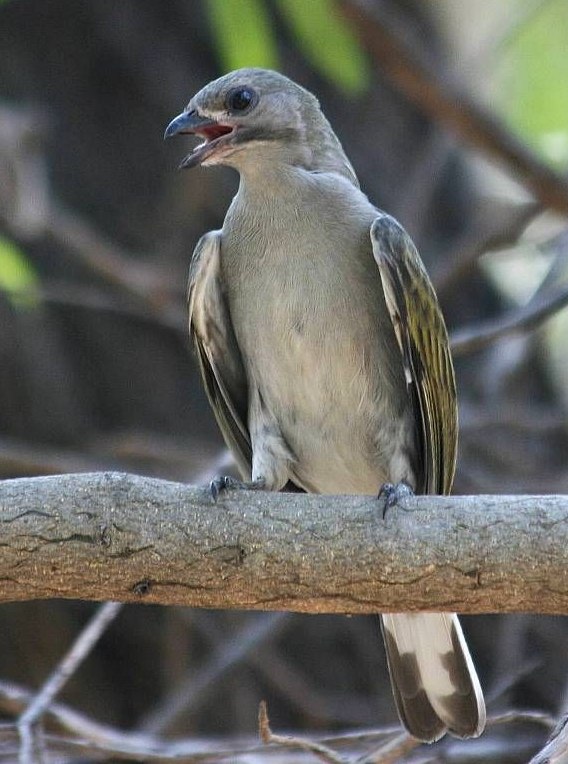
The Prodotiscus Whitei can be identified by its distinctive greenish back, which contrasts with its pale underparts. Adult plumage features a subtle but noticeable olive hue on the back, extending to the wings, while the throat and belly are a soft white. Males and females are similar in appearance, though males may exhibit slightly more vibrant green tones.
Juveniles can be differentiated from adults by their duller plumage, lacking the full intensity of the green back seen in mature birds. In flight, the Prodotiscus Whitei displays a compact silhouette with rapid wingbeats and a characteristic short tail. Its perching posture is typically upright, often seen in the mid-canopy of trees.
This species could be confused with other members of the Indicatoridae family, such as the Lesser Honeyguide, but the Prodotiscus Whitei's greenish back and smaller size help in distinguishing it. Observers should note the absence of bright throat patches, which are seen in some similar species.
Having trouble telling birds apart? Upload a photo to our bird identification tool for an instant species match.
Prodotiscus Whitei Habitat and Range
Preferred Habitat
The Prodotiscus Whitei mainly inhabits subtropical and tropical dry forests, as well as bushland and woodland savannas. These environments provide the dense canopy cover and rich insect life essential for its survival. It is commonly found at elevations ranging from sea level up to 2000 meters, showing a preference for areas with a mix of open spaces and dense vegetation.
Seasonal shifts in habitat use are minimal, as the Prodotiscus Whitei tends to remain in the same regions year-round, adapting to local changes in food availability. While not typically found in urban areas, it may occasionally venture into rural gardens and orchards, particularly those adjacent to its preferred woodland habitats.
Geographic Range
The Prodotiscus Whitei's range is primarily concentrated in eastern sub-Saharan Africa. Its breeding range includes countries like Kenya, Tanzania, and Mozambique, where it is a resident species. The bird does not participate in long-distance migrations but may engage in local movements within its range depending on resource availability.
Population density hotspots are often found in regions with extensive woodland and bushland, such as the coastal forests of Kenya and the miombo woodlands of Tanzania. While its range does not extend into the southernmost or westernmost parts of Africa, the Prodotiscus Whitei is considered widespread within its core regions.
Want to know which birds visit your area? Browse our backyard birds by location guides for region-specific species lists.
What Does the Prodotiscus Whitei Eat?
The diet of the Prodotiscus Whitei primarily consists of insects, particularly caterpillars and other soft-bodied invertebrates. These birds are adept foragers, often seen gleaning insects from leaves and bark in the mid-canopy of trees. During periods of abundance, particularly in the rainy season, they may consume a larger variety of insects, including beetles and ants.
Besides insects, the Prodotiscus Whitei occasionally feeds on nectar and fruits, supplementing its diet with these resources when available. Its foraging schedule is largely diurnal, with peak activity occurring during the cooler hours of the morning and late afternoon when insect activity is heightened.
Want to attract Prodotiscus Whiteis to your yard? See our recommended feeders and seed types for the best results.
Prodotiscus Whitei Behavior and Social Structure
The Prodotiscus Whitei exhibits fascinating social and territorial behaviors. While generally seen alone or in pairs, it may occasionally join mixed-species flocks, especially during non-breeding seasons when food resources are scattered. This opportunistic flocking can enhance foraging efficiency and provide protection from predators.
Territorial behavior is most pronounced during the breeding season, with males actively defending chosen territories against intruders. Courtship displays involve a series of rapid flights and subtle vocalizations to attract mates and deter rivals.
The Prodotiscus Whitei's response to predators is cautious; it relies on its cryptic plumage and swift flight to evade threats. Daily activity patterns revolve around foraging, interspersed with periods of rest and preening. These birds are most active during the cooler parts of the day, avoiding the midday heat.
Prodotiscus Whitei Nesting and Reproduction
The nesting strategy of the Prodotiscus Whitei is unique, as it is a brood parasite. Unlike many birds that construct nests, the Prodotiscus Whitei lays its eggs in the nests of other bird species, often those of smaller passerines like warblers. This strategy involves careful selection of host nests, typically those already containing eggs or young.
After laying a single egg in a host's nest, the Prodotiscus Whitei departs, leaving the host species to raise its chick. The incubation period and fledging timeline thus depend on the host species. The parasitic chick often outcompetes the host's young for food and parental care, ensuring its survival. Parental roles are minimal, as the Prodotiscus Whitei relies entirely on the host for chick rearing.
The number of broods produced per year can vary but is usually aligned with the breeding cycles of the host species, allowing the Prodotiscus Whitei to exploit multiple nests within a season.
Prodotiscus Whitei Sounds and Vocalizations
The vocalizations of Prodotiscus Whitei include a series of high-pitched, rapid whistles. These calls are often described as thin and insect-like, making them difficult to detect amidst the ambient sounds of the forest. The primary song serves not only for mate attraction during the breeding season but also plays a role in territorial defense.
Call notes are short and soft, typically repeated in quick succession. These calls can vary slightly in pitch and rhythm depending on the context, such as alerting to a predator or signaling to a mate. During the dawn chorus, the Prodotiscus Whitei's calls may be overshadowed by louder species, but discerning birders can identify them by their distinctive quality.
Interesting Facts About the Prodotiscus Whitei
- 1The Prodotiscus Whitei is one of the few bird species known for its brood parasitism, laying eggs in nests of other birds.
- 2Unlike cuckoos, Prodotiscus Whitei does not remove host eggs; instead, its chicks outcompete host offspring after hatching.
- 3Prodotiscus Whitei's diet includes a wide variety of insects, which it skillfully picks from tree canopies.
- 4This bird is named after the naturalist C. White, who significantly contributed to African ornithology.
- 5Despite its parasitic nature, Prodotiscus Whitei's presence indicates healthy, biodiverse woodland ecosystems.
- 6Prodotiscus Whitei can adapt to different woodland types, from dry savannas to moist coastal forests.
- 7The species is known for its elusive and secretive behavior, making it a challenging subject for birders.
Prodotiscus Whitei Conservation Status
The Prodotiscus Whitei currently holds a status of Least Concern according to the IUCN. Its population trend appears stable, with no significant declines observed in recent years. However, habitat destruction and fragmentation pose potential threats, particularly in regions where deforestation is prevalent. Conservation efforts in parts of its range focus on protecting woodland habitats and maintaining ecosystem integrity. Historical population changes are not well-documented, but ongoing monitoring is essential to detect any shifts in population dynamics. Conservationists emphasize the importance of preserving the Prodotiscus Whitei's habitats to ensure its continued survival.
Attracting Prodotiscus Whiteis to Your Feeder
The Prodotiscus Whitei is a regular visitor to backyard bird feeders across its range. At the Eye On The Fly feeding station, we observe Prodotiscus Whiteis regularly and capture footage with our feeder cameras.
Other Indicatoridae Species



Birds Similar to the Prodotiscus Whitei
These species are often confused with the Prodotiscus Whitei due to similar appearance or overlapping range.
