
Puna Plover
Charadrius alticola
Order: Charadriiformes / Family: Charadriidae
Wikimedia Commons
About the Puna Plover
The Puna Plover, Charadrius alticola, is a small shorebird endemic to the high-altitude regions of the Andes in South America. This species primarily inhabits the puna grasslands and salt flats, which are characterized by harsh conditions due to their elevation, often exceeding 3,500 meters. The Puna Plover is well-adapted to these environments, showcasing remarkable resilience and adaptability. Its presence in the puna ecosystem signifies a critical ecological role, as it contributes to the complex food webs of these remote areas. The plover's activities help control insect populations, while also serving as prey for larger avian predators, thus maintaining ecological balance.
The Puna Plover's seasonal behaviors are adapted to the extreme climate of its environment. During the breeding season, which occurs from November to February, these birds are often sighted in pairs or small groups, focused on nesting and rearing their young. Outside the breeding season, they exhibit more solitary behavior, although they may form loose flocks to exploit feeding opportunities. Migration, while relatively limited due to the specificity of their habitat requirements, involves slight altitudinal movements in response to climatic changes and food availability, ensuring their survival in the variable puna ecosystem.
The Puna Plover's ecological significance extends beyond its immediate habitat. As an indicator species, its presence and population trends can reflect broader environmental changes and health. Conservationists monitor this species to understand the impacts of climate change and human activities on high-altitude wetland ecosystems. The Puna Plover's adaptability and ecological role highlight the importance of preserving its habitat, both for the species itself and for the myriad forms of life that share its Andean home.
The Puna Plover belongs to the family Charadriidae, within the order Charadriiformes. These birds typically live average 4-6 years; maximum recorded 8 years..
How to Identify a Puna Plover
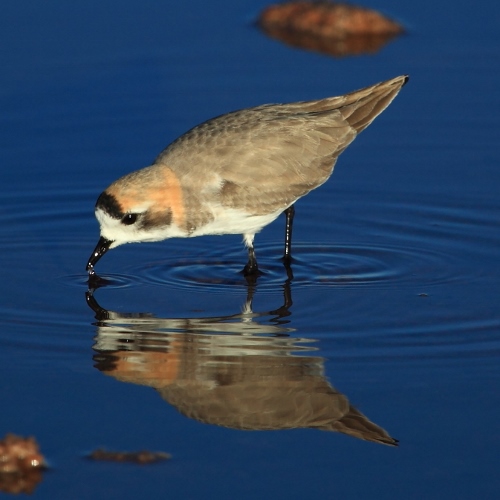
The adult Puna Plover displays a distinctive plumage with pale gray upperparts, a white underside, and a characteristic black band across the chest. This band is more pronounced in males, especially during the breeding season when plumage is at its brightest. In contrast, females and juveniles exhibit a more subdued appearance, with less defined chest bands and generally duller coloration. The bill is short and black, contrasting with the bird's pale coloration, while the legs are a yellowish hue, aiding identification in the field.
In flight, the Puna Plover exhibits a swift and direct style, with rapid wingbeats that reveal the narrow white wing bars characteristic of the Charadrius genus. When perching, the plover often adopts a slightly hunched posture, which allows it to blend seamlessly into the mottled ground of its high-altitude habitat. Comparatively, it can be confused with other small plovers, such as the Two-banded Plover, but the Puna Plover's distinct habitat preferences and chest band pattern are reliable distinguishing features.
Its similarities with other Charadrius species can sometimes lead to confusion among less experienced birders. However, the Puna Plover's preference for high-altitude wetland environments sets it apart from lowland plovers. Birders should pay attention to both physical characteristics and habitat to accurately identify this unique species.
Having trouble telling birds apart? Upload a photo to our bird identification tool for an instant species match.
Puna Plover Habitat and Range
Preferred Habitat
The Puna Plover is predominantly found in high-altitude wetlands, specifically within the puna grasslands and salt flats of the Andes. These habitats are situated at elevations typically ranging from 3,500 to 4,500 meters. The bird favors open, sparsely vegetated areas near water sources, such as lagoons and marshes, which provide ample foraging opportunities and nesting sites. Seasonal shifts in habitat are minimal, as the Puna Plover remains within these high-altitude regions year-round, making only slight altitudinal adjustments in response to seasonal changes.
Unlike some plovers that may venture into urban areas, the Puna Plover is seldom found in such environments, preferring the isolation and unique ecological conditions of its native puna grasslands. The scarcity of human settlements in these high-altitude zones further reduces human-wildlife conflict, allowing the Puna Plover to thrive in its natural habitat with minimal disturbance.
Geographic Range
The Puna Plover's range is primarily confined to the high-altitude regions of the Andes, spanning countries such as Peru, Bolivia, Chile, and Argentina. Its breeding range is centered around the altiplano, a plateau region characterized by its elevated, flat terrain and saline lakes. Here, the Puna Plover finds suitable conditions for nesting and feeding.
During the non-breeding season, these birds remain within the Andean highlands, displaying limited migratory behavior. Unlike many shorebirds that undertake long-distance migrations, the Puna Plover's movements are restricted to altitudinal adjustments. Population density hotspots are most prominent around the large salt flats of Bolivia, such as Salar de Uyuni, and the puna wetlands of Peru. These areas provide the necessary resources for sustaining stable populations.
The restricted range of the Puna Plover, coupled with its specialized habitat requirements, makes it an important species for monitoring environmental changes in the Andes. The bird's presence across these regions underscores its adaptability to high-altitude ecosystems, where it contributes significantly to local biodiversity.
Want to know which birds visit your area? Browse our backyard birds by location guides for region-specific species lists.
What Does the Puna Plover Eat?
The Puna Plover's diet primarily consists of small invertebrates, which it adeptly extracts from the soft substrate of wetland areas. Insects, such as beetles and flies, form the core of its diet, supplemented by crustaceans and small mollusks. The plover employs a distinctive 'run-stop-peck' foraging technique, characterized by short bursts of movement followed by precise pecking to capture prey.
Seasonal changes in food availability influence the Puna Plover's diet, with a broader variety of insects available during the wet season. During drier periods, when food is less abundant, the plover demonstrates remarkable adaptability by expanding its diet to include aquatic larvae and other invertebrates. Prey size typically ranges from small to medium, with the bird's keen eyesight facilitating the detection of even the smallest insects.
Feeding occurs throughout the day, with peak activity during early morning and late afternoon. The Puna Plover's foraging strategies are crucial for its survival in the nutrient-poor environments of the Andean highlands, enabling it to exploit diverse food resources efficiently.
Puna Plover Behavior and Social Structure
The Puna Plover exhibits a blend of solitary and social behaviors, shaped by its high-altitude habitat. During the breeding season, it becomes highly territorial, with pairs defending their nesting sites against intruders. Courtship displays involve a combination of visual and auditory signals, including elaborate aerial maneuvers and vocalizations that strengthen pair bonds.
Outside the breeding season, the Puna Plover may form loose flocks, particularly around abundant food sources. This social structure allows for increased foraging efficiency and protection against predators, such as hawks and falcons, which pose significant threats. The bird's response to predators includes a range of strategies, from freezing in place to flying away swiftly, depending on the level of threat perceived.
Daily activity patterns are largely dictated by the availability of food. The Puna Plover is most active during cooler parts of the day, minimizing energy expenditure in the harsh midday sun. Its behaviors, from territoriality to flocking, reflect a complex adaptation to the dynamic and challenging environment of the Andes.
Puna Plover Nesting and Reproduction
The Puna Plover constructs simple nests, often mere depressions in the ground lined with small pebbles and vegetation. These nests are strategically placed near water sources, providing easy access to food and moisture. The bird's nesting preferences reflect its need to balance exposure and protection, with sites chosen for their proximity to feeding areas and relative safety from predators.
A typical clutch consists of two to three eggs, camouflaged with speckled patterns that blend into the surrounding environment. The incubation period lasts approximately 23 to 25 days, with both male and female sharing duties. This shared responsibility extends to caring for the young, which are precocial and leave the nest shortly after hatching.
Fledging occurs around 30 days after hatching, during which time the chicks are closely guarded by their parents. The Puna Plover typically raises one brood per year, although favorable conditions may occasionally allow for a second. This reproductive strategy ensures the survival of offspring in the unpredictable climate of the Andean highlands.
Puna Plover Sounds and Vocalizations
The Puna Plover's primary song is a rhythmic series of sharp, high-pitched whistles that carry across the open landscape. This song serves both as a territorial declaration and a courtship call, particularly prominent during the breeding season. In addition to its song, the bird emits short, sharp call notes that facilitate communication between mates and signal alarm in the presence of predators.
Alarm calls are more staccato and urgent, designed to alert other plovers to potential threats. While the Puna Plover does not participate in a dawn chorus typical of many songbirds, its vocalizations are critical for maintaining social bonds and territorial boundaries in the sparse grasslands it inhabits. These sounds, though less varied than those of more vocal species, are integral to the Puna Plover's life in the high-altitude Andes.
Interesting Facts About the Puna Plover
- 1The Puna Plover thrives at altitudes higher than most other plovers, regularly found above 3,500 meters.
- 2Despite its high-altitude habitat, the Puna Plover exhibits minimal migratory behavior, staying in the Andes year-round.
- 3The Puna Plover's diet adapts with the seasons, shifting from primarily insects to include more diverse invertebrates during drier months.
- 4With a clutch size of two to three eggs, the Puna Plover shares incubation and chick-rearing duties equally between sexes.
- 5Puna Plovers have been observed using deceptive behavior, such as feigning injury, to distract predators from their nests.
- 6The bird's pale gray plumage provides effective camouflage against the barren landscape of the high-altitude salt flats.
- 7Puna Plovers contribute to the control of insect populations, playing a vital role in the ecological balance of their habitats.
Puna Plover Conservation Status
The Puna Plover is currently classified as "Least Concern" by the IUCN, reflecting a stable population trend. However, the species faces potential threats from habitat degradation, climate change, and increased human activity in its high-altitude habitats. Wetland drainage and mining operations pose significant risks to the puna ecosystems, threatening the availability of critical resources. Conservation efforts focus on habitat preservation and monitoring population trends to preemptively address declines. Protected areas, such as national parks and reserves, play a crucial role in safeguarding the plover's environment. Historical data indicate that while the Puna Plover's population has remained relatively stable, ongoing vigilance is necessary to ensure its continued survival amidst environmental changes.
Other Charadriidae Species


Birds Similar to the Puna Plover
These species are often confused with the Puna Plover due to similar appearance or overlapping range.

