
Red-breasted Parakeet
Psittacula alexandri
Order: Psittaciformes / Family: Psittacidae
Wikimedia Commons
About the Red-breasted Parakeet
The Red-breasted Parakeet, scientifically known as Psittacula alexandri, is a charismatic bird recognized for its striking red chest and lively demeanor. These parakeets are native to the Indian subcontinent and parts of Southeast Asia, including regions such as India, Nepal, Bhutan, Myanmar, and parts of Thailand. They have also been introduced to various other locations, including Singapore and Hong Kong. The Red-breasted Parakeet prefers subtropical and tropical environments, often inhabiting evergreen forests, deciduous woodlands, and mangrove forests. In urban areas, they adapt well to parks and gardens, making them popular among city dwellers.
The presence of the Red-breasted Parakeet in these regions is of considerable ecological significance. These birds play a role in seed dispersal, aiding in the propagation of various plant species. By feeding on fruits and seeds, they help maintain the health of their ecosystems, promoting plant diversity and stability. Additionally, their vibrant plumage and social behavior make them a favorite among bird watchers and naturalists, contributing to ecotourism in the regions they inhabit.
During the breeding season, which usually occurs between December and April, Red-breasted Parakeets become more territorial as they seek out nesting sites and prospective mates. Outside the breeding months, they are more social, often forming large, noisy flocks that can be seen feeding and flying together. These parakeets are most active during dawn and dusk when they engage in foraging and social interactions. With their boisterous calls and colorful presence, Red-breasted Parakeets are an integral part of the avian community across their range.
The Red-breasted Parakeet belongs to the family Psittacidae, within the order Psittaciformes. These birds typically live average 15-20 years, with some individuals living up to 25 years..
How to Identify a Red-breasted Parakeet
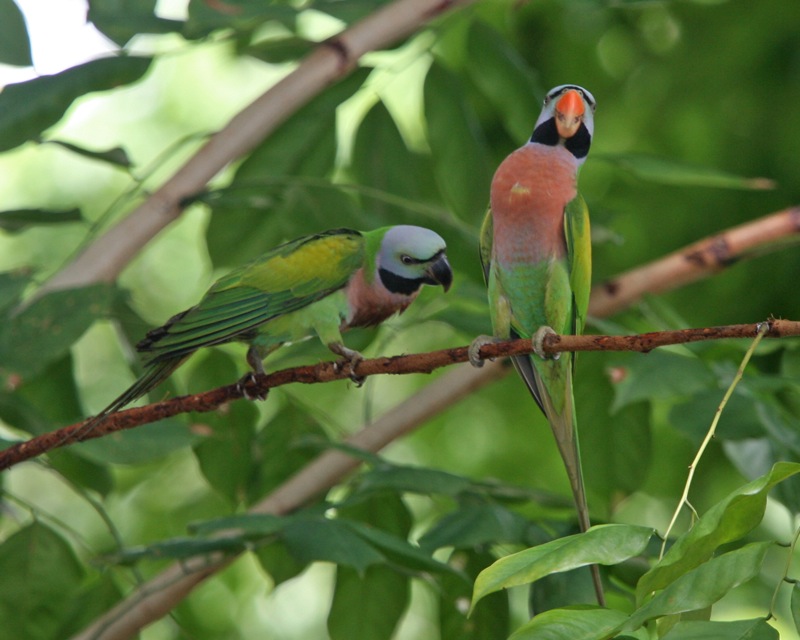
The Red-breasted Parakeet is a medium-sized parrot with a body length of about 36 centimeters. Adults are easily recognized by their distinctive red chest, which contrasts with their predominantly green plumage. The back and wings exhibit a rich green color, while the head often shows a blush of blue. A thin black line stretches from the beak to the eyes, enhancing their expressive appearance.
Juvenile Red-breasted Parakeets lack the intense red coloration on the chest, which develops as they mature. Instead, their breast is often a pale pink or orange. Males and females have similar plumage, making it challenging to distinguish between the sexes based on appearance alone. However, males are generally slightly larger than females.
In flight, the Red-breasted Parakeet exhibits a strong, direct flight pattern with rapid wing beats. They show a distinctive silhouette characterized by long, pointed wings and a long, tapered tail. When perched, their upright posture and social interactions make them stand out among other parrot species. Mistaking them for other parakeets is rare due to their unique red breast, but they can be confused with the Blossom-headed Parakeet, which has a more pronounced pink head and lacks the red chest.
Having trouble telling birds apart? Upload a photo to our bird identification tool for an instant species match.
Red-breasted Parakeet Habitat and Range
Preferred Habitat
Red-breasted Parakeets inhabit a range of environments, from dense tropical forests to urban landscapes. They thrive in evergreen and deciduous forests, where they find abundant food sources and nesting sites. These parakeets are also common in mangrove forests and coastal regions, where they take advantage of the diverse plant life.
In urban areas, Red-breasted Parakeets have adapted remarkably well to human-altered environments. They are frequently observed in city parks, botanical gardens, and even in residential areas where they feed on fruiting trees and ornamental plants. The elevation range of these birds extends from sea level up to about 1,500 meters, though they are most commonly found at lower altitudes where food is abundant.
Seasonal habitat shifts are minimal for the Red-breasted Parakeet, as they typically reside in the same regions year-round. Their ability to adapt to various habitats, including both wild and urban areas, contributes to their widespread presence across their range.
Geographic Range
The Red-breasted Parakeet's range extends across the Indian subcontinent and into Southeast Asia. Their primary breeding range includes northeastern India, Nepal, Bhutan, and parts of Bangladesh. In Myanmar and Thailand, the species is also well-established, with thriving populations in both rural and urban areas.
These parakeets do not undertake long-distance migrations, making them resident birds in their native regions. However, local movements occur in response to food availability and breeding opportunities. In areas like Singapore and Hong Kong, where they have been introduced, they have established stable, reproducing populations.
Population density hotspots include the forests of northeastern India and the urban landscapes of Bangkok, where they are commonly seen. Although they are widespread, habitat destruction and urbanization pose challenges to their long-term survival. Efforts are underway in several countries to monitor their populations and ensure the conservation of their habitats.
Want to know which birds visit your area? Browse our backyard birds by location guides for region-specific species lists.
What Does the Red-breasted Parakeet Eat?
The diet of the Red-breasted Parakeet primarily consists of fruits, seeds, and nuts, with a preference for the fruits of fig trees and other native plants. They also consume buds, flowers, and occasionally insects, especially during the breeding season when protein needs increase.
These parakeets exhibit versatile foraging techniques, adeptly navigating tree canopies and using their strong beaks to crack open hard shells. They often forage in flocks, which provides safety in numbers and increases their efficiency in locating food sources. Their feeding schedule is most active during the early morning and late afternoon, aligning with their natural activity patterns.
Seasonal diet changes are evident, with a shift towards more protein-rich foods such as insects and seeds during breeding months. In urban settings, Red-breasted Parakeets may also exploit non-native vegetation, feeding on a variety of ornamental and cultivated plants. Their adaptability in diet contributes to their success in both wild and urban environments.
Red-breasted Parakeet Behavior and Social Structure
Red-breasted Parakeets exhibit highly social behavior, often forming large flocks that can number in the hundreds. These flocks provide protection against predators and enhance foraging efficiency. Within the flock, they engage in communal roosting, often choosing tall trees or man-made structures that offer safety and vantage points.
Territorial behavior becomes more pronounced during the breeding season. Males perform elaborate courtship displays to attract females, which include vocalizations and synchronized movements. Once paired, these parakeets are monogamous, maintaining strong pair bonds.
Daily activity patterns show a bimodal peak, with heightened activity during dawn and dusk. During these times, they are most vocal and visible, engaging in feeding and social interactions. In response to predators, Red-breasted Parakeets rely on their agility in flight and the safety of their flock. Alarm calls serve as a warning system, alerting others to potential threats. Despite their social nature, they are known to defend their chosen nesting sites aggressively.
Red-breasted Parakeet Nesting and Reproduction
Red-breasted Parakeets prefer to nest in tree cavities, which provide protection from predators and harsh weather. They do not build traditional nests but instead use existing cavities or those created by other animals. Preferred nesting trees are often located in forests, though urban settings with large, mature trees also accommodate nesting pairs.
The clutch size typically ranges from three to four eggs. Both parents participate in incubation, which lasts about 23 to 25 days. After hatching, the young remain in the nest for approximately six to seven weeks before fledging. During this time, both parents continue to feed and protect the chicks.
This species usually raises one brood per year, though in ideal conditions with abundant resources, they may attempt a second. Parental care extends well beyond fledging, with young birds staying close to their parents for several weeks as they learn to forage and become independent.
Red-breasted Parakeet Sounds and Vocalizations
The Red-breasted Parakeet produces a variety of sounds, characterized by loud, raucous calls that carry over long distances. Their primary song consists of a series of sharp, repetitive squawks with a rhythmic quality, often used during flight or to communicate within the flock.
In addition to their primary song, they emit a range of call notes, including softer chattering sounds used in close-quarters communication and during feeding. Alarm calls are shriller and more urgent, designed to alert the flock to the presence of predators.
During the dawn chorus, Red-breasted Parakeets are particularly vocal, contributing to the lively soundscape of their habitats. Their calls are reminiscent of other parakeet species but are distinguished by their unique rhythm and pitch.
Interesting Facts About the Red-breasted Parakeet
- 1Red-breasted Parakeets are known for their long lifespans, often reaching 20 to 25 years in the wild.
- 2These parakeets have a strong pair bond, with mated pairs often seen preening each other as a sign of affection.
- 3Their adaptability allows them to thrive in urban areas, making them one of the few parrot species to be successful in city environments.
- 4Red-breasted Parakeets are capable of mimicking human speech and other sounds, although they are not as adept as some larger parrot species.
- 5They have a unique flight call that can vary slightly between different populations, potentially aiding in group cohesion.
- 6Their diet includes a variety of native and non-native plants, showcasing their ability to exploit diverse food sources.
- 7Red-breasted Parakeets are often seen in large flocks, which can number up to 300 individuals during non-breeding seasons.
Red-breasted Parakeet Conservation Status
The Red-breasted Parakeet is currently classified as Least Concern by the IUCN, although some populations face threats from habitat loss and trapping for the pet trade. Deforestation and urban expansion are the primary challenges affecting their natural habitats. Despite these threats, the species has shown resilience, adapting well to urban environments where they can find food and nesting sites. Conservation efforts focus on habitat preservation, particularly in regions where deforestation is rampant. Historically, the population trend has been stable in most areas, though localized declines have occurred where habitat destruction is severe. Continued monitoring and habitat protection are essential to ensure the long-term survival of the Red-breasted Parakeet.


